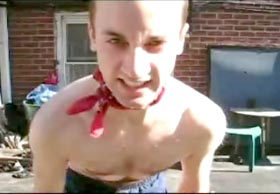
Dan Canyon

Quilts Never Sleep
Quilts Never Sleep (short version) (2007, 20.9MB, 3:07 min)

Me... U
Me… U (2007, 80MB, 12:45 min)

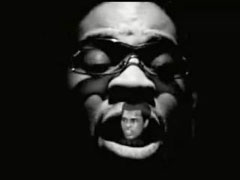
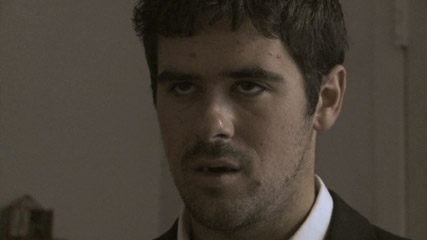
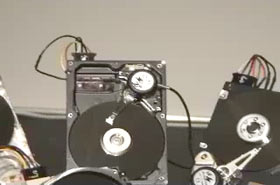
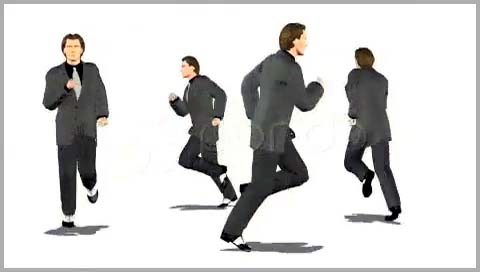
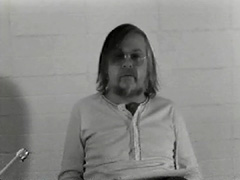
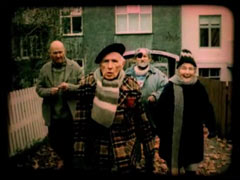
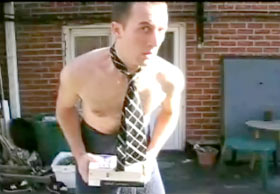
Two very different but attractive & telling pieces from Dan Canyon.
The first was part of a show of – you guessed it – quilts in London in 2006,
about which read more here.
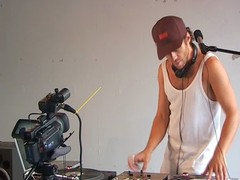
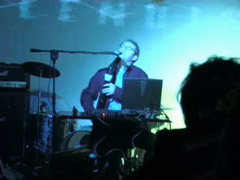
The second could’ve been made for dvblog, well, at least for me, as I’m a fool
for all things turntablist, & features the splendidly monickered Mickey Morphingaz.

Sondheim, Foofwa – <em>Blanking</em>

blanking
Blanking (2011, 30MB, 1:07 min)

for Carol Novack

‘I was working on this, shot with Foofwa d’Imobilite at Eyebeam,
when I heard the news that Carol Novack had died. for many of us,
this was unexpected and awful, as if the year couldn’t end
without just one more tragedy.

Foofwa and I had talked about our
work together, earlier, about issues of pain, wounding, death;
I think this piece, made at the time, is all I could do, I speak
through image and sound, these words already lost, resting in
peace
thank you Foofwa and Jamie and Jackson at Eyebeam’

Alan Sondheim

Morrisa Maltz – an interesting intersection of art & commerce

mofonemeandzac
Saved By The Bell/Mofones (2011, 33MB, 54 secs)

The title of this post being words that seldom pass my lips but which in this case
are entirely to the point.
The splendidly creative video artist Morrisa Maltz whose work we’ve been delighted
to feature here several times made these..um..arty-i-phone holders, which are, it has
to be said, rather good and to cut a long story short their commercial potential was
spotted and now she is a C….E….O & Urban Outfitters are selling her stuff.
You can read a fuller account here and you can view & buy here.
I hope she spends all of any money she makes on giving herself time to make more of the
very smart and fetching art videos she’s so good at.
Anyway this is a promotional vid for the moFones, lovingly carved from “Saved by the Bell”.
She even does marketing classily.

Sondheim – Prisoners

Prisoners
prisoners (2008, 25.4MB, 2:36 min)

Nearest thing to a Picasso we yet have, in my view.
Whatever history decides, there’s no denying one point
of Sondheim/Picasso commonality – an almost compulsive
productivity.
I’d push it further -they both constantly transform lead into
gold. Picasso & his seat & handlebars, Sondheim, for example,
these bits of video.
The music, a kind of hallucinogenic, shredded-up
slow funk/blues, is also particularly noteworthy.
Here, for good measure, is Alan’s accompanying rubric:

prisoners of motion capture, prisoners of west virginia

prisoners of caloric, froid, prisoners of gravitation
prisoners of art, mayhem, vandal, prisoners of desecration

o to be a prisoner of life again (above the clouds
o to be a prisoner of love again (within the waters
o to be a prisoner of truth again (beyond the earths
o to be a prisoner of dance again (before the fires

prisoners of fires, froid, prisoners of aerostat and transport
transport of prisoners, clouds, waters, earths, fluids

yes, prisoners of fluids, prisoners of fluids and places
prisoners of west virginia, of fluids, places, life, love,
truth and dance again

Yu-Chen Wang – Struggle for Existence

struggle_existence
Struggle for Existence (2004, 18MB, 1:58 min.)

“By linking Darwin’s “The truth of universal struggle for existence” with a Taiwanese children’s game, The video represents two individuals’ slaughter in the virtual battle field and reflects on the ideology of boundary dividing, self-defending patriotism and bellicosity.”
by – Yu-Chen Wang.

Gilbert & George -The Singing Sculpture

Gilbert and George
The Singing Sculpture (1992, 830k, 41 sec.)

“Singing Sculpture documents one of Gilbert & George’s most famous “living sculpture” pieces.
Covered in multicolored bronze paint, the artists sing and interchange parts of the English
music hall standard “Underneath the Arches.” Through their stylized performance,
Gilbert & George deliberately blur the lines between life and art, reality and contrivance.
This ambiguity does not rely on a transformation from living to sculptural form. On the contrary,
they have merged the two in order to obliterate, rather than emphasize, the distinctions between life and art.” – Walker Art Center
from Video Data Bank

Scritti Politti – pop sublimity

Word Girl
The Word Girl (1985, 7.62MB, 3:14 min)

Oh Patti
Oh Patti (1988, 20.3MB, 4:14 min)

Two of the most perfect pop songs ever made, the first from
1985’s Cupid & Psyche & the second from 1988’s Provision
(& which features a trumpet solo from Miles Davis of staggering
economy & otherworldly beauty).
Pet Sounds excepted, pop music just doesn’t come better.
The vids aren’t just an adjunct – of course they have historical
interest (that weird decade!), but there’s something fragile
& haunting & mysterious there which survives the occasional impossible
to overlook moment of naffness.
Wonderful.

Toby Tatum –The Golden Age

the golden age
The Golden Age (2011, 181MB, 5:34 min)

We’ve posted Toby Tatum’s work
before and it’s work with a definite charge to it and ambitious too.

I think this piece is more wholly successful than its predecessor but I’m still not totally convinced.
It’s something to do with the aim of conjuring a very precise & particular
dream-world which strikes me as an all-eggs-in-one-basket kind of approach,
in that the tiniest false note disrupts the sought for spell.
Therefore Tatum creates a very high bar indeed for himself and his performers.

If one compares similarly oneiric work by Cocteau, Lynch or Hadžihalilović,
however dense and rich the atmosphere gets, there is variation with humour
or banality preparing us for more poetry to come and somehow too, framing it,
setting it off.
That sounds more critical that I want to be for this is, in every respect, a
very nicely realised and haunting piece.

Next week, or the week after, we’ll post an interview with Tatum about his work.

Semiotics of a Kitchen


Martha Rosler – Semiotics of a Kitchen (1975, 18.3MB, 6:29)

An A-Z look at the tools of a kitchen, of domesticity,
of the self in the midst of frustrated ennui.
Historically significant feminist performance art that reminds us,
“When the woman speaks, she names her own oppression.”
Rosler is one of my favorites.

Abbie Hoffman and gefilte fish


Abbie Making Gefilte Fish (1973, 156.4MB, 21:04)

Footage of Abbie Hoffman making gefilte fish with Laura Cavestani
(who made the video) in his kitchen, 1973.
Like Abbie, I think art is in the everyday, and it sure is a fun
(and rather informative) twenty minutes if you’ve got it to spare.

Art for Abbie was education, constant revolution, evolution, and living for free.
Art and freedom were one in the same, inextricable from each other.
We miss you man.

Ruth Catlow – As I Looked Up…

as i looked up
As I Looked Up (2011, 32MB, 2:23 min)
A co-director of the formidable Furtherfield, Ruth Catlow charms
and something more – something to do with the urgency and vulnerability
of performance and the importance of memory, of a sense of place – in this
fragile & lovely elaboration of an Ivor Cutler song.
Things its difficult to put your finger on but which go right to our core;
pointing to – literally singing – those things being in the ‘artist’ job description…

First of three. Two more pieces, just as delicate, just as necessary, to come.

Gov. Scott Walker gets checked, Mic Checked!

scott walker mic checked
Gov. Scott Walker gets checked, Mic Checked! (2011, 81MB, 3:45 min)

If you don’t feel inspired & cheered up by this tremendous video please do the checking
your pulse thing…
Stand Up Chicago

Annie Abrahams –Training for a Better World

angry women left
Angry Women (Left Panel/Clip) (2011, 188MB, 6:23 min)
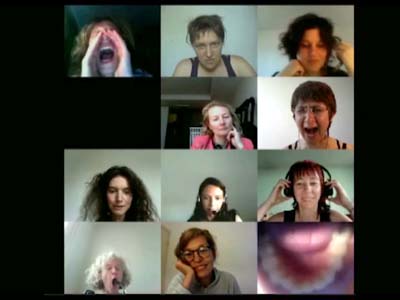
angry women left
Angry Women (Right Panel/Clip) (2011, 142MB, 6:33 min)

Here are a couple of extracts by Annie Abrahams, whose work we love here at DVblog, from her show Training For a Better World which is currently running at the Centre Régional d’Art Contemporain, Languedoc-Roussillon in Sète until the first of January 2012.
I’d seriously suggest that anyone physically able to do so should visit it – I travelled down from London in a day, stayed a night and then trekked back, all by train. Very pleasant it was too.

Abraham’s exhibition runs in tandem with another, of the works of French artist Catherine Gfeller; Gfeller on the ground floor and Abrahams on the first, and the formal similarities (though I think these are largely superficial, for reasons I’ll enlarge upon soon) – the use of both moving and still images, text, an intervention at some level in the mechanics , the whys and wherefores, of how one presents these as art in a gallery setting – make it a stimulating pairing.

Abraham’s selection includes four pieces which are essentially (with some qualifications) video. They are constructed out of the telematics performance territory that she has so signally staked out in the last few years but, she insists, are not documentations of those performances. I think she’s right to emphasise this distinction – although in one sense the pieces clearly do document things that happened in performance they are ultimately video pieces made performatively .

The show doesn’t consist of moving image work only. There are some prints, drawings and a minimalist installation consisting of a single photograph of a pair of married fire-fighters and a sound track of them reading (in an extraordinarily graceful and musical edit [and this is where in this piece any surface similarities to, say, Nauman find their limit. Grace. Grace and elegance throughout.]) a collaborative text on fear.

The moving image and the other pieces occupy different ends of what is mostly a long thin exhibition space and are connected –“tied” together by a “ribbon”- a very long, three or four inch high, strip, of black highlighted, collaboratively generated white text –on the theme of madness – running at floor level for some considerable distance.

It’s important to both acknowledge this distinctly bi-partite character and then to immediately forget about it, so intimate is the connection between the two halves.
Despite the disparate and apparently laissez-faire methodologies used in the generation of all the work and the huge level of trust in the participants evinced by Abrahams, one’s main impression is of a body of work which forms a tight unity both stylistically and in its preoccupations. (And I’d argue that the principal pre-occupation is the question of what it means, physically, socially, psychically, to be a human being. And, further, that this high seriousness –allied to a playfulness which veers from the childishly innocent to the Rabelaisian – is what ultimately gives this work its huge authority and significance and distinguishes it in kind from the technically well executed and often engaging work on the floor below.)

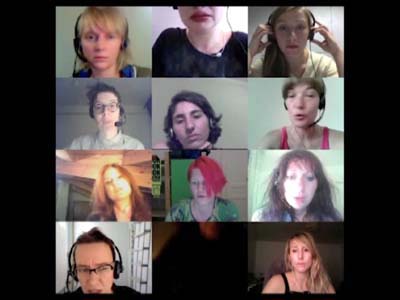
The jewel in the crown of the show is the video installation ‘Angry Women’, created by Abrahams and 22 other women of many nationalities (3 more , in fact, in total, 2 “backstage” assistants, and a performer who opted for silence throughout) speaking about, acting out, demonstrating, reflecting upon, their anger and its causes and triggers, on webcams at their different individual locations and in their native tongues, with the images being sent to a 3X4 grid, in a format that Abrahams has made her own. Because of the limits of even current streaming technology it was necessary to conduct two distinct performances, separated, in fact, by an interval of two months. The length of each was determined by a protocol where a minute’s silence by all participants signalled the end. This resulted in pieces of differing lengths the lack of synchronisation of which adds another layer of fragile grace to the final projections, projected large on adjacent walls around their common corner, with sound from the left image grid fed to the right speaker and vice versa.

The piece occupies most of a large rectangular space at the CRAC (with the video ‘Double Blind (love)’, a collaboration with Curt Cloninger we’ve savoured here before, in its performance incarnation, in the opposite corner and in its full and majestic 264 minute duration).

The impact is visceral – we face what feels like a wave of humanity, not so much in numbers, although 23 women is impressive, at least to this man, but in the infinite malleability of face and hand, of gesture and expression and of how these things might occupy a frame. Sometimes that frame will resemble a Giacometti portrait, with the subject appearing to recede into what seems to be endlessly deep space. At others red lips or an open mouth, sensual and terrifying by turns, occupy the whole of the space – and furthermore each cell is constantly in flux (because these are living, breathing, unpredictable, human beings). There’s something both of portraiture and of the dance at work here, and a kind of found poetry too (which the moving image work has in common with the collaborative texts at the other end of the exhibition). The combination of iron control, planning, foresight (the grid, the protocols) with the letting go and trust evident elsewhere – the phased lengths, the blank space for the person who didn’t turn up, the open performative structure – makes for something of great richness.
Additionally it’s clear that those performers who had previous experience of the format were consciously playing with and against their fellows – gestures are mirrored, sounds echoed, the fiction of looking elsewhere – to the side, or above – of making contact in and across the grid itself, is impressively sustained.

The angry women turn out to be at one and the same time very particular – unique – women and women in general too; the women in general turn out to be human beings in general (and general en masse because each so particular) and the human beings in general turn out to live here, or there, now, in this, one, our only, very particular, world – that mysterious, frightening and wonderful place.

Book your train/plane ticket now!

***

Voici quelques extraits par Annie Abrahams, dont nous aimons le travail ici à DVblog, de son exposition Training For a Better World qui se déroule actuellement au Centre Régional d’Art Contemporain, Languedoc-Roussillon à Sète jusqu’au premier janvier 2012.
Je suggère sérieusement de la visiter à quiconque qui est effectivement en mesure d’y aller – j’ai voyagé depuis Londres en une seule journée, je suis resté une nuit et j’ai fait le retour le lendemain, le tout par train. C’était très agréable.

L’exposition d’Abrahams fonctionne en tandem avec une autre, des œuvres de l’artiste française Catherine Gfeller; Gfeller au rez de chaussée et Abrahams au premier étage, et les similitudes formelles (bien que je pense qu’elles soient essentiellement superficiels, pour des raisons sur lesquelles je vais m’étendre bientôt) – l’utilisation à la fois de l’image fixe et de l’image en mouvement, du texte, l’intervention à un certain niveau dans la mécanique, les tenants et aboutissants, de la façon dont on présente celles ci en tant que de l’art dans le contexte d’une galerie – en font un jumelage stimulant.

La sélection d’Abrahams comprend quatre pièces qui sont essentiellement (avec certaines réserves) vidéo. Elles sont construites à partir du territoire de la performance télématique qu’elle a jalonné si singulièrement les dernières années, mais, elle insiste, ce ne sont pas des documentations de ces performances. Je pense qu’elle a raison de souligner cette distinction – bien que dans un sens les pièces documentent bel et bien ce qui est arrivé dans la performance, elles sont finalement des pièces vidéo réalisées performativement.

L’exposition ne consiste pas seulement d’images en mouvement. Il y a quelques imprimées, des dessins et une installation minimaliste composé d’une seule photo d’un couple de pompiers mariés et une piste sonore d’eux lisant (dans un montage extrêmement gracieuse et musicale [et c’est là que dans cette pièce toute similitude de surface à, disons, Nauman trouve son limite. Grace. Grâce et de l’élégance tout au long.]) un texte collaborative sur la peur.

L’image en mouvement et les autres pièces occupent des extrémités différents de ce qui est surtout un espace d’exposition longue et mince et sont reliés – “liées” par un “ruban” – une très longue, trois ou quatre pouces de haut, bande, de texte blanc, généré en collaboration, souligné en noir – sur le thème de la folie – se déroulant au niveau du sol sur une distance considérable.

Il est important de reconnaître ce caractère nettement bi-partite et ensuite de l’oublier immédiatement, tellement intime est la connexion entre les deux moitiés.
Malgré les méthodologies disparates et apparemment laissez-faire utilisées dans la production de tout le travail et l’énorme niveau de confiance aux participants manifesté par Abrahams, la principale impression est celle d’un corps de travail qui forme une unité serrée à la fois stylistique et dans ses préoccupations. (Et je dirais que la principale préoccupation est la question de ce qu’il signifie, physiquement, socialement, psychologiquement, d’être un être humain. Et, puis, que cette haute degré de sérieux, allié à un enjouement qui vire de l’innocence enfantine au rabelaisien – est, ce qui donne finalement ce travail son énorme autorité et importance et le distingue de sa nature du travail techniquement bien exécuté et souvent engageant de l’étage en dessous).

Le joyau de la couronne de l’exposition est l’installation vidéo «Angry Women», créé par Abrahams et 22 autres femmes de plusieurs nationalités, (en fait, 3 de plus au total, 2 assistantes de “secours”, et une performeuse qui a choisi de rester silencieuse jusqu’à la fin), parlant, actant, démontrant, réfléchissant à, leur colère et ses causes et déclencheurs, devant des webcams dans leurs locations individuellement différentes et dans leur langue maternelle, avec les images envoyées à une grille de 3X4, dans un format que Abrahams a fait le sien. En raison des limites des technologies de streaming, mêmes actuelles, il était nécessaire d’effectuer deux performances distinctes, en fait séparées par une période de deux mois. La longueur de chaque performance a été déterminé par un protocole où une minute de silence par toutes les participantes marquait la fin. Il en résulte des pièces de longueurs différentes dont le manque de synchronisation ajoute une autre couche de grâce fragile aux projections finales, projetées en grand sur des murs adjacents autour de leur coin commun, avec le son de l’ image grillée de gauche envoyé au haut-parleur droit et vice versa.

La pièce occupe la majeure partie d’un grand espace rectangulaire au CRAC (avec la vidéo «Double Blind (love)», une collaboration avec Curt Cloninger que nous avons savouré ici avant dans son incarnation performative, dans le coin opposé, dans sa durée totale et majestueuse de 264 minutes).

L’effet est viscérale – nous faisons face à ce qui ressemble à une vague de humanité, non pas tant en nombre, bien que 23 femmes est impressionnant, au moins à cet homme, mais dans l’incessante malléabilité du visage et des mains, du geste et de l’expression et de la façon dont ces choses peuvent occuper un cadre. Parfois, ce cadre ressemble à un portrait de Giacometti, avec le sujet apparaissant reculer dans ce qui semble être un espace profond infini. À d’autres moments, des lèvres rouges ou une bouche ouverte, sensuel et terrifiant à tour de rôle, occupent la totalité de l’espace – et en plus chaque cellule est constamment en mouvement (parce que ce sont des êtres humains vivantes, respirantes, imprévisibles). Il y a quelque chose à la fois du portrait et de la danse à l’œuvre ici, et aussi une sorte de poésie trouvée (ce que le travail d’image en mouvement a en commun avec les textes collaboratives à l’autre bout de l’exposition). La combinaison du contrôle de fer, de la planification, de la prévision (la grille, les protocoles) avec le laisser-aller et la confiance manifeste ailleurs – les longueurs phasées, l’espace noir pour la personne qui ne se présente pas, la structure performative ouverte – produit quelque chose d’une grande richesse.
En outre, il est clair que ces artistes qui ont eu une expérience antérieure du format ont joué sciemment avec et contre leurs partenaires – les gestes sont mises en miroir, des sons font écho, la fiction de regarder ailleurs – sur le côté ou au-dessus – la prise de contact dans et à travers la grille lui-même, est impressionnant et soutenue.

Les femmes en colère se révèlent être tout à la fois des femmes très particulier – unique – et des femmes en général aussi ; les femmes en général se révèlent être des êtres humains en général (et en général en masse parce que chacune si particulière) et les êtres humains en général s’avèrent vivre ici, ou là, maintenant, dans ce, un, notre seul, très particulier monde – cet endroit mystérieux, effrayant et merveilleux.

Réservez votre train / avion billet dès maintenant!

Hexstatic

Ninja Tune
ninja tune (2006, 10.9MB, 5:06 min.)

Distorted Minds
distorted minds (2006, 6.9MB, 3:18 min.)

Brilliant, and in the case of the first piece, hilarious work from
Hexstatic out of London.
The second featuring Juice Aleem.

Now. Go practice.

Sebastian Sommer – Happily Drowning

indian_movie.jpg
Happily Drowning [clip] (2011, 126MB, 58 sec)

Here’s a clip from a short film by Sebastian Sommer, based on stories by the seemingly ubiquitousTao Lin.

It’s very nicely made – here is someone who takes to (and to some extent, reforges)
film grammar like a fish in water.
I’m not entirely convinced that the narrative is clear enough ( it all
looks so great and having not read the original I was intially prepared
to accept any lack of understanding was mine) – it was only a one sentence precis on
Sommer’s site that really clued me into what was happening.
Clearly, though, someone to be watched…
See the whole thing here

Harddisko – Noise & Disturbances Amplifier System

Harddisko
Harddisko (2007, 29MB, 1:29 min.)

Harddisko is an installation piece by Valentina Vuksic dealing with raw
computer sounds. Rhythmic noises are evoked from sixteen
hard drives, orchestrated through simple power circuits.
By cutting each disk’s power in varying sequences and amplifying its
particular sound characteristics, an unpredictable acoustic
and visual interplay emerges.

Andrew Norman Wilson #5

the_incorporation_of_demands_for_liberation.jpg
The Incorporation of Demands for Liberation(2011, 13MB, 3:24 min)

Brilliant!
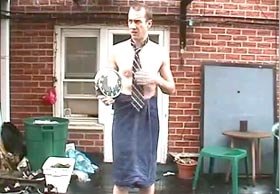
Last piece from ANW, for the moment, although we
certainly hope to feature more in the future –
some of the most original and exciting work I’ve seen recently.

For some context see Monday’s post.

Andrew Norman Wilson #4

flowspottest6.jpg
Flow Spot Test #6 (2011, 18MB, 3:34 min)

“Just downloading apps at my Blanc Laptop Cart when all
of a sudden BenJi, an old teammate from XpresSpa shows up.
He happens to be subcontracted now by the American Airlines
subsidiary AffinityAlliance as an evaluator of potential for their
Oneworld Alliance codeshare lounges (of which FlowSpot is the
newest member).”

See Monday and Tuesday’s posts.

Andrew Norman Wilson #3

network_research.jpg
Network Research (2011, 75MB, 2:11 min)

See Monday’s post.

Andrew Norman Wilson #2

FlowSpotTest5s.jpg
Flow Spot Test #5 (2011, 57MB, 2:03 min)

“Just having my early afternoon session of Body-Work with
Nnah, my Body-Designer.”

Says ANW, of the FlowSpot Tests:

For a large-scale exhibition at the School of the Art Institute of Chicago
I created a color coordinated airport/hotel/mall/bank/spa/biennial lounge to
offer a site of relaxation and bodily engagement in an exhibition dominated
by isolated, sellable art objects.
All lounge products were purchased through online transactions (mostly
Target and Walmart), and were returned at the end of the exhibition.
My dystopic science fiction news video Global Countdown played on
a 55” flat panel monitor.
On opening night, visitors to FlowSpot could register for massages from
licensed massage therapists. While participants received massages they
could not see anything and listened to my directors commentary of the
Global Countdown video. The commentary consists of very basic visual
descriptions, with the goal being that the person receiving the massage
can visualize the video in their minds.
Throughout the duration of the exhibition, I used the lounge as a science
fiction video set to make “FlowSpot Tests.” In these videos I engaged
with the lounge both conceptually and materially in a color coordinated
outfit.
Contact me if you are interested in opening a FlowSpot in your airport,
hotel, mall, bank, spa, biennial, gallery, cultural center, or any other
space that you own/lease/use.

See also.

Andrew Norman Wilson – Webinars & FlowSpot Tests

anxiety_about_relationships_between_friendship_and_business.jpg
Anxiety About Relationships Between Friendship and Business (2011, 11MB, 2:41 min)

I’m so taken with Andrew Norman Wilson’s work I’m going to devote
the whole first week of this DVblog season to it.

He initially sent us a longish piece, Networking with Andrew Norman Wilson
made with Nicholas O’Brien of Bad At Sports.
It’s wonderful but pretty huge so you should definitely go and
look at the Vimeo version there.

On Monday, Weds and Friday of this week we’ll post smaller
pieces extracted from that (but without the commentary or
‘interview’ as it is styled elsewhere [-the text on the BAS page linked above]) ,
On Tuesday and Thursday we’ll post two of Wilson’s FlowSpot Tests
with some accompanying explanation from him.

I find this work in general very exciting because it does a lot
of interesting, nuanced and often rather funny (and I’m in favour of funny
there are very few great works of art which contain no funny at all)
and intially apparently contradictory things.

Let me give you my take on it.
The Webinars are all composed entirely of footage sourced from Pond5
“the worlds stock media marketplace” . The FlowSpot Tests are performative
pieces involving bizarre consumer items sourced from e-bay and wallmart and
deployed in a 21st Century updating of silent movie Lloyd-Keaton-Chaplin
deadpan involving, too, a certain degree of slapstick
and displaying a deliciously calibrated sense of the ridiculous.
The Webinars (a least when one takes account of their titles and certainly viewed
in the light of the commentary from “networking”) are a kind of consumerist
reductio-ad-absurdam.
The intent is celarly in some sense satirical but the pieces take risks in
that they don’t stop and end in critique – there is an understanding of
how toxically compelling some of this imagery is and to some extent they
toy with celebrating this.
Wilson is clearly a natural movie maker. He doesn’t restrain himself from
visual flourishes and jokes which are by no means integral to any
satirical case but make the pieces more fun to watch.
(The distortion effects applied to objects in the periphery of the
action in FlowSpot Test #5 are a case in point.)
Additionally, and most impressively, there is a muddying of the
waters in Networking… (and by implication the
Webinars and FlowSpot Tests) whereby
cogent and apparently straightforward philosophising is allowed
to cross pollinate/contaminate with the satire and vice versa,
leaving the viewer with -ahem- work to do.
This work is not glib; it takes risks – in order to maintain its
high level potency it risks misunderstanding.

A look at Wilson’s CV shows a spell spent working for a
labour union and I read the impulse behind these pieces
as radically anti-commodification and corporate mind rot.
Agit-prop, thankfully, it’s not, but “something rich and strange”
– radical art for interesting times to come.
Nice to see this when so many younger artists seem to be
tempted by a career orientated and somewhat cynical celebration
of that same deadend emptiness.

Joan Brossa – Fi

brossa.jpg
Fi (2011, 51MB, 9:57 min)

Joan Brossa, the Catalan poet, artist, performer and polymath,
who died in 1998, deserves to be more widely
known in the rest of the world.
I’ve often thought his work, in particular the visual
poems, prefigured much of the art of the early days
of the net (but mostly better: terser, wittier, riskier –
I think Brossa would have loved the net).
This elegant & delightful performance ( ‘Fi’ is Catalan
for ‘End’, in this context The End) was recorded
in Barcelona eight months before his death.

It requires a little patience; the reward being that
it can be viewed many more than one time, so it
seems like an appropriate thing to leave you with
over the summer.
Remember we’re always delighted to look at new work,
so if you’re making moving image yourself,
or you happen across great stuff don’t hesitate
to send us links.

We’re back on Monday, September the 26th – in
the meantime we wish you all a happy and relaxing summer.

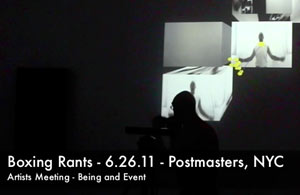
G.H. Hovagimyan – Boxing Rants

boxing_rants
Boxing Rants (2011, 28 MB, 3:11 min)

Documentation of an interactive video performance by
G.H. Hovagimyan that took place at Postmasters Gallery in NY,
from a series of performances titled ‘Being and Event’.

Delpha Hudson – A Walk with Jane Austen

a_walk_with_jane_austen1.jpg
A Walk with Jane Austen (1999, 144MB, 12:20 min)

‘the work is about exploring the veracity of history and of time,
and its constructs (in this case especially the notion of
“bodice-ripping” romance genres).
Playing with text and in-authenticity, the intention was to engage
an audience with notions of historical construction of women;
their facts and fictions, and the possibility of re-visioning histories.

Delpha Hudson

Engaging hybrid of site specific performance and movie making,
the somewhat improvisatory quality lending it all a pleasantly
languid & unhurried air.
At the very end the sun joins in to striking effect & I love the rogue
arm at our right as the spectators leave.
Hudson is a charismatic & commanding performer –
we’ll have another of her performance pieces here in the Autumn.

Sondheim – Unmissable , Unmatchable

native_dancer
Native Dancer (2011, 92MB, 2:08 min)

Genbush
Genbush (2006, 17MB, 6:03 min)

Two pieces from Alan Sondheim -one we originally posted in 2006
and one very recent. The new piece –Native Dancer
is a particularly affecting example of recent motion capture/avatar work.
It properly forms part of a triptych but I think it is the outstanding of the
three and I’m going to exercise curatorial perogative & post it singly.
It enchants me -I don’t know exactly why, I think the reasons could be
quite banal -there’s something of the children’s TV sci-fi epic about it perhaps…
Don’t know, just love it.
And here’s what we originally said about the other piece, which I see no reason to change:

Humor is perhaps not a quality that springs immediately
to mind when discussing the work of Alan Sondheim.
Wrong! His work is saturated in it, often a species of
graveyard or gallows wit.
Here, though, he just lets loose, plays.
But the man is incapable of doing anything that doesn’t
resonate with layer upon layer of meaning too!

Charlie Roberts

band aid
Band-Aid (2007, 54.4MB, 21:53 min)

Temple To Aeolos
Temple To Aeolos (2003, 1.52MB, 43 sec)

Well executed & not a little disturbing work from Charlie Roberts,
a man whose CV features the interesting combination of
performance video & ..er.. inflatable sculpture.
Bit of both here, both a compelling watch…

Baldessari sings LeWitt


Baldessari Sings LeWitt

Baldessari Sings LeWitt (excerpt) (1972, 30.5MB, 3:38 min)

In which John Baldessari sings Sol LeWitt’s
sentences on conceptual art.

From the indispensible Ubuweb.

Arni & Kinski


glosoli (2005, 45.3MB, 6:14 min)


hoppipolla (2006, 34.7MB, 4:38 min)

Iceland’s own, Stefan Arni and Siggi Kinski, have provided
“pure aesthetic beauty” to back these two wonderful Sigur Ros tracks.

Found on their site.

Martin Archer live at The Grapes

Martin Archer
Martin Archer Live at The Grapes, Sheffield (2006, 85.8MB, 9:52 min)

Great vid made by Jonny Drury of Martin Archer, a unique
& towering figure in British (here I was going to interpolate experimental but that
doesn’t really do justice to the intensely personal soundworld Archer has
forged over the years – a combination of fierce poetry, a huge
intellectual range & hunger & a love affair with sound & how it
can be ordered & dis-ordered & where one now feels he knows
exactly where he’s going, so experimental feels in a way
like an impertinence) music of the past 25 years,
performing at The Grapes pub in his home town of Sheffield, UK.

If you like this do check out his site, where you can buy a
staggering diversity of recordings from over the years.

The WhetherMan

Whetherman1
03.07.06 (2006, 5.3MB, 1:54 min.)

Whetherman2
03.12.06 (2006, 3.7MB, 1:08 min.)

Whetherman3
03.17.06 (2006, 3.8MB, 1:13 min.)

Back in 2006, when video blogging just started, Andrew Schneider
was the funniest person on the internet.
From Astoria, Queens, it’s the whether|man.