Woody Allen/Nathaniel Stern

At Interval
at interval (1977/2006, 24.3MB, 13:22 min)

Early work from the redoubtable Nathaniel Stern where he reworked,
in the most curious of ways, Woody Allen’s Annie Hall.
Interesting that although the working method here seems
almost diametrically opposed to the hands on, performative
approach found in his odys series here too is that same
sense of the fragility & vulnerability of human beings and their
bodies & psyches & of the unreliability of the language we use
to try & make what we want to happen & to relate or lie about what did .

ZDEN – emptyspaces

emptyspaces
emptyspaces (2000, 31MB, 2:26 min)

Zdeno Hlinka aka ZDEN.
A multimedia artist from Slovakia who’s been a pioneer in
working with real-time and visual mixing.

Gabriel Shalom – Small Room Tango

Small Room Tango
Small Room Tango (2007, 7.9MB, 3:43 min.)

Anyone who has attempted this kind of video-sampling-whilst-letting-the-
audio-determine-the-structure will now just how extremely bloody
difficult & fiddly
it all is.
Hats off bigtime, then, to Gabriel Shalom, who not only makes it look
natural & easy but even squeezes poetry from it.

Joan Jonas – Waltz

Waltz
Waltz (2003, 55.9MB, 7:04 min)

More ideas per second than many have in a lifetime & wonderful
& haunting & evocative & engaging & smart ones too.
She makes it look easy & natural. Think about it – bet it’s not.
A fantastic piece by veteran video artist/performer Joan Jonas found
on the invaluable Lumen Eclipse site.

Dark Continents 1 – Tyler Coburn

dc1
Dark Continents 1 (2007, 51 MB, 2:34 min.)

Video artist and animator Tyler Coburn‘s self conscious and rough use
of digital techniques presents a compelling parallel to Hollywood’s continual
and rapid movement toward the fantastically “real”.

Paul Rodriguez – the Mean Reds

Mean Reds
Mean Reds (2007, 11.6MB, 1:48 min)

Artist & filmmaker Paul Rodriguez made this rather good
(I particularly like the collage plus the loopy/scratchy business
towards the very end where he collages/edits the sound too)
music video in 2007.

He said:

‘I was planning on shooting my friends for a
documentary. Magically the Mean Reds were also
playing, so I decided to shoot them as well.
Months went by with me sitting on this footage.
Then I found my self printing out frames,
and doing collage on individual frames.’

Tony Arnold – Foundation

foundation
Foundation(2011, 153MB, 14:01 min)

Here’s a striking and very beautiful piece of work from
Mississippi based artist Tony Arnold.
There is clear evidence of his discovery and love affair
with the greats of the American experimental film tradition but
he’s obviously gifted and visionary and very much his own
person. (I love his choice of music, sounds a bit like Ornette
Coleman but I think it’s not…wonderful, anyway)
This is evidenced by his website* too –
with exhilaratingly edgy and engaging work, full of ideas –
I particularly like his altered fashion ads series.
Interesting, very interesting, to see how this work develops.

*I am uncomfortable, however, with the dangerously
naive & abstentionist defence of hate-speech there – well,
more than uncomfortable:- it’s stupid & wrong headed –
tell the family of the next racist murder victim that the
language that convicted and sentenced them was just a “series of grunts”.
I’m assuming though it comes from young artist hunger &
restlessness & in-your-faceness and nothing worse.

Anri Sala – Time After Time

Time After Time
Time After Time (2003, 45.5MB, 5:39 min)

I was initially rather mystified by the vogue in UK galleries for
the work of Albanian artist Anri Sala but after a while the penny
dropped.
The courage to embrace the poetry of detail, of stillness,
apparent lack of incident & furthermore to trust
one’s viewers to accompany one to that place…
Elegant, sad, lugubrious & also, I think, much more crafted
than first meets the eye.
Great.

Glimpse of the Garden


Marie Menken – Glimpse of the Garden (1957, 36.2MB, 5:04)

Marie Menken, avant-garde filmmaker of the 1940s, 50s,
and 60s – in addition to being the inspiration for
Who’s Afraid of Virginia Woolf? and a Warhol
superstar – made inspirational work from a time we seem
to overlook too much today. The garden here belongs
to one of her husband’s former male lovers, and while
Menken was often criticized for being quaint in her displays,
her style is an obviously feminine one that hides much
deeper meaning in ordinary but stunning visuals.

Cory Arcangel – Urbandale

urbandale
Urbandale (2000, 43MB, 7:30 min.)

“Urbandale”, an ASCII/ANSI movie by Cory Arcangel.
“Filmed at Urbandale Plaza in the eastern suburbs of Buffalo N.Y.,
“urbandale” is a study of America’s suburban sprawl stripped to its barest
essentials and void of unnecessary contemporary cultural influence. This
film captures the sly, bland smile strip plazas cast at modern culture.
The film, rendered in text, focuses on the repetitive motion of food
stuffs being cooked in the lobby of a discount department store.”

Urbandale” is a 2000 commission of New Radio and Performing Arts, Inc
for its Turbulence project.

Recreation, Re-Creation, or, We Like OLD Stuff – Bitsy Knox

Recreation, Re-Creation
Recreation, Re-Creation (2006, 9.6 MB, 4:27 min.)

“This video juxtaposes original 16 mm footage acquired from my Grandfather
with interview footage taken of my Mother and Grandparents. All but the
past-tenses of their speaking are left intact, while the film footage has been
aggressively manipulated.
The project seeks to question the language of constructing one’s identity through
negotiation with familial history, where the past has been constructed and reconstructed
in order to corroborate certain facades of culture which are wished to be left intact.”

Bitsy Knox from 312.

Jennifer Steinkamp – Mike Kelley

steinkamp_kelley
Mike Kelley (2007, 7.3 MB, 15 sec.)

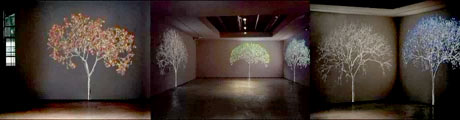
‘Mike Kelley’ are high definition video projections of individual trees
with branches moving in a twirling pattern. Projected to fill the height
of the gallery’s walls, the images interact with the architecture of the gallery,
creating tension between the imaginary landscape and the physical space.

by Jennifer Steinkamp.

Sondheim – Prisoners

Prisoners
prisoners (2008, 25.4MB, 2:36 min)

Nearest thing to a Picasso we yet have, in my view.
Whatever history decides, there’s no denying one point
of Sondheim/Picasso commonality – an almost compulsive
productivity.
I’d push it further -they both constantly transform lead into
gold. Picasso & his seat & handlebars, Sondheim, for example,
these bits of video.
The music, a kind of hallucinogenic, shredded-up
slow funk/blues, is also particularly noteworthy.
Here, for good measure, is Alan’s accompanying rubric:

prisoners of motion capture, prisoners of west virginia

prisoners of caloric, froid, prisoners of gravitation
prisoners of art, mayhem, vandal, prisoners of desecration

o to be a prisoner of life again (above the clouds
o to be a prisoner of love again (within the waters
o to be a prisoner of truth again (beyond the earths
o to be a prisoner of dance again (before the fires

prisoners of fires, froid, prisoners of aerostat and transport
transport of prisoners, clouds, waters, earths, fluids

yes, prisoners of fluids, prisoners of fluids and places
prisoners of west virginia, of fluids, places, life, love,
truth and dance again

Gilbert & George -The Singing Sculpture

Gilbert and George
The Singing Sculpture (1992, 830k, 41 sec.)

“Singing Sculpture documents one of Gilbert & George’s most famous “living sculpture” pieces.
Covered in multicolored bronze paint, the artists sing and interchange parts of the English
music hall standard “Underneath the Arches.” Through their stylized performance,
Gilbert & George deliberately blur the lines between life and art, reality and contrivance.
This ambiguity does not rely on a transformation from living to sculptural form. On the contrary,
they have merged the two in order to obliterate, rather than emphasize, the distinctions between life and art.” – Walker Art Center
from Video Data Bank

Annie Pui Ling Lok

EP
EP (2008, 45MB, 2:29 min)

Anyone who has been lucky enough to see dancer & artist Annie Pui Ling Lok
do the former will know what a fruitful combination of fierce, almost austere,
intellect & yet sensitivity to the particular, the fragile & the human, to expect.
There’s such a sure hand at work here – the confidence in collaging
disparate material brings Marker to mind & although we’ve tagged it
‘experimental’, in one sense the piece is anything but -it’s so not
a technical exercise, but a rounded, resonant work of art.

More from Regina Célia Pinto

Paintings

Neste vídeo há uma grande delicadeza, uma fragilidade,
que não deve levar a pensar que essa peça de Regina Pinto
é de alguma forma ocasional ou menos artística.
Em vez disso, esse é o trabalho de um artista maduro,
sem nada a provar, e com a enorme liberdade que isso traz.
Um estudo de todo o corpo de seu trabalho evidencia
amplamente tudo isso e mostra quão profundamente
consistente e coerente ele se apresenta.
Poder-se-ia ainda acrescentar o quanto ele nos emociona,
o quanto é estranho e muito bonito.

There’s a delicacy, a fragility, about this piece
that shouldn’t lead one to think that Regina Célia Pinto’s
work is in any way casual or artless.
Rather, this is the work of a mature artist with
nothing to prove and the enormous freedom that brings.
A study of the whole body of her work
amply bears this out.
It shows just how consistent and deeply considered
it is and, one should add, how affecting, how strange
and how very beautiful.

Toby Tatum –The Golden Age

the golden age
The Golden Age (2011, 181MB, 5:34 min)

We’ve posted Toby Tatum’s work
before and it’s work with a definite charge to it and ambitious too.

I think this piece is more wholly successful than its predecessor but I’m still not totally convinced.
It’s something to do with the aim of conjuring a very precise & particular
dream-world which strikes me as an all-eggs-in-one-basket kind of approach,
in that the tiniest false note disrupts the sought for spell.
Therefore Tatum creates a very high bar indeed for himself and his performers.

If one compares similarly oneiric work by Cocteau, Lynch or Hadžihalilović,
however dense and rich the atmosphere gets, there is variation with humour
or banality preparing us for more poetry to come and somehow too, framing it,
setting it off.
That sounds more critical that I want to be for this is, in every respect, a
very nicely realised and haunting piece.

Next week, or the week after, we’ll post an interview with Tatum about his work.

Another from Ruth Catlow

as i looked up
travel images unseen (2011, 156MB, 6:01 min)

‘5 video clips taken on a simple video camera, through a window on a coach to the
plane from Istanbul and arriving in London by train. Selected by and stitched, unseen
by the creator who will never watch the video, ever.’

The gentlest conceptualism & quite, quite lovely too.
There’s something about knowing the premise that leaves one
very open – one could say innoculates one – to its formal consequences –
here a looseness which somehow gently stretches time, makes it grainier
but conversely sharpens our attention, perhaps to make up for the
maker’s own vow of abstention.
One more in the series to come.

Aī-Hz – My Miwoo

My Miwoo
My Miwoo [Tai Chi Weekend Control] (2007, 24.6MB, 50 secs)

Aī-Hz, real name Michael Renassia,
is a French visual performer living and working in Tokyo.
His site contains possibly my favourite biographical nugget ever:

‘He is using compositing software in a diverted way, and real-time mixing
instruments with the aim to create a noisy/pop universe…’

Now, who could possibly object to that?
This piece is rather lovely – the thing that totally makes it for me
is the epiphanic moment at the end when the music/animation stops &
the person appears ..there’s a haunting sense of time suspended..
So, for me, 10/10 for visuals.
I am pretty bored ,though, with the by-the-yard avant-dance music
that accompanies so much work of this kind..it’s not bad
or anything, just pedestrian…

Jerome Hill

Film Portrait
Film Portrait (1972, 31MB, 11:45 min.)

Cartomancienne
La Cartomancienne (1932, 13MB, 12 min.)

This is a memoir and the last film made by artist and filmmaker Jerome Hill.

I also found ‘La Cartomancienne’, one of his earliest film experiments.

By Mica

Brian Kim Stefans – Difficult Beauty

vex1
Vex #1 (2006, 29.1MB, 2:08 min.)

vex5
Vex #5 (2006, 25.9MB, 1:09 min.)

ferrari dogs
Ferrari Dogs (2006, 25.9MB, 1:09 min.)

You know sometimes how when you first look at a work
you can’t process it immediately, it seems jumbled – wrong
& you’re tempted to dismiss it.
Then you live with it awhile & suddenly it leaps into focus &
you realise you’re in the presence of something much richer
& more rewarding than the things which did immediately fall into place?
Do you know that feeling?
Well, that’s how I felt as I prepared this post.
The work, by the artist & poet Brian Kim Stefans, snuck up
on me & then hit me over the head.
Furthermore, there’s still a puzzling quality to it all, for me:
the Ferrari Dogs piece seems like work of a different category
to the vex pieces somehow ( as does Manchurian Rainman on
the site. Check it. Now – what is that all about?)
Anyway – I’ll take mystery over glibness anyday – I look forward to more.

Semiotics of a Kitchen


Martha Rosler – Semiotics of a Kitchen (1975, 18.3MB, 6:29)

An A-Z look at the tools of a kitchen, of domesticity,
of the self in the midst of frustrated ennui.
Historically significant feminist performance art that reminds us,
“When the woman speaks, she names her own oppression.”
Rosler is one of my favorites.

Ruth Catlow – As I Looked Up…

as i looked up
As I Looked Up (2011, 32MB, 2:23 min)
A co-director of the formidable Furtherfield, Ruth Catlow charms
and something more – something to do with the urgency and vulnerability
of performance and the importance of memory, of a sense of place – in this
fragile & lovely elaboration of an Ivor Cutler song.
Things its difficult to put your finger on but which go right to our core;
pointing to – literally singing – those things being in the ‘artist’ job description…

First of three. Two more pieces, just as delicate, just as necessary, to come.

Annie Abrahams –Training for a Better World

angry women left
Angry Women (Left Panel/Clip) (2011, 188MB, 6:23 min)
angry women left
Angry Women (Right Panel/Clip) (2011, 142MB, 6:33 min)

Here are a couple of extracts by Annie Abrahams, whose work we love here at DVblog, from her show Training For a Better World which is currently running at the Centre Régional d’Art Contemporain, Languedoc-Roussillon in Sète until the first of January 2012.
I’d seriously suggest that anyone physically able to do so should visit it – I travelled down from London in a day, stayed a night and then trekked back, all by train. Very pleasant it was too.

Abraham’s exhibition runs in tandem with another, of the works of French artist Catherine Gfeller; Gfeller on the ground floor and Abrahams on the first, and the formal similarities (though I think these are largely superficial, for reasons I’ll enlarge upon soon) – the use of both moving and still images, text, an intervention at some level in the mechanics , the whys and wherefores, of how one presents these as art in a gallery setting – make it a stimulating pairing.

Abraham’s selection includes four pieces which are essentially (with some qualifications) video. They are constructed out of the telematics performance territory that she has so signally staked out in the last few years but, she insists, are not documentations of those performances. I think she’s right to emphasise this distinction – although in one sense the pieces clearly do document things that happened in performance they are ultimately video pieces made performatively .

The show doesn’t consist of moving image work only. There are some prints, drawings and a minimalist installation consisting of a single photograph of a pair of married fire-fighters and a sound track of them reading (in an extraordinarily graceful and musical edit [and this is where in this piece any surface similarities to, say, Nauman find their limit. Grace. Grace and elegance throughout.]) a collaborative text on fear.

The moving image and the other pieces occupy different ends of what is mostly a long thin exhibition space and are connected –“tied” together by a “ribbon”- a very long, three or four inch high, strip, of black highlighted, collaboratively generated white text –on the theme of madness – running at floor level for some considerable distance.

It’s important to both acknowledge this distinctly bi-partite character and then to immediately forget about it, so intimate is the connection between the two halves.
Despite the disparate and apparently laissez-faire methodologies used in the generation of all the work and the huge level of trust in the participants evinced by Abrahams, one’s main impression is of a body of work which forms a tight unity both stylistically and in its preoccupations. (And I’d argue that the principal pre-occupation is the question of what it means, physically, socially, psychically, to be a human being. And, further, that this high seriousness –allied to a playfulness which veers from the childishly innocent to the Rabelaisian – is what ultimately gives this work its huge authority and significance and distinguishes it in kind from the technically well executed and often engaging work on the floor below.)

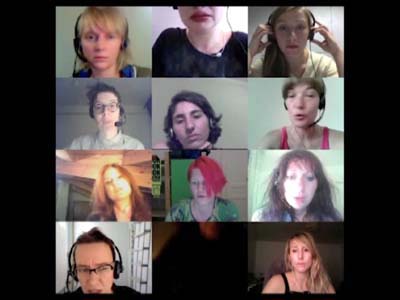
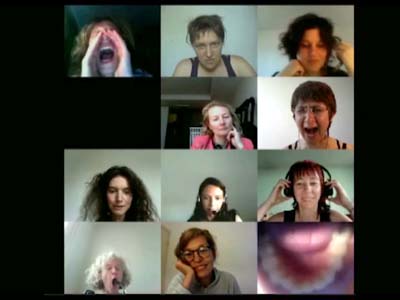
The jewel in the crown of the show is the video installation ‘Angry Women’, created by Abrahams and 22 other women of many nationalities (3 more , in fact, in total, 2 “backstage” assistants, and a performer who opted for silence throughout) speaking about, acting out, demonstrating, reflecting upon, their anger and its causes and triggers, on webcams at their different individual locations and in their native tongues, with the images being sent to a 3X4 grid, in a format that Abrahams has made her own. Because of the limits of even current streaming technology it was necessary to conduct two distinct performances, separated, in fact, by an interval of two months. The length of each was determined by a protocol where a minute’s silence by all participants signalled the end. This resulted in pieces of differing lengths the lack of synchronisation of which adds another layer of fragile grace to the final projections, projected large on adjacent walls around their common corner, with sound from the left image grid fed to the right speaker and vice versa.

The piece occupies most of a large rectangular space at the CRAC (with the video ‘Double Blind (love)’, a collaboration with Curt Cloninger we’ve savoured here before, in its performance incarnation, in the opposite corner and in its full and majestic 264 minute duration).

The impact is visceral – we face what feels like a wave of humanity, not so much in numbers, although 23 women is impressive, at least to this man, but in the infinite malleability of face and hand, of gesture and expression and of how these things might occupy a frame. Sometimes that frame will resemble a Giacometti portrait, with the subject appearing to recede into what seems to be endlessly deep space. At others red lips or an open mouth, sensual and terrifying by turns, occupy the whole of the space – and furthermore each cell is constantly in flux (because these are living, breathing, unpredictable, human beings). There’s something both of portraiture and of the dance at work here, and a kind of found poetry too (which the moving image work has in common with the collaborative texts at the other end of the exhibition). The combination of iron control, planning, foresight (the grid, the protocols) with the letting go and trust evident elsewhere – the phased lengths, the blank space for the person who didn’t turn up, the open performative structure – makes for something of great richness.
Additionally it’s clear that those performers who had previous experience of the format were consciously playing with and against their fellows – gestures are mirrored, sounds echoed, the fiction of looking elsewhere – to the side, or above – of making contact in and across the grid itself, is impressively sustained.

The angry women turn out to be at one and the same time very particular – unique – women and women in general too; the women in general turn out to be human beings in general (and general en masse because each so particular) and the human beings in general turn out to live here, or there, now, in this, one, our only, very particular, world – that mysterious, frightening and wonderful place.

Book your train/plane ticket now!

***

Voici quelques extraits par Annie Abrahams, dont nous aimons le travail ici à DVblog, de son exposition Training For a Better World qui se déroule actuellement au Centre Régional d’Art Contemporain, Languedoc-Roussillon à Sète jusqu’au premier janvier 2012.
Je suggère sérieusement de la visiter à quiconque qui est effectivement en mesure d’y aller – j’ai voyagé depuis Londres en une seule journée, je suis resté une nuit et j’ai fait le retour le lendemain, le tout par train. C’était très agréable.

L’exposition d’Abrahams fonctionne en tandem avec une autre, des œuvres de l’artiste française Catherine Gfeller; Gfeller au rez de chaussée et Abrahams au premier étage, et les similitudes formelles (bien que je pense qu’elles soient essentiellement superficiels, pour des raisons sur lesquelles je vais m’étendre bientôt) – l’utilisation à la fois de l’image fixe et de l’image en mouvement, du texte, l’intervention à un certain niveau dans la mécanique, les tenants et aboutissants, de la façon dont on présente celles ci en tant que de l’art dans le contexte d’une galerie – en font un jumelage stimulant.

La sélection d’Abrahams comprend quatre pièces qui sont essentiellement (avec certaines réserves) vidéo. Elles sont construites à partir du territoire de la performance télématique qu’elle a jalonné si singulièrement les dernières années, mais, elle insiste, ce ne sont pas des documentations de ces performances. Je pense qu’elle a raison de souligner cette distinction – bien que dans un sens les pièces documentent bel et bien ce qui est arrivé dans la performance, elles sont finalement des pièces vidéo réalisées performativement.

L’exposition ne consiste pas seulement d’images en mouvement. Il y a quelques imprimées, des dessins et une installation minimaliste composé d’une seule photo d’un couple de pompiers mariés et une piste sonore d’eux lisant (dans un montage extrêmement gracieuse et musicale [et c’est là que dans cette pièce toute similitude de surface à, disons, Nauman trouve son limite. Grace. Grâce et de l’élégance tout au long.]) un texte collaborative sur la peur.

L’image en mouvement et les autres pièces occupent des extrémités différents de ce qui est surtout un espace d’exposition longue et mince et sont reliés – “liées” par un “ruban” – une très longue, trois ou quatre pouces de haut, bande, de texte blanc, généré en collaboration, souligné en noir – sur le thème de la folie – se déroulant au niveau du sol sur une distance considérable.

Il est important de reconnaître ce caractère nettement bi-partite et ensuite de l’oublier immédiatement, tellement intime est la connexion entre les deux moitiés.
Malgré les méthodologies disparates et apparemment laissez-faire utilisées dans la production de tout le travail et l’énorme niveau de confiance aux participants manifesté par Abrahams, la principale impression est celle d’un corps de travail qui forme une unité serrée à la fois stylistique et dans ses préoccupations. (Et je dirais que la principale préoccupation est la question de ce qu’il signifie, physiquement, socialement, psychologiquement, d’être un être humain. Et, puis, que cette haute degré de sérieux, allié à un enjouement qui vire de l’innocence enfantine au rabelaisien – est, ce qui donne finalement ce travail son énorme autorité et importance et le distingue de sa nature du travail techniquement bien exécuté et souvent engageant de l’étage en dessous).

Le joyau de la couronne de l’exposition est l’installation vidéo «Angry Women», créé par Abrahams et 22 autres femmes de plusieurs nationalités, (en fait, 3 de plus au total, 2 assistantes de “secours”, et une performeuse qui a choisi de rester silencieuse jusqu’à la fin), parlant, actant, démontrant, réfléchissant à, leur colère et ses causes et déclencheurs, devant des webcams dans leurs locations individuellement différentes et dans leur langue maternelle, avec les images envoyées à une grille de 3X4, dans un format que Abrahams a fait le sien. En raison des limites des technologies de streaming, mêmes actuelles, il était nécessaire d’effectuer deux performances distinctes, en fait séparées par une période de deux mois. La longueur de chaque performance a été déterminé par un protocole où une minute de silence par toutes les participantes marquait la fin. Il en résulte des pièces de longueurs différentes dont le manque de synchronisation ajoute une autre couche de grâce fragile aux projections finales, projetées en grand sur des murs adjacents autour de leur coin commun, avec le son de l’ image grillée de gauche envoyé au haut-parleur droit et vice versa.

La pièce occupe la majeure partie d’un grand espace rectangulaire au CRAC (avec la vidéo «Double Blind (love)», une collaboration avec Curt Cloninger que nous avons savouré ici avant dans son incarnation performative, dans le coin opposé, dans sa durée totale et majestueuse de 264 minutes).

L’effet est viscérale – nous faisons face à ce qui ressemble à une vague de humanité, non pas tant en nombre, bien que 23 femmes est impressionnant, au moins à cet homme, mais dans l’incessante malléabilité du visage et des mains, du geste et de l’expression et de la façon dont ces choses peuvent occuper un cadre. Parfois, ce cadre ressemble à un portrait de Giacometti, avec le sujet apparaissant reculer dans ce qui semble être un espace profond infini. À d’autres moments, des lèvres rouges ou une bouche ouverte, sensuel et terrifiant à tour de rôle, occupent la totalité de l’espace – et en plus chaque cellule est constamment en mouvement (parce que ce sont des êtres humains vivantes, respirantes, imprévisibles). Il y a quelque chose à la fois du portrait et de la danse à l’œuvre ici, et aussi une sorte de poésie trouvée (ce que le travail d’image en mouvement a en commun avec les textes collaboratives à l’autre bout de l’exposition). La combinaison du contrôle de fer, de la planification, de la prévision (la grille, les protocoles) avec le laisser-aller et la confiance manifeste ailleurs – les longueurs phasées, l’espace noir pour la personne qui ne se présente pas, la structure performative ouverte – produit quelque chose d’une grande richesse.
En outre, il est clair que ces artistes qui ont eu une expérience antérieure du format ont joué sciemment avec et contre leurs partenaires – les gestes sont mises en miroir, des sons font écho, la fiction de regarder ailleurs – sur le côté ou au-dessus – la prise de contact dans et à travers la grille lui-même, est impressionnant et soutenue.

Les femmes en colère se révèlent être tout à la fois des femmes très particulier – unique – et des femmes en général aussi ; les femmes en général se révèlent être des êtres humains en général (et en général en masse parce que chacune si particulière) et les êtres humains en général s’avèrent vivre ici, ou là, maintenant, dans ce, un, notre seul, très particulier monde – cet endroit mystérieux, effrayant et merveilleux.

Réservez votre train / avion billet dès maintenant!
Sam Renseiw – Change of Colour

Change of Colour
Change of Colour (2007, 6.16MB, 1:00 min)

Does what it says on the packaging & sublimely.
This is so beautiful.
A Lumière from Sam Renseiw.

Alan Sondheim – Two Movies

Beauty
Beauty (2007, 11.4MB, 1:04 min.)

Romania
Romania (2007, 19MB, 2:01 min.)

What to say, we’ve said it all, again & again, Sondheim’s
movies are a unique & indispensable body of work.
Specifically, anyone working in video on the net who
doesn’t know them is navigating blind.
For a free masterclass hop over to his site & work your
way through all the stuff with .mov or .mp4 extensions.
( I mean, don’t confine yourself to the movies but this
is dvblog)
You won’t have wasted your time.

Two from Jade Enterprises


jade – takethebus (2002, 3.6MB, 1:37)


jade – jet (2003, 2.4MB, 0:17)

Older experimental clips from Austria’s Michaela
Schwentner, also known as jade enterprises.

Business – Junu Ahn

Business
Business (2007, 67.9MB, 9:33 min)

I find it easier to admire this piece, to respect its clear integrity,
than to actually like it much – it’s a pretty hardcore glitch
assemblage & it doesn’t let up …oooooh noooo… not at all
(Strikes me as a bit of a video analog for something like Lou Reed’s (in)famous
)
It’ll be interesting to see where Junu Ahn goes next…

Hanns Eisler – ‘Composing for the Films’

White Flood clip 1
‘White Flood’ – clip 1 (1940-2, 1.1 MB, 30 sec.)

A Child Went Forth clip
‘A Child Went Forth’ – clip (1940-2, 1.4 MB, 30 sec.)

White Flood clip 2
‘White Flood’ – clip 2 (1940-2, 661 KB, 29 sec.)

Easily the most interesting of all Brecht’s composer collaborators
& in flat contradiction to the current myth spread by those
who dislike his politics, by far the better composer than the rather
dull Weill, Hanns Eisler’s keen intellect turned to questions of film in his
exile in the USA in the early forties.
Under the auspices of the New School & funded by the Rockefeller foundation
Eisler conducted an intensive investigation of the relationship between
film & music , often involving him writing new music to already existing footage.
You can see some of this footage here – but what you really need to do is to listen.
There is no-one who could not learn something from the amazing way Eisler
deploys music here.
After the project, Eisler went on to write, with Theodore Adorno,
himself no slouch intellectually (& also a practicing composer),
one of the key books on music & the movies –‘Composing for the Films’
These clips come from the website for a new edition of the book
released with a companion DVD documenting much of the Rockefeller experimentation.
Indispensable.

‘Erection’ by John Lennon & Yoko Ono

Erection John Lennon
Erection (1971, 180MB, 18:06 min.)

A nineteen-minute film by John and Yoko, which was made in London during
1970 and 1971. When John had heard that the London International Hotel was
to be built in Kensington, he sought permission to film its entire construction.
Once he’d obtained it he contacted the photographer Iain MacMillan and asked
him to take a series of photographs of the construction. MacMillan had a stills
camera and filmed the erection of the hotel from a fixed position for a period
of eighteen months.
The stills were presented in sequence in the film, which ended with a shot of the
completed hotel where all the lights were then turned off, leaving a black screen.
On the soundtrack Yoko sang two songs, ‘Airmale’ and ‘You’, using tapes of recordings
of Joe Jones Tone Deaf Music Co., which was, in fact, a number of toy percussion
instruments that played themselves, a squeaky style of sound devised by a former
associate of Yoke’s Fluxus days, Joe Jones. The hotel was situated at 147 Cromwell
Road and later became the London Swallow Hotel.