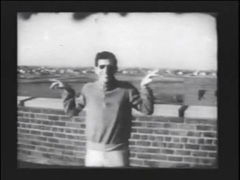
Jørgen Leth – 66 Scenes from America (1981, 9.9MB, 4:16)
Pretty self-explanatory: Andy eats a burger.
Scene from controversial Danish filmmaker
Jørgen Leth’s 1981 composite film, 66 Scenes from America.
Jørgen Leth – 66 Scenes from America (1981, 9.9MB, 4:16)
Pretty self-explanatory: Andy eats a burger.
Scene from controversial Danish filmmaker
Jørgen Leth’s 1981 composite film, 66 Scenes from America.

Waltz (2003, 55.9MB, 7:04 min)
More ideas per second than many have in a lifetime & wonderful
& haunting & evocative & engaging & smart ones too.
She makes it look easy & natural. Think about it – bet it’s not.
A fantastic piece by veteran video artist/performer Joan Jonas found
on the invaluable Lumen Eclipse site.
Ardvark (2001, 1.6MB, 15 sec.)

Scorpion (2001, 1.1MB, 10 sec.)
Tumbleweeds (2001, 1.2MB, 10 sec.)
Since 1988, Sam Easterton has been using tiny
‘helmet mounted’ cameras to create an archive of videos filmed
from the perspective of plants and animals.
By Mica
The Cut-Ups (clip) (1966, 15.4MB, 1:20 min.)
William Burroughs & co-conspirators made this in 1966.
1966! – could’ve been the day after tomorrow.
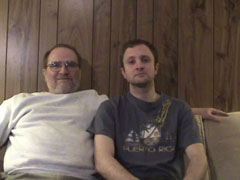
Me and Pop (2004, 3.88MB, 1:00min)
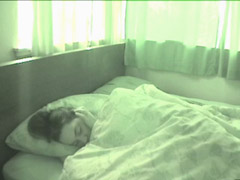
Sleeping (2007, 2.34MB, 57 secs)
Maker’s site

Gallo (2007, 5.17MB, 55 secs)
Maker’s site

Dance of Death (2007, 5.53MB, 1:00 min)
Maker’s site
A Week’s Worth (2007, 4.93MB, 1:00 min)
The rules for Lumière videos are as follows:
* 60 seconds max.
* Fixed camera
* No audio
* No zoom
* No edit
* No effects
In the spirit of the Lumière brothers and comparable in some ways to Dogme 95,
the Lumière video project emerged from a documentary perspective,
as Auguste and Louis Lumière blazed the trail in this genre.
In the tradition of the the cinematographe, the first movie camera,
which was arguably used and possibly built by the brothers, all
21st C Lumiere videos should be made only using features available in
camera (ie, no external editing, including bumpers and titles, should
be included).
Lumière videos hope to expand upon the ways that online video allows for
the advancement of personal narratives by capturing the everyday, and sometimes
unexpected, within a specific framework of constraints, less conflicted by sometimes
unnecessary editing.
See all Lumière videos.
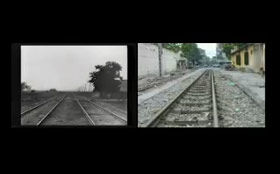
Man With a Movie Camera (Trailer) (1929-2007, 6MB, 2:17 min.)
“Man With a Movie Camera is a participatory video shot by people around the world
who are invited to record video according to the original script of Vertov’s Man With
A Movie Camera and submit it to a website which will archive, sequence and deliver
it. When the work streams your contribution becomes part of a worldwide montage,
in Vertov’s terms the ‘decoding of life as it is’.
Project by Perry Bard.
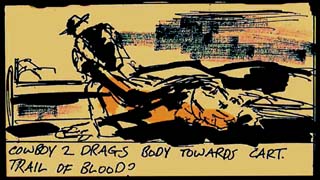
Death was the West (2012, 221MB, 5:19 min)
A restrained, austere, smart and at the same time gripping piece from
Essex, UK, film-maker Peter Scott, still in his final months at art school.
I understand it to be a by product of a work in progress but it
has an integrity and presence entirely of its own.
I look forward to more.
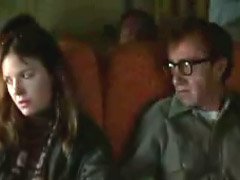
at interval (1977/2006, 24.3MB, 13:22 min)
Early work from the redoubtable Nathaniel Stern where he reworked,
in the most curious of ways, Woody Allen’s Annie Hall.
Interesting that although the working method here seems
almost diametrically opposed to the hands on, performative
approach found in his odys series here too is that same
sense of the fragility & vulnerability of human beings and their
bodies & psyches & of the unreliability of the language we use
to try & make what we want to happen & to relate or lie about what did .
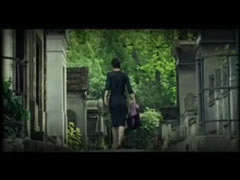
comme un chat noir au fond d’un sac (2006, 18.4MB, 4:47 min)
A beautiful excerpt from Stephane Elmadjian’s feature film found
on composer Daniel Wohl’s website.
Starting off a bit intense it winds itself down and into some breathtaking stuff.
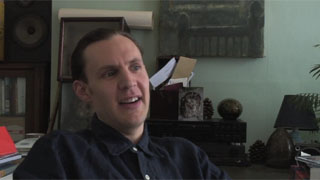
Toby Tatum on ‘The Golden Age’ (2011, 78MB, 4:38 min)
Toby Tatum, talking about his film The Golden Age, which we posted here
a couple of weeks back.
I’m always hungry for artists talking about process. Learn! Steal!
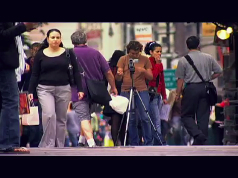
A Broad Way, Trailer (2007, 60.89 MB, 5:17 min)
Saul Goode worked with 400 filmmakers to
document every corner of New York’s most
famous street, Broadway.
By Mica
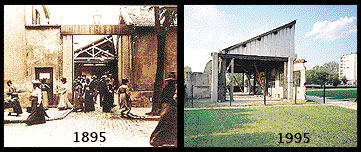
La sortie des ouvriers de l’usine Lumière à Lyon (1895, 6MB, 46 sec.)
The year is 1895. The “Hangar” was the first set in the history of Cinematography and
can be seen here in “La Sortie de l’usine Lumière”, Lumière’s first film.
from the fantastic site – Institut Lumière.

Experiment (2006, 3.3MB, 1:20 min.)
2006: Michael Verdi takes a stand and stakes out
some videoblogging territory.
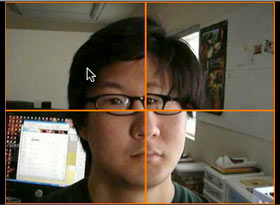
Asynchrony – Split (Head) (2006, 11 MB, 2:14 min)
“My latest project is Asynchrony. It’s a set of four interactive sketches for the
simultaneous visualization of multiple points in time within video. When combined
with time-lapse or looped video clips, each sketch generates a crudely synthesized
image of different time points in video, all within the shared space of the visual frame.
They divide the video frame into static or animated rectangular regions,
each of which can have its own time flow.”
by James Jung-Hoon Seo.
from Split Screen.
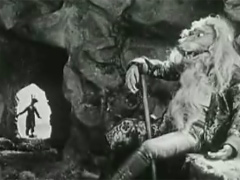
Le Lion Devenu Vieux (1932, 3.5MB, 1:04 sec.)
Ladislas Starewitch is often credited with inventing stop motion animation
as we know it, though so are several other people. It depends on what fits
into your definition of stop motion.
Certainly he was probably the first to actually make little figures and move
them frame by frame in an attempt to duplicate lifelike movement of actual
living things. it was because he was filming beetles and found that the hot
lights made them lethargic, so he made his own little beetles asrealistically
as possible and animated them instead.
This gave birth to further projects with very lifelike but sometimes partially
anthropomorphic (human-like) animals.
from – Darkstrider.
By Mica. (thanks Adam)
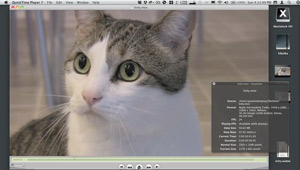
Making Web MVideo (2011, 51 MB, 5:55 min)
“There was a lot of talk this week about WebM video after Google announced
that they were going to drop H.264 support from Chrome. This is huge news
for video makers, especially since Firefox 4 (which supports WebM) is almost done.
I figured it was time to look into WebM encoding tools again.”..
from Michael Verdi.
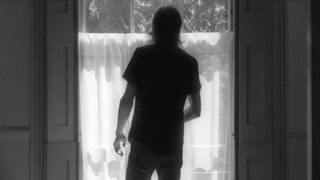
The Mouse Escapes (2010, 56MB, 11:06 min)
After we posted the trailer for this the other week, director Simon
Mclennan was kind enough to let us post the whole movie, so here it is (and
quirky, and poetic and imaginative as it promised to be, it is.)

Alice in Wonderland (1903, 136MB, 9:32)
Enthralling first ever screen version of Alice in Wonderland
from 1903, lovingly restored by the folks at the BFI.
There’s no-one –no-one – who could not learn
something about film-making from this gem.
Nine minutes of sheer, grinning-with-joy delight.
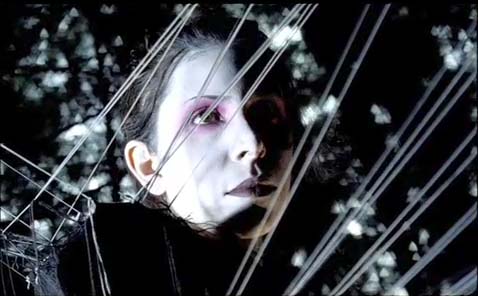
The Mouse Escapes [Trailer] (2010, 4MB, 37 secs)
Difficult to gauge from the trailer what the full 12 minute piece
might be like but it will clearly be interesting & atmospheric and guided
by an acute visual sense.
The music, written by director Mclennan, is also rather good.
Website, with lots of details, here.
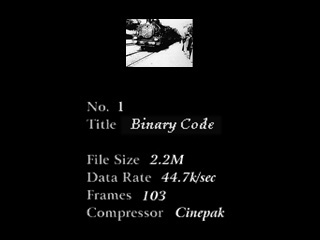
Binary Code (1994-98, 2MB, 52 secs)
On the Ephemeral Nature of Little Movies (1994-98, 3MB, 1:05 min)
I mentioned the Manovich Little Movies in the post I did the
other week on Eryk Salvaggio’s ‘Unfinished Mpeg Haiku’.
In the course of writing that I went to Manovich’s site to look at them
& was surprised to find that their page was in some disarray
and the movies themselves had been removed.
Nor could I find them either in the version archived on the Rhizome Artbase.
It seems a shame for them not to be available -they’re historical
(and in many ways amazingly presecient) documents at the least,
although I find them – especially the last one – gripping and touching too.
Then I remembered the wonderful Wayback Machine and I found them
there, all snug and safe and sound.
We’ll post them here in twos in the next week or so,
in the order in which they appeared in Manovich’s
original presentation of them.
Although the image linking to it has been removed from the site
Manovich’s very interesting statement remains.
(I guess if that goes too you’ll still be able to Wayback it)
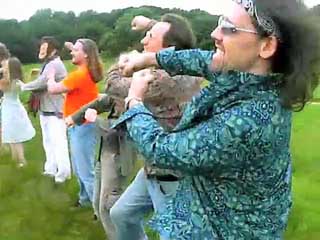
The Wicker Man (2010, 12 MB, 1:09 min)
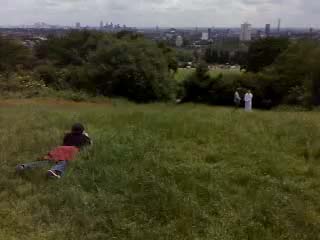
The Wicker Man Live (2010, 7 MB, 3:31 min)
Rupert Howe is always doing interesting things.
He’s also an early adopter of the sort of tech that in-my-old-age I
would cautiously leave a few months to see how it turns
out, so many of the interesting things he does mystify me
somewhat at first.
SO.. here he seems to have got given (?) lots of extras
(in what universe does this occur?) to remake a section of
cult British horror film The Wicker Man on Hampstead Heath.
The results are jaw dropping in two ways.
Jaw droppingly charmingly-funny.
And jaw droppingly odd.
Most of his work is essentially some combination of these
two axes. ( Plus serious skills)
As an added bonus there a kind of Making-Of-The-Wicker-Man-Remake
which apparently was originally streamed live from his mobile.
I didn’t even know you could do that.
If anything the ‘making-of’ piece surpasses the substantive one on the
Howe strangeness scale. Even his friends & colleagues seem touched too
by a species of benign insanity.
Long may he flourish.
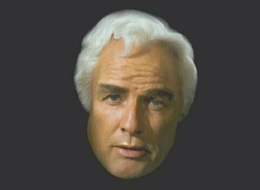
Jor El (1978-2006, 38MB, 3:29 min.)
Marlon Brando, the CG character, rather spookily reappears as
Jor-El in Superman Returns.
From Rhythm & Hues studios.
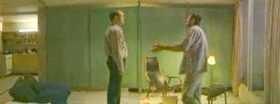
Win, Place or Show (clip) (1998, 1.6 MB, 47 sec.)
Two men are having a discussion in a small apartment. The scene,
lasting only six minutes, is filmed from twenty camera positions.
A computer program then produces some 200,000 possible combinations
of images and sounds, so the viewer always sees a different version of the story.
Win, Place or Show questions our conditioned viewing behaviour.
video installation by Stan Douglas.
from ZKM Videosammlung.
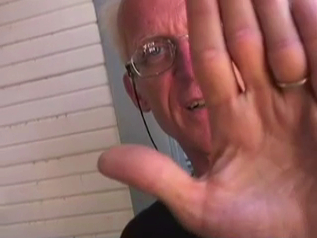
Jon Jost is not making movies (2006, 36.4 MB, 6 min.)
In 2006, Woods Hole Film Festival featured a tribute
to filmmaker Jon Jost.
I got a chance to talk with him for a few minutes
about his career in film and his commitment to
pushing the medium of digital video. In this video
he gives some great advice to new DV filmmakers,
and explains once and for all 24fps setting on your camera.
By Mica.
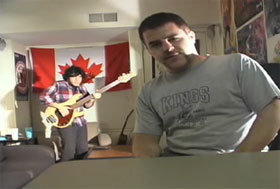
Auto Exposure and White/Black BGs (2009, 23MB, 3:53 min.)
Educational video by Ian Parks.
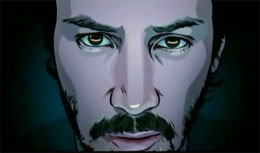
A Scanner Darkly (trailer) (2006, 3MB, 1:15 min.)
“A Scanner Darkly” movie was filmed digitally and then animated
using interpolated rotoscope over the original footage.
by Richard Linklater.
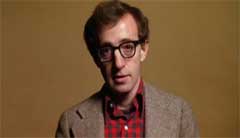
Erik Bunger – the Allens (2004, 23.3MB, 3:19)
Absolutely clever piece by Swedish artist Erik Bunger,
drawn from his experience moving from Sweden to
Germany, where many films on TV are dubbed. As
language can be so central to a character, Bunger
started thinking about people like Woody Allen, who
always play the same character but also one so
connected to his whiny, nervous New York accent.
For this installation piece, a computer program
continuously changed the dubbing of Allen between
his various vocal incarnations. Totally delightful.

Ari Macopoulos – Claremont (2008, 50.5MB, 10:44)
Okay, this requires some breakdown and explanation.
So Adam Kimmel is an NYC men’s wear designer. This
video is a promo for his Spring 2009 line. And you’re
thinking, what does this have to do with video art or
conceptual cinema or animation? Right. Well, not much.
But what it does have to do with is the Internet. The way
that now, we get to see things we didn’t five years ago.
Five years ago, this video would have been shown at some
runway event that few to none of us would ever fathom
attending – not that they’d let us in the door. And I’m not
worried about that. But I am worried about not seeing great
video. And that changed.
So now, you can watch this insane video of two skater guys –
yes, in Adam Kimmel suits, that’s the point – ride down wild
hills, dodging cars, in southern California. It isn’t that this
has superior quality – the first two minutes are a little dry –
and it doesn’t say anything meaningful about the evolution
of digital video, though they did make an HD version, if that
sort of thing interests you. But you get to see it, and you
probably wouldn’t get this point of view unless you’re a
gifted skater in our midst and we had no idea. It would also
be tacky to hate on this kind of video because the skill of
skating, filming, and not wiping out is something laudable
on its own. This kind of extreme boarding? Well, it clearly
struck a chord with me. No one makes this video for a film
festival, and if they did, it wouldn’t be like this. The Internet
is the natural home for this sort of piece. I’m just saying that
I’m glad the house was built.
Video by Ari Macopoulos.
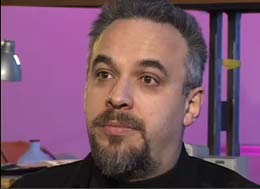
Interview with Lev Manovich (excerpt) (2006, 8.8 MB, 4:23 min.)
Lev Manovich is a Professor in Visual Arts Department, University
of California -San Diego and the author of The Language of New Media
which is hailed as
Scenes of Provincial Life (2005, 3.5MB, each loop 25 sec.)
“Well, it does what it says on the box – let it loop and pretty much every cycle will be
different, both image & sound. #87 in a continuing sequence, my first but
definitely won

Breaking the Rules (2007, 8.7MB, 2 min.)
‘..I thought it might be interesting to have one episode devoted to breaking the rules.
This was a fun one for us’.
Some more DV tutorials – here.
From Izzy Video.
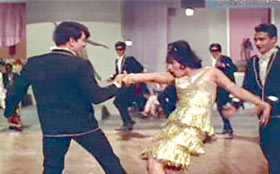
Jaan Pehechan Ho (1966, 55.4MB, 5:33 min)
Clip from the 1966 film Gumnaam sung by
Bollywood legend Mohammed Rafi, which you might
recognise from the opening sequence of Ghost World.
There’s the full lyrics & several translations here.
From WFMU’s Beware of the Blog
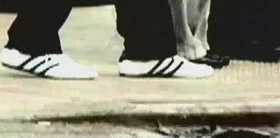
DualDual (2007, 90MB, 10:08 min.)
“Last week Doron and I walked around SoHo with identical cameras
looking for potential subjects. We began with a subway vent fuming
with smoke and found our way down West Broadway. The idea was
to pick a location and focus on the same subject from different perspectives.”
A slow burn of a piece from Doron & Brian.
I love the way it moves from an almost journalistic detachment to
the most ravishing & ravished joy in pure form & colour.
What’s also interesting is how seamlessly, actually, their
styles are melded here, especially given that both
have very distinct filmic identities.
Interesting. Interesting & luminous!
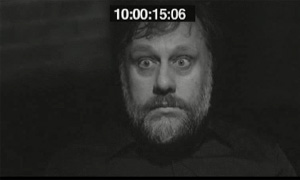
The Pervert’s Guide to Cinema -Trailer (2007, 8.97MB, 1:06 min.)
Slavoj Žižek, philosophy’s PT Barnum, struts his stuff
con shed-loads of brio in this Sophie Fiennes directed opus.
Doesn’t seem to be much genuinely new (the terrible fate of
the celebrity academic being to be lionised for what we already
know they’re going to do/say) but still vastly entertaining.
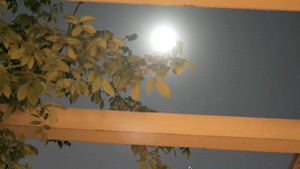
Eclectic (2007, 66MB, 2:26 min.)
“This film I created by myself. It is a series of time-lapse shots that I edited
together and put to music. Rather than using a regular video camera,
I opted to use a digital SLR camera because it allowed me to shoot in ultra
high definition as well as get the depth of field only available to film cameras”.
Time-lapse photography by Ross Ching.
The Postman walks with a spring in his step –They’re back!–
The little girl with freckles & pigtails tumbles joyfully headlong
down the street –They’re back!–
Even Fr. Pinault seems to twinkle ever so slightly..
Now, old Cottard stumbles cantankerously into the boulangerie.
-I don’t understand why everyone’s so damned cheerful today-
-Why, M’sieu, haven’t you heard? They’re back!
The FluxFilms are back on UbuWeb! –
George Maciunas: ‘Ten Feet’
George Landow/Owen Land: ‘The Evil Faerie’ (although
Landow/Land denies authorship – it has been suggested
this piece was actually made by John Cavanaugh)
Paul Sharits: ‘Sears Catalogue 1-3′
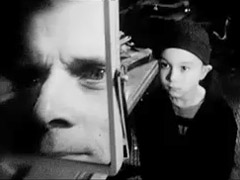
Brand Upon The Brain (Trailer) (2007, 3.47MB, 1:34 min)
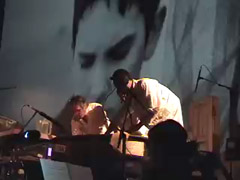
Brand Upon The Brain (Foley) (2007, 4.92MB, 3:20 min)
Brand Upon The Brain, a new feature film by Guy Maddin, tours the US this summer accompanied with a live orchestrations by Ensemble Sospeso.
Maddin’s fantastically extravagant Super 8 films are always enchanting and the additional elements of live music, sound effects and narration by quirky celebs is sure to delight cinephiles of all ages. I was lucky enough to catch it in NYC last week with Crispin Glover as a very charming narrator, but the three Foley artists nearly stole the show. You can see them hard at work in their lab coats in the rehearsal video. Looks like it will have further distribution later this year with recorded soundtrack and narration by Isabella Rossellini.
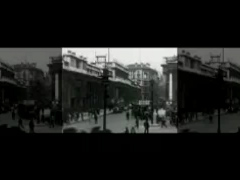
Film (2005, 1.6MB, 17 sec loop)
“It’s Prelinger Archive footage of 1920s London.
Method:
(1) Make a virtual ‘film strip’, a long jpeg.
(2) Make a virtual ‘projector’ for this in Director.
(3) Export it all to QuickTime & Bob’s your uncle.”
Depth of Field (2005, 25.9MB, 4:39 min.)

Hard and Soft Light (2005, 16.4MB, 4:37 min.)

Cutting (2006, 22.7MB, 4:15 min.)
Izzy is Israel Hyman, a weekend videographer from Mesa, Arizona.
His short educational tutorials are great and illustrate simple
techniques for shooting better DV.