Bonnie Prince Billy/Ben Berman –I See a Darkness

I See a Darkness
I See a Darkness (2012, 32MB, 2:40 min)

Bonnie Prince Billy/Will Oldham has a way of generating interesting things
around his core business of making extraordinary music.
In a similar way to that of Ornette Coleman, his album artwork always
contains many little explosions of visual pleasure and neither is it devoid of
food for thought.
This is also true of the videos he commissions to accompany his music.
We’ve posted some of these before , including a deliciously bizarre
one from Harmony Korine.
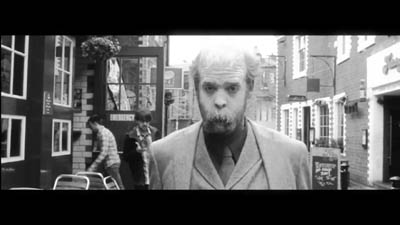
This is one of my favourites to date. Made by Ben Berman, it involves
Oldham lolloping around the streets of Glasgow in a way that in real
life would have me crossing the road toot sweet.
I’m an Oldham fan. If I had to put my finger on one of the things
that lifts him so far from the ordinary it would be a confidence in his
work so great (or maybe better, simply an integrity to it and to his art),
that he can encompass within it and place around it things of utter
ridiculousness without undermining it, indeed, whilst rendering it the more potent.
This is not to downplay the role of Berman in this. He is clearly a significant
talent and a fine co-conspirator for Oldham.

Curt Cloninger & A Bill Miller – sliveRider

sliveRider
sliveRider (2012, 316MB, 5:26 min)

From: Curt Cloninger
To: Michael Szpakowski
Sent: Tuesday, May 15, 2012 4:21 PM

A video collaboration between A. Bill Miller and Curt Cloninger.
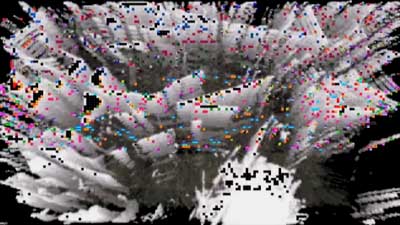
Audio by Low. Bill and Curt swapped files back and forth until the
person receiving the file felt it was finished. Links to the video
files in progress are included
.

I’ve been reading Deleuze on Leibniz about the Baroque fold, and
this project seems like we were folding video. Like cooking, folding
in ingredients. The trace of each iteration is discernible, baked
into the final fold. Not so much cutting, fading, layering, moshing,
or even remixing (although there is some “databending”).

Hope you are doing well over there,
Curt

On Sunday, May 20, 2012, Michael Szpakowski wrote:

This is quite, quite enchanting.
Do either of you have any objection to me doing a DVblog post on it?
thanks!
Michael

At 8:28 AM -0400 5/20/12,
a bill miller wrote:
Fine with me!
bill

Thanks Michael,
Yes, please do.
Best,
Curt

Dawid Krępski & Jason Chiu – Fall into Light

Fall into Light
Fall into Light (2012, 209MB, 3:57 min)

For about the first twenty seconds I didn’t think I was going to like
this music video by Dawid Krępski & Jason Chiu, or at least that I
would remain easily indifferent and unmoved.

Then, ..well.. , it’s a slow burn but it gently explodes, if that’s not too
much of an oxymoron, into something fertile and strange that won’t let
go of you.
I don’t think there probably is a narrative but, as you watch, the piece
fools you into believing there is, one straight from a fever dream.
Great.

Credits:
Song: Beca – Fall into Light
Directed: Dawid Krępski & Jason Chiu

Actors: Kelsey Peterson, Fred Geyer
D.O.P: Dawid Krępski & Jason Chiu

Edit: Dawid Krępski
Special thanks: Magdalena Gaca, Michael McKeogh

Diana Brighouse – Floating Green Leaves

Floating Green Leaves
Floating Green Leaves (2012, 212MB, 3:52 min)

Diana Brighouse is a doctor turned artist in a grand tradition.
She’s currently completing an MA at the University of Chichester in the UK.
Her work is intensely thoughtful and thought through and also often very beautiful.
I’m not always keen on artist commentaries on their own work but what she sent
me is a model of clarity so I’ll reproduce it in full here.

‘The underlying stimulus for my work is to challenge the reductive philosophy
that prevails in Western society today.
I believe that reductionism is manifest through a prioritising of scientific
or quantitative methodology. An unquestioning belief in the measurable is
found not only in science and technology, but also in education, medicine
and politics.
I believe that the supremacy of the measurable can be directly related not
only to the political and financial threats to the arts, but also to the
regressive attitudes towards women and the disabled.
Successive postgraduate university educations in medicine, spirituality,
psychotherapy and art have repeatedly challenged the certainties I have
been taught.
My use of digital video (a quantitative binary process) to produce images
that I believe to be non-reductive reflects the paradoxes created by my
chosen professions.
There are multiple possible interpretations of the videos depending on
the background of the viewer. This is deliberate and hopefully supports
my non-reductive thesis.
These videos are part of a series investigating reflections; a second
series that I am also currently working on investigates shadows.
My intention is that this series will be more politically orientated.
My videos are taken in my garden and edited with Sony Vegas Platinum 11.0HD.’

We’ll have another of these beautiful works next week.

Psycho Bob – Bob’s Big Date

bob_date.jpg
Bob’s Big Date (2008, 7 MB, 50 sec.)

“These are the adventures of a psychopath named Bob. Bob is not
a nice man; not even a little bit. This show is the video equivalent
of a Sunday comic strip.

Here Bob goes out on a date with Betty, perhaps the first woman
other than his mother to truly understand and appreciate him.”
From The AV Club.

Dr Hairy – Mentoring

Floating Green Leaves
Mentoring (2012, 255MB, 16:01 min)

Final one in the present series of Edward Picot’s Dr Hairy videos.
Great stuff, which we’ve enjoyed a great deal.
We eagerly anticipate series #2, perhaps we could suggest The Return of Dr Hairy,
Dr Hairy’s Repeat Prescription or The Beard is Back.
Glad to see he’ll be putting in an artworld appearance at
the new Furtherfield Gallery in Finsbury Park, London.
Not to be missed if you’re in the area during the run of the show (not only
because Dr H is great but also because Furtherfield haven’t put together
a remotely dull show yet).

Lior Shvil – Rough Cut

roughcut
Rough Cut (2007, 54MB, 4 min.)

Born in 1971 in Tel Aviv, Lior Shvil currently lives in New York and recently attended Columbia University’s School of the Arts MFA program.

Shvil works primarily in video, installation and sculpture. His works are multi-layered, both poetic and critical; they tap into collective memory (cultural, mythical, historical), and are inspired by television, cinema and story telling.

Shvil received his B.A. from the Bezalel Academy of Art and Design, Jerusalem. He has had a solo shows at the Herzliya Museum of Art and the Heder Gallery in Israel. His work has been featured in group exhibitions at the Haifa Museum of Art in Israel, Milliken Gallery in Stockholm, The 7th International Istanbul Biennial, and NGBK Gallery in Berlin. Shvil won the Samuel Givon Prize for Young Artists, awarded by the Tel Aviv Museum of Art, as well as the Israel-America Fund for Culture, Israel. – See more at: givon art gallery.

Ant Farm – Media Burn


Media Burn by Ant Farm (1975, 202MB, 25:46)

Infamous July 4, 1975 “pseudo-event” featuring a
speech by “JFK Jr.” and a 1959 Cadillac turned wacky
crash test car through a wall of burning television sets,
produced by video artists and activist collective Ant Farm.
The first four and a half minutes of this particular video
feature actual news coverage about the event.
The rest is the full speech and crash. Inspiration.
Video via the Media Burn archive.

Brody Condon – Performance Modifications

DeathAnimations
Death Animations (2007, 22 MB, 2:58 min.)

“‘Death Animations’ by Brody Condon.
Closely linked to his past process of modification of existing computer games,
as well as performative events with medieval re-enactment and fantasy live
action role playing subcultures, the work is a re-creation in medieval fantasy costume of Bruce Nauman.

More Larissa Sansour – Happy Days

Larissa Sansour: Happy Days
Larissa Sansour: A Happy Days (2006, 13MB, 2:57 min)

Following on from the work we showed last week from the
excellent Subversions show, here’s another piece by
Larissa Sansour.
This is featured in the other UK show featuring work
from the Arabic speaking world, this time specifically
from artists with roots in Palestine, Navigations at
the Barbican in London.

There’s some tremendous work on show there, not least this
one – all the work Sansour I’ve so far seen has delighted me
by being much better than a verbal description might lead one
to expect. So with this one you might hear:

“To the tune of the theme from Happy Days Larissa Sansour
edits together stills of herself, a Palestinian woman,
in various locations in the occupied territories.”

And you might think:

“Ho-hum, seen it all, virtuous agit-prop, with the usual sledgehammer irony”

and you would be totally wrong.

Of course the irony is there, and anger, of course, but
there’s a lightness of treatment – the Sansour “character”,
the everyday found surrealism of some of the shots, the
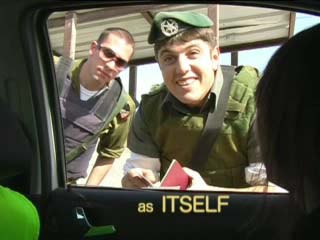
little jokes (the titles: “The Palestinian”
– “The Israeli Army as…Itself” &c.)
which, without negating any political content, makes the
whole thing richly human and a pleasure to watch and watch again.

Navigations is definitely worth a visit – there is a great variety
of very engaging work.
Two complaints though – unlike the lovingly assembled and spacious show
in Manchester, Navigations feels like a somewhat cramped and token
footnote to the “proper business” of the Palestine Film Festival –
publicity for it only appears on the Barbicam website in this context.
(Better than a couple of weeks back when a search for “Navigations” on the Barbican
website yielded precisely – nothing.)
This is disrespectful to artist moving image work in general and
also, I think, to the artists concerned.
Secondly the fact that it sits, looking a tad temporary, on the
busy walk-through mezzanine on four small identical screens, with long
compilation times, gives it an anthropological rather than an art
exhibition character, whilst the (yawn!) Bauhaus blockbuster takes place
upstairs in the galleries proper. This is again disrespectful to
the artists and specifically to them as Palestinian artists:
footnotes, curiosities, on the margins.
Work of this strength and diversity would have made a great large scale
show.
What a shame that the Barbican, with all its resources, doesn’t
seem to understand both why and how it should have attempted something
similar.
Nonetheless, if in London, you should go!