Ruth Catlow -Time is speeding up


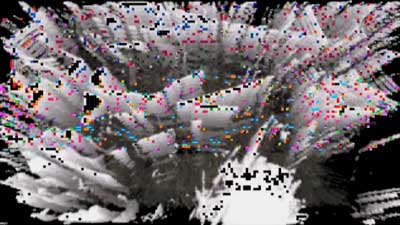
Time is speeding up (2016, 11MB, 1:00 min)

This is a beautiful piece, a distillation down to a minute of a three month installation by Ruth Catlow, artist and co-director of the marvellous Furtherfield.
She explains its premise and construction better than I can, so I’ll hand over to her:

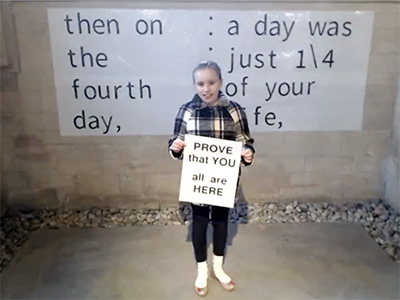
This networked video performance and installation is about how life seems to speed up as we get older; based on the reflection that when I was one day old, a day was my whole life but on the second day one day was only half my life etc.
The work was commissioned for ‘We Are Not Alone’, an exhibition for 20-21 Visual Arts Centre, Scunthorpe, UK.


During exhibition opening hours between 23rd January -24th April 2016, viewers could watch a live looping video online. At the exhibition people could pose for the web cam, or might be caught looking at the video in which they were soon to be portrayed.
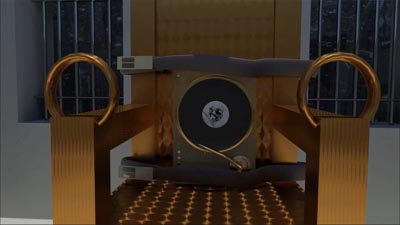
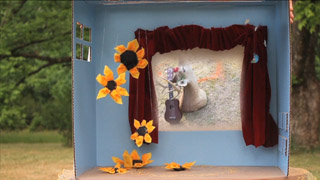
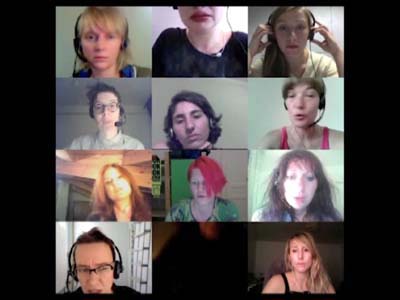
Using a computer programme called Geological Time Piece that I created with Gareth Foote a still webcam image was captured every 3-5 minutes during exhibition opening hours. The camera pointed at a wall in the gallery, upon which a changing text was displayed. The software added each image as a frame to a looping video, of fixed 3 minute duration. The frame density increased every 3 minutes, as each images was added to the video.
In the exhibition space full of movement – of light and shade and people coming and going – people could insert themselves into the video by standing between the webcam and the text. Over three months the human presences started to flicker and disappear and the moving image progressively conveyed a more geological sense of time, the arc of daylight moving through the space, the architecture, and other more static things came to dominate the image. The computer programme stopped running when the exhibition closed by which time the video contained over 3600 images. The final video runs for a minute at 60fps.

‘running to catch a train’ – a performance by Paula Musgrove


running to catch a train (2016, 103MB, 9:07 min)

I’m gently waking DVblog up to post this extraordinary piece of work from Paula Musgrove, with videography from Yasmin Cox (both year two Art & Design students at WSD where – transparency! – I currently teach.)
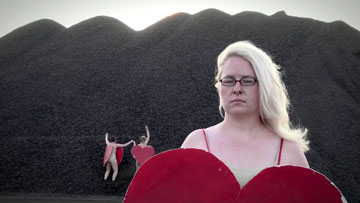
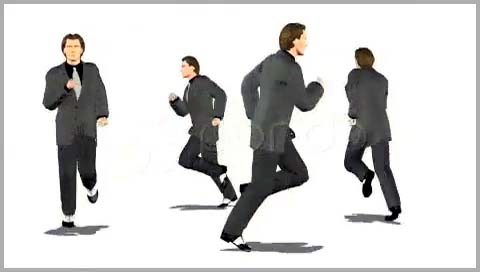
The performance took place at the private view of the end of year show and the video was then inserted as is,replacing the original performance soundtrack and joining the various physical outputs of the performance to form the substantive exhibition piece ( As you can see in the poster image.)
I think it is marvellous, subtle and profoundly moving work and I hope we will all hear a good deal more from Paula over the coming years.

GAC – Belgrades


Belgrades (2013, 50MB, 4:04 min)

Neat music video – for a D J Investor track – from Martin Rychicki a.k.a GAC,
originally from Poland and now Paris resident.
The bendy Sax is particularly fetching.
Assured & engaging movie making.

Osvaldo Cibils – 2 Humans, 1 Paper


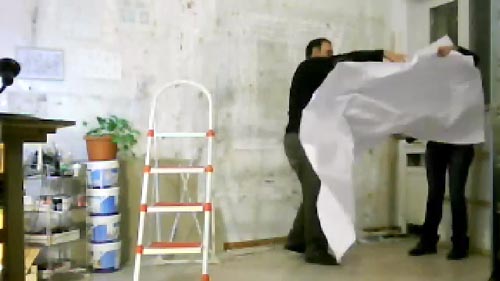
2 Humans, 1 Paper (2013, 10MB, 3:38 min)

I first stumbled across Osvaldo Cibils and his marvellously eclectic and well..simply marvellous work
on Flickr but he seems to have all sorts of things going.
So simple but so, so telling. Kind of Buster Keaton meets Bruce Nauman meets something hard to pin down but lyrical, grotesque and smart all at once.
My kind of artist.
+++
2 humans 1 paper
video art/soundart.
performance with plotter paper 200 x 107 centimeters.
performers: fiorella alberti architect and osvaldo cibils artist.
place: artist’s studio. Via della Cervara, 55 – 38121 – Trento (TN) Italia
22 march 2013, 20 hours

Betty Martins – I Wasn’t always Dressed Like This


I Wasn’t always Dressed Like This [Trailer] (2013, 120MB, 1:42 min)

If the substantive piece (which I gather is about 33 minutes in length) is
anything like as good as this trailer promises it will be stunning.

This has all the hallmarks of the previous piece by Betty Martins – When the Souls Arrive – we posted here : beautifully made, scrupulously attentive to those being observed/interviewed but with its own quite particular gentle and steely authorial stamp.
(I usually hate anthropomorphising art – you know the thing, ‘this piece investigates’ &c. – except here
I am sorely tempted to say that Martin’s work ‘knows how to listen’. Of course what I mean is Martins knows how to listen, carefully and empathetically, and then to re-configure parts of that listening and looking and understanding too as moving image soaked with detail and feeling.)
In addition the subject matter could not be more timely: a broadside of delicate
beauty in the face of bigotry.

Play Local


Play Local (2013, 69MB, 3:58 min)

Enchanting video by Tom White of a sound/music outreach project he ran in Peckham, South London on behalf, appropriately, of the South London Gallery.
There are so many piss-poor arts outreach projects. So nice to observe that this one was clearly brilliant.

Morrisa Maltz & Lauren Lillie – The Caretaker


The Caretaker (2013, 397MB, 7:24 min)

We’ve been following Morrisa Maltz‘s work since just about the beginning and we’re delighted to show here her first longer, narrative (well, if you count fever dream as narrative), piece.
Quite a lot of firepower (lots of collaborators) deployed here, happily to excellent effect ( In fact the piece actually directed by Lauren Lillie although the look of it is pure & vintage MM). It all retains in buckets the goose-bump factor of earlier work but embeds it into a very satisfyingly rounded whole.
This is great work; it deserves to be seen widely.

Happy New Year/Everything Changes

gilgamesh
Gilgamesh, Part #1 (2012, 214MB, 5:03 min)

gilgamesh
Beyond Spectacle (2012, 214MB, 5:03 min)


About DVblog –

Doron started DVblog in summer 2005 and Michael started posting about a month after.
A number of people have contributed hugely along the way – notably Mica Scalin, Brittany
Shoot and Brian Gibson.
We’ve been vandalised a couple of times (hence postings now dating back only to late 2006,
although the vast majority of what was ever posted is back up now) but we’ve also had some really
delightful feedback from people who’ve felt what we’ve done is worthwhile.

Early on we decided that anything we posted would actually live on our server and this means we have assembled an extraordinary and unique archive of the birth and infancy of art video specifically created for or focussed upon the network.

One day we will donate this to an institution that will preserve it and continue to make it available for both joy and study.

When we started Quicktime was the only serious way for anyone to post moving image work to the net. Although it remains the backbone of virtually all digital moving image activity, as a mode of delivery it has now been almost completely superseded by streaming video. This has two implications – one being that the casual viewer has become less patient and is much more likely to go to YouTube or similar, where there’s no significant wait and where quality has improved immeasurably. The other is that fewer and fewer artists are posting their work in QuickTime format – so our old methodology of accepting submitted work but also scouring the net for interesting stuff is at least 50% outmoded.

Finally we want to say – it has been hard work and for no material reward. Indeed, not only have we never made a dime out of DVblog, it has cost us both cash and a great deal of time to sustain. Not that we are complaining – we hope we provided a service to people and certainly we learned a great deal and derived a great deal of pleasure from everything we posted. We made some good and lasting friendships too.

For the reasons listed above we are going to stop posting regularly from today. We finish with pieces from two artists who, in very different ways, have given us a great deal of pleasure – Annie Abrahams and Edward Picot.
Annie, with a record of a networked performance in November of 2012 and Edward with a splendidly mad take on the tale of Gilgamesh, featuring characters from his Dr Hairy series.

We’re not proposing to shut up shop entirely – we will continue post such work in QuickTime format which is submitted to us and which we like. We still think there is something special about the amount of control over quality posting an actual QT file gives and we’re very interested in continuing to write short, but we hope thoughtful and helpful, texts about these. Please, therefore, don’t be shy abuot sending us stuff!

We’d like to thank all who have contributed work over the past seven and a half years and, of course, those who have taken an interest both in the work and what we’ve had to say about it.

Finally we wish readers and contributors alike a happy, productive and thoughtful 2013.

Michael Szpakowski & Doron Golan, 1st Jan 2013.

Jim Punk & Antonio Mendoza – Dysleksic

dudeboat
dudeboat (2012, 2 MB, 11 secs)

misteriosoxxx
misteriosoxxx (2012, 4 MB, 41 secs)

Slightly traducing the spirit of the project where
the two artists mix, hack and otherwise mutate
and abut up to 9 videos simutaneously in the same web page
as a (very welcome) online adjunct to the current Drawing Surrealism
show at LACMA, we’re featuring a couple of the component parts.
(Because we love both these artists and we want to publicise
everything they do, which is never, ever, dull.)
To view it properly go (and keep on going back) to the
project page and to learn more go here.

David Olmos//José M. Sánchez-Verdú – Paisajes del placer y de la culpa

Paisajes del placer y de la culpa #1
Paisajes del placer y de la culpa #1 (2008, 119MB, 7:49 min)

Paisajes del placer y de la culpa #1
Paisajes del placer y de la culpa #2 (2008, 74MB, 4:52 min)

José M. Sánchez-Verdú is a Spanish composer who creates richly textured and
sensuous music in an uncompromisingly contemporary idiom.
His richness is no frippery but properly fought for and won.
Here is a short movie, in two parts, made by David Olmos, about whom I can find
no information whatsoever, which blends a fictional narrative with footage of
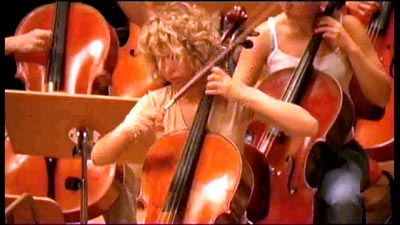
an orchestral performance of one of Sánchez-Verdú’s works
Paisajes del placer y de la culpa – Landscapes
of Pleasure and Guilt.
The film is undoubtedly skillfully made but I remain slightly agnostic
about its premise or even necessity; however no such doubts about some
of the most extraordinary music of recent years.
I grabbed the film from YouTube and as you can see the image quality isn’t great
although in some ways the graininess appeals and seems apposite to the subject.

More from Martin Rychlicki

tyrytyry
TyryTyry (2012, 133MB, 2:06 min)

Nice bit of work from Polish film maker and musician Martin Rychlicki, who also
trades as DJ Gacmaster & GacPax,
for a track by DJ Investor.
We’ve featured Rychlicki’s rather winning work here before and no doubt will again.

Robb Bradely/Randy Newman – I’m Dreaming of a White President

 I
I’m Dreaming of a White President (2012, 15MB, 3:16 min)

Great bit of film-making to match a genius song.
But…but…
Of course you want Obama to win just
to wrongfoot the racists et. al. but you
can’t help wishing he’d actually done something
to merit the mad hostility of the rich, the bigots
and the terminally gullible.

Mad King Thomas/Kevin Obsatz – Eat up, Little Pearl – trailer

eat up little pearl - trailer
Eat up, Little Pearl – trailer (2012, 42MB, 3:26min)

Absolutely wonderful promotional/performance video from US performance/dance
outfit Mad King Thomas (whom I know little about but would love to see),
the vid directed, apparently, by Kevin Obsatz who was behind the
video haikus we posted in July.
Video…&..er…troupe…all great, great.

Barney Doodlebug at i-Kast 2012

i-kast 2012
iKast 2012 (2012, 70MB, 3:23min)

i-kast voodoodoodles
iKast voodoodoodles (2012, 89MB, 2:35min)

voodoo1
voodoo 1 (2012, 362MB, 9:58min)

Here’s some more gripping work from Michael Barnes-Wynters a.k.a Barney Doodlebug
who previously opened my eyes to a thriving live arts scene in Manchester, UK.
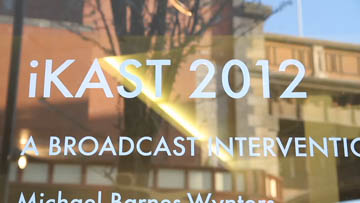
Featured here are two videos of a new piece by Michael which figured in i-Kast,
“a live intervention transmission for www.artplayer.tv with artists roney fraser-munroe,
naomi kashiwagi and michael barnes-wynters” in May of this year.
The first video is an excellent short documentary overview of the event
with interviews with key figures.

Michael is going to be running an event for 15-25 year olds as part of the season
in the new Tate Modern space “The Tanks” on Thursday 23 August.

via Aram Bartholl – Magnotta SpeedShow

magnotta
Magnotta SpeedShow (2012, 20.4, 3:07 min)

Magnotta SpeedShow – A vanity surf performance.

“One week after Magnotta got caught we present a vanity surf performance at the exact same Internetcafe in Berlin where Magnotta was arrested while vanity surfing! Be invited to join and vanity surf yourself!”

“Killing is bad, mailing bodyparts is worse, vanity surfing (while getting caught) is cool!”

“Internet cafes are not just vaguely unglamorous places for ethnic minorities and communications challenged, they do have a genuinely bad reputation.” [Olia Lialina – ‘Still There’] Where else a social network killer can be caught? Of course in the Internet cafe!”

[shot and edited(!) on a smart phone ]

Internetcafe Helin, Karl-Marx-Straße 156, Berlin
Tuesday 12th of June, 2012, 8-10 pm

by Constant Dullaart, CuratingYoutube, Olia Lialina & Aram Bartholl

Bonnie Prince Billy/Ben Berman –I See a Darkness

I See a Darkness
I See a Darkness (2012, 32MB, 2:40 min)

Bonnie Prince Billy/Will Oldham has a way of generating interesting things
around his core business of making extraordinary music.
In a similar way to that of Ornette Coleman, his album artwork always
contains many little explosions of visual pleasure and neither is it devoid of
food for thought.
This is also true of the videos he commissions to accompany his music.
We’ve posted some of these before , including a deliciously bizarre
one from Harmony Korine.
This is one of my favourites to date. Made by Ben Berman, it involves
Oldham lolloping around the streets of Glasgow in a way that in real
life would have me crossing the road toot sweet.
I’m an Oldham fan. If I had to put my finger on one of the things
that lifts him so far from the ordinary it would be a confidence in his
work so great (or maybe better, simply an integrity to it and to his art),
that he can encompass within it and place around it things of utter
ridiculousness without undermining it, indeed, whilst rendering it the more potent.
This is not to downplay the role of Berman in this. He is clearly a significant
talent and a fine co-conspirator for Oldham.

Curt Cloninger & A Bill Miller – sliveRider

sliveRider
sliveRider (2012, 316MB, 5:26 min)

From: Curt Cloninger
To: Michael Szpakowski
Sent: Tuesday, May 15, 2012 4:21 PM

A video collaboration between A. Bill Miller and Curt Cloninger.
Audio by Low. Bill and Curt swapped files back and forth until the
person receiving the file felt it was finished. Links to the video
files in progress are included
.

I’ve been reading Deleuze on Leibniz about the Baroque fold, and
this project seems like we were folding video. Like cooking, folding
in ingredients. The trace of each iteration is discernible, baked
into the final fold. Not so much cutting, fading, layering, moshing,
or even remixing (although there is some “databending”).

Hope you are doing well over there,
Curt

On Sunday, May 20, 2012, Michael Szpakowski wrote:

This is quite, quite enchanting.
Do either of you have any objection to me doing a DVblog post on it?
thanks!
Michael

At 8:28 AM -0400 5/20/12,
a bill miller wrote:
Fine with me!
bill

Thanks Michael,
Yes, please do.
Best,
Curt

Curt Cloninger: Again (I Wish I Was A Fool For You)

Again (I Wish I Was A Fool For You) #1
Again (I Wish I Was A Fool For You): 9:23-9:26 pm (2012, 70MB, 2:27 min)

Again (I Wish I Was A Fool For You) #3
Again (I Wish I Was A Fool For You): 10:08-10:10 pm (2012, 64MB, 2:33 min)

I love (and increasingly so) Curt Cloninger’s work.
The wonderful series of gif/flash/loop/glitch/kitchen sink audio visual poems on his site, his forays into
datamoshing and his series of live performative/endurance pieces
which, sprouting like green shoots from a rather austere central
European branch manage to be filled with light and nuance and a
-how shall I put it -… a joy which is earned, which is not trivial,
and to which we are invited and which arises out of a heightened sense
of ourselves and of others as embodied beings and of our necessary interconnections…

Here’s Curt’s account of a recent piece, a collaboration with his wife Julie,
for which we post two pieces of documentation. (I don’t know whether Curt sees
them as simply that. I think they are quite lovely in themselves – certainly the video
piece derived from Curt and Annie Abraham’s telematic collab Double Blind,
featured here previously certainly has artistic legs of its own and perhaps should
be taken as something of a precedent.)

Anyway, over to you Curt:

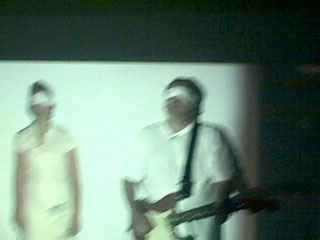
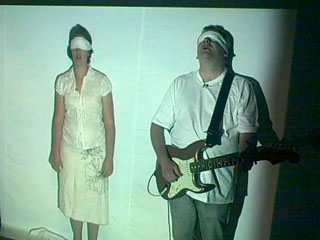
“A 3 Hour performance by Curt and Julie Cloninger. Julie is pre-recorded
on video singing for ten minutes along with Curt playing Rhodes piano.
Her video and audio are then projected and looped in the performance space
while Curt sings and plays guitar live. Both are blindfolded.
A duet across time. The repeated excerpt is from the Richard and
Linda Thompson song “For Shame of Doing Wrong.
Performed at the Black Mountain College campus during the 2012 reHappening festival“.

2 from Patrick Lichty

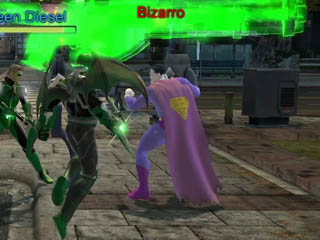
Explaining Conceptual Art to Bizarro
Explaining Conceptual Art to Bizarro (2012, 89MB, 1:36 min)

Danger Music #17
Danger Music #17 by Dick Higgins (2012, 19MB, 45 secs)

And to celebrate our resurrection (for which heartfelt thanks go to James Morris), two newish pieces from the redoubtable (I write so many of these things a nagging doubt enters my mind as to whether I’ve perhaps called Patrick redoubtable before, once, twice…more? But leave it – redoubtable he is) Patrick Lichty.

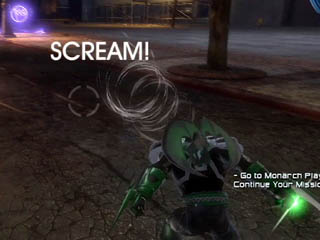
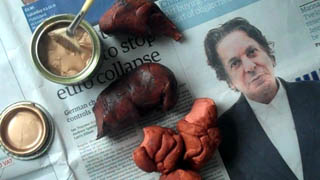
Both pieces take place in DC Universe Online, about which I know nothing so I won’t even begin to show myself up by attempting to expand, and both reference recent art history – one Beuys explaining pictures to a dead hare and the other Dick Higgins’s Danger Music.
Both are utterly splendid.

Ruth Catlow & Marc Garrett –Festival of Money

festival of money
Festival of Money (2012, 111MB, 8:06 min)

Amusing & depressing both, because it is so spot on, a lovely bit of
satire from Marc Garrett and Ruth Catlow of Furtherfield fame.
Most artists, of course, are from the 99%…this is a timely reminder of
where our interests lie and don’t lie…

Will Goss – Sonnet by William Shakespeare

sonnet
Sonnet by William Shakespeare (2011, 64 MB, 2:31 min)

“Here is a video I made a few months ago.
It’s a recitation of Shakespeare’s #135th sonnet.
In the background are Dexter Dalwood’s paintings,
which are collaged from other famous paintings.
The piece engages ideas of appropriation and identity.”
A beauty by Will Goss.

Annie Abrahams –Training for a Better World

angry women left
Angry Women (Left Panel/Clip) (2011, 188MB, 6:23 min)
angry women left
Angry Women (Right Panel/Clip) (2011, 142MB, 6:33 min)

Here are a couple of extracts by Annie Abrahams, whose work we love here at DVblog, from her show Training For a Better World which is currently running at the Centre Régional d’Art Contemporain, Languedoc-Roussillon in Sète until the first of January 2012.
I’d seriously suggest that anyone physically able to do so should visit it – I travelled down from London in a day, stayed a night and then trekked back, all by train. Very pleasant it was too.

Abraham’s exhibition runs in tandem with another, of the works of French artist Catherine Gfeller; Gfeller on the ground floor and Abrahams on the first, and the formal similarities (though I think these are largely superficial, for reasons I’ll enlarge upon soon) – the use of both moving and still images, text, an intervention at some level in the mechanics , the whys and wherefores, of how one presents these as art in a gallery setting – make it a stimulating pairing.

Abraham’s selection includes four pieces which are essentially (with some qualifications) video. They are constructed out of the telematics performance territory that she has so signally staked out in the last few years but, she insists, are not documentations of those performances. I think she’s right to emphasise this distinction – although in one sense the pieces clearly do document things that happened in performance they are ultimately video pieces made performatively .

The show doesn’t consist of moving image work only. There are some prints, drawings and a minimalist installation consisting of a single photograph of a pair of married fire-fighters and a sound track of them reading (in an extraordinarily graceful and musical edit [and this is where in this piece any surface similarities to, say, Nauman find their limit. Grace. Grace and elegance throughout.]) a collaborative text on fear.

The moving image and the other pieces occupy different ends of what is mostly a long thin exhibition space and are connected –“tied” together by a “ribbon”- a very long, three or four inch high, strip, of black highlighted, collaboratively generated white text –on the theme of madness – running at floor level for some considerable distance.

It’s important to both acknowledge this distinctly bi-partite character and then to immediately forget about it, so intimate is the connection between the two halves.
Despite the disparate and apparently laissez-faire methodologies used in the generation of all the work and the huge level of trust in the participants evinced by Abrahams, one’s main impression is of a body of work which forms a tight unity both stylistically and in its preoccupations. (And I’d argue that the principal pre-occupation is the question of what it means, physically, socially, psychically, to be a human being. And, further, that this high seriousness –allied to a playfulness which veers from the childishly innocent to the Rabelaisian – is what ultimately gives this work its huge authority and significance and distinguishes it in kind from the technically well executed and often engaging work on the floor below.)

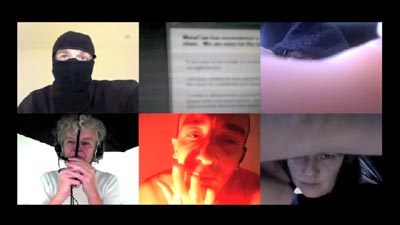
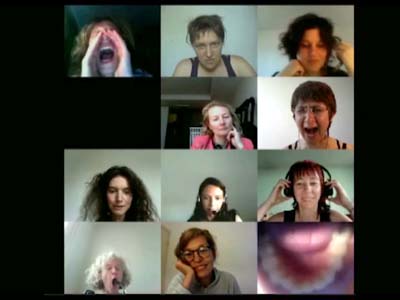
The jewel in the crown of the show is the video installation ‘Angry Women’, created by Abrahams and 22 other women of many nationalities (3 more , in fact, in total, 2 “backstage” assistants, and a performer who opted for silence throughout) speaking about, acting out, demonstrating, reflecting upon, their anger and its causes and triggers, on webcams at their different individual locations and in their native tongues, with the images being sent to a 3X4 grid, in a format that Abrahams has made her own. Because of the limits of even current streaming technology it was necessary to conduct two distinct performances, separated, in fact, by an interval of two months. The length of each was determined by a protocol where a minute’s silence by all participants signalled the end. This resulted in pieces of differing lengths the lack of synchronisation of which adds another layer of fragile grace to the final projections, projected large on adjacent walls around their common corner, with sound from the left image grid fed to the right speaker and vice versa.

The piece occupies most of a large rectangular space at the CRAC (with the video ‘Double Blind (love)’, a collaboration with Curt Cloninger we’ve savoured here before, in its performance incarnation, in the opposite corner and in its full and majestic 264 minute duration).

The impact is visceral – we face what feels like a wave of humanity, not so much in numbers, although 23 women is impressive, at least to this man, but in the infinite malleability of face and hand, of gesture and expression and of how these things might occupy a frame. Sometimes that frame will resemble a Giacometti portrait, with the subject appearing to recede into what seems to be endlessly deep space. At others red lips or an open mouth, sensual and terrifying by turns, occupy the whole of the space – and furthermore each cell is constantly in flux (because these are living, breathing, unpredictable, human beings). There’s something both of portraiture and of the dance at work here, and a kind of found poetry too (which the moving image work has in common with the collaborative texts at the other end of the exhibition). The combination of iron control, planning, foresight (the grid, the protocols) with the letting go and trust evident elsewhere – the phased lengths, the blank space for the person who didn’t turn up, the open performative structure – makes for something of great richness.
Additionally it’s clear that those performers who had previous experience of the format were consciously playing with and against their fellows – gestures are mirrored, sounds echoed, the fiction of looking elsewhere – to the side, or above – of making contact in and across the grid itself, is impressively sustained.

The angry women turn out to be at one and the same time very particular – unique – women and women in general too; the women in general turn out to be human beings in general (and general en masse because each so particular) and the human beings in general turn out to live here, or there, now, in this, one, our only, very particular, world – that mysterious, frightening and wonderful place.

Book your train/plane ticket now!

***

Voici quelques extraits par Annie Abrahams, dont nous aimons le travail ici à DVblog, de son exposition Training For a Better World qui se déroule actuellement au Centre Régional d’Art Contemporain, Languedoc-Roussillon à Sète jusqu’au premier janvier 2012.
Je suggère sérieusement de la visiter à quiconque qui est effectivement en mesure d’y aller – j’ai voyagé depuis Londres en une seule journée, je suis resté une nuit et j’ai fait le retour le lendemain, le tout par train. C’était très agréable.

L’exposition d’Abrahams fonctionne en tandem avec une autre, des œuvres de l’artiste française Catherine Gfeller; Gfeller au rez de chaussée et Abrahams au premier étage, et les similitudes formelles (bien que je pense qu’elles soient essentiellement superficiels, pour des raisons sur lesquelles je vais m’étendre bientôt) – l’utilisation à la fois de l’image fixe et de l’image en mouvement, du texte, l’intervention à un certain niveau dans la mécanique, les tenants et aboutissants, de la façon dont on présente celles ci en tant que de l’art dans le contexte d’une galerie – en font un jumelage stimulant.

La sélection d’Abrahams comprend quatre pièces qui sont essentiellement (avec certaines réserves) vidéo. Elles sont construites à partir du territoire de la performance télématique qu’elle a jalonné si singulièrement les dernières années, mais, elle insiste, ce ne sont pas des documentations de ces performances. Je pense qu’elle a raison de souligner cette distinction – bien que dans un sens les pièces documentent bel et bien ce qui est arrivé dans la performance, elles sont finalement des pièces vidéo réalisées performativement.

L’exposition ne consiste pas seulement d’images en mouvement. Il y a quelques imprimées, des dessins et une installation minimaliste composé d’une seule photo d’un couple de pompiers mariés et une piste sonore d’eux lisant (dans un montage extrêmement gracieuse et musicale [et c’est là que dans cette pièce toute similitude de surface à, disons, Nauman trouve son limite. Grace. Grâce et de l’élégance tout au long.]) un texte collaborative sur la peur.

L’image en mouvement et les autres pièces occupent des extrémités différents de ce qui est surtout un espace d’exposition longue et mince et sont reliés – “liées” par un “ruban” – une très longue, trois ou quatre pouces de haut, bande, de texte blanc, généré en collaboration, souligné en noir – sur le thème de la folie – se déroulant au niveau du sol sur une distance considérable.

Il est important de reconnaître ce caractère nettement bi-partite et ensuite de l’oublier immédiatement, tellement intime est la connexion entre les deux moitiés.
Malgré les méthodologies disparates et apparemment laissez-faire utilisées dans la production de tout le travail et l’énorme niveau de confiance aux participants manifesté par Abrahams, la principale impression est celle d’un corps de travail qui forme une unité serrée à la fois stylistique et dans ses préoccupations. (Et je dirais que la principale préoccupation est la question de ce qu’il signifie, physiquement, socialement, psychologiquement, d’être un être humain. Et, puis, que cette haute degré de sérieux, allié à un enjouement qui vire de l’innocence enfantine au rabelaisien – est, ce qui donne finalement ce travail son énorme autorité et importance et le distingue de sa nature du travail techniquement bien exécuté et souvent engageant de l’étage en dessous).

Le joyau de la couronne de l’exposition est l’installation vidéo «Angry Women», créé par Abrahams et 22 autres femmes de plusieurs nationalités, (en fait, 3 de plus au total, 2 assistantes de “secours”, et une performeuse qui a choisi de rester silencieuse jusqu’à la fin), parlant, actant, démontrant, réfléchissant à, leur colère et ses causes et déclencheurs, devant des webcams dans leurs locations individuellement différentes et dans leur langue maternelle, avec les images envoyées à une grille de 3X4, dans un format que Abrahams a fait le sien. En raison des limites des technologies de streaming, mêmes actuelles, il était nécessaire d’effectuer deux performances distinctes, en fait séparées par une période de deux mois. La longueur de chaque performance a été déterminé par un protocole où une minute de silence par toutes les participantes marquait la fin. Il en résulte des pièces de longueurs différentes dont le manque de synchronisation ajoute une autre couche de grâce fragile aux projections finales, projetées en grand sur des murs adjacents autour de leur coin commun, avec le son de l’ image grillée de gauche envoyé au haut-parleur droit et vice versa.

La pièce occupe la majeure partie d’un grand espace rectangulaire au CRAC (avec la vidéo «Double Blind (love)», une collaboration avec Curt Cloninger que nous avons savouré ici avant dans son incarnation performative, dans le coin opposé, dans sa durée totale et majestueuse de 264 minutes).

L’effet est viscérale – nous faisons face à ce qui ressemble à une vague de humanité, non pas tant en nombre, bien que 23 femmes est impressionnant, au moins à cet homme, mais dans l’incessante malléabilité du visage et des mains, du geste et de l’expression et de la façon dont ces choses peuvent occuper un cadre. Parfois, ce cadre ressemble à un portrait de Giacometti, avec le sujet apparaissant reculer dans ce qui semble être un espace profond infini. À d’autres moments, des lèvres rouges ou une bouche ouverte, sensuel et terrifiant à tour de rôle, occupent la totalité de l’espace – et en plus chaque cellule est constamment en mouvement (parce que ce sont des êtres humains vivantes, respirantes, imprévisibles). Il y a quelque chose à la fois du portrait et de la danse à l’œuvre ici, et aussi une sorte de poésie trouvée (ce que le travail d’image en mouvement a en commun avec les textes collaboratives à l’autre bout de l’exposition). La combinaison du contrôle de fer, de la planification, de la prévision (la grille, les protocoles) avec le laisser-aller et la confiance manifeste ailleurs – les longueurs phasées, l’espace noir pour la personne qui ne se présente pas, la structure performative ouverte – produit quelque chose d’une grande richesse.
En outre, il est clair que ces artistes qui ont eu une expérience antérieure du format ont joué sciemment avec et contre leurs partenaires – les gestes sont mises en miroir, des sons font écho, la fiction de regarder ailleurs – sur le côté ou au-dessus – la prise de contact dans et à travers la grille lui-même, est impressionnant et soutenue.

Les femmes en colère se révèlent être tout à la fois des femmes très particulier – unique – et des femmes en général aussi ; les femmes en général se révèlent être des êtres humains en général (et en général en masse parce que chacune si particulière) et les êtres humains en général s’avèrent vivre ici, ou là, maintenant, dans ce, un, notre seul, très particulier monde – cet endroit mystérieux, effrayant et merveilleux.

Réservez votre train / avion billet dès maintenant!
Sebastian Sommer – Happily Drowning

indian_movie.jpg
Happily Drowning [clip] (2011, 126MB, 58 sec)

Here’s a clip from a short film by Sebastian Sommer, based on stories by the seemingly ubiquitousTao Lin.

It’s very nicely made – here is someone who takes to (and to some extent, reforges)
film grammar like a fish in water.
I’m not entirely convinced that the narrative is clear enough ( it all
looks so great and having not read the original I was intially prepared
to accept any lack of understanding was mine) – it was only a one sentence precis on
Sommer’s site that really clued me into what was happening.
Clearly, though, someone to be watched…
See the whole thing here

Andrew Norman Wilson #5

the_incorporation_of_demands_for_liberation.jpg
The Incorporation of Demands for Liberation(2011, 13MB, 3:24 min)

Brilliant!
Last piece from ANW, for the moment, although we
certainly hope to feature more in the future –
some of the most original and exciting work I’ve seen recently.

For some context see Monday’s post.

Andrew Norman Wilson #4

flowspottest6.jpg
Flow Spot Test #6 (2011, 18MB, 3:34 min)

“Just downloading apps at my Blanc Laptop Cart when all
of a sudden BenJi, an old teammate from XpresSpa shows up.
He happens to be subcontracted now by the American Airlines
subsidiary AffinityAlliance as an evaluator of potential for their
Oneworld Alliance codeshare lounges (of which FlowSpot is the
newest member).”

See Monday and Tuesday’s posts.

Andrew Norman Wilson #3

network_research.jpg
Network Research (2011, 75MB, 2:11 min)

See Monday’s post.

Andrew Norman Wilson #2

FlowSpotTest5s.jpg
Flow Spot Test #5 (2011, 57MB, 2:03 min)

“Just having my early afternoon session of Body-Work with
Nnah, my Body-Designer.”

Says ANW, of the FlowSpot Tests:

For a large-scale exhibition at the School of the Art Institute of Chicago
I created a color coordinated airport/hotel/mall/bank/spa/biennial lounge to
offer a site of relaxation and bodily engagement in an exhibition dominated
by isolated, sellable art objects.
All lounge products were purchased through online transactions (mostly
Target and Walmart), and were returned at the end of the exhibition.
My dystopic science fiction news video Global Countdown played on
a 55” flat panel monitor.
On opening night, visitors to FlowSpot could register for massages from
licensed massage therapists. While participants received massages they
could not see anything and listened to my directors commentary of the
Global Countdown video. The commentary consists of very basic visual
descriptions, with the goal being that the person receiving the massage
can visualize the video in their minds.
Throughout the duration of the exhibition, I used the lounge as a science
fiction video set to make “FlowSpot Tests.” In these videos I engaged
with the lounge both conceptually and materially in a color coordinated
outfit.
Contact me if you are interested in opening a FlowSpot in your airport,
hotel, mall, bank, spa, biennial, gallery, cultural center, or any other
space that you own/lease/use.

See also.

Andrew Norman Wilson – Webinars & FlowSpot Tests

anxiety_about_relationships_between_friendship_and_business.jpg
Anxiety About Relationships Between Friendship and Business (2011, 11MB, 2:41 min)

I’m so taken with Andrew Norman Wilson’s work I’m going to devote
the whole first week of this DVblog season to it.

He initially sent us a longish piece, Networking with Andrew Norman Wilson
made with Nicholas O’Brien of Bad At Sports.
It’s wonderful but pretty huge so you should definitely go and
look at the Vimeo version there.

On Monday, Weds and Friday of this week we’ll post smaller
pieces extracted from that (but without the commentary or
‘interview’ as it is styled elsewhere [-the text on the BAS page linked above]) ,
On Tuesday and Thursday we’ll post two of Wilson’s FlowSpot Tests
with some accompanying explanation from him.

I find this work in general very exciting because it does a lot
of interesting, nuanced and often rather funny (and I’m in favour of funny
there are very few great works of art which contain no funny at all)
and intially apparently contradictory things.

Let me give you my take on it.
The Webinars are all composed entirely of footage sourced from Pond5
“the worlds stock media marketplace” . The FlowSpot Tests are performative
pieces involving bizarre consumer items sourced from e-bay and wallmart and
deployed in a 21st Century updating of silent movie Lloyd-Keaton-Chaplin
deadpan involving, too, a certain degree of slapstick
and displaying a deliciously calibrated sense of the ridiculous.
The Webinars (a least when one takes account of their titles and certainly viewed
in the light of the commentary from “networking”) are a kind of consumerist
reductio-ad-absurdam.
The intent is celarly in some sense satirical but the pieces take risks in
that they don’t stop and end in critique – there is an understanding of
how toxically compelling some of this imagery is and to some extent they
toy with celebrating this.
Wilson is clearly a natural movie maker. He doesn’t restrain himself from
visual flourishes and jokes which are by no means integral to any
satirical case but make the pieces more fun to watch.
(The distortion effects applied to objects in the periphery of the
action in FlowSpot Test #5 are a case in point.)
Additionally, and most impressively, there is a muddying of the
waters in Networking… (and by implication the
Webinars and FlowSpot Tests) whereby
cogent and apparently straightforward philosophising is allowed
to cross pollinate/contaminate with the satire and vice versa,
leaving the viewer with -ahem- work to do.
This work is not glib; it takes risks – in order to maintain its
high level potency it risks misunderstanding.

A look at Wilson’s CV shows a spell spent working for a
labour union and I read the impulse behind these pieces
as radically anti-commodification and corporate mind rot.
Agit-prop, thankfully, it’s not, but “something rich and strange”
– radical art for interesting times to come.
Nice to see this when so many younger artists seem to be
tempted by a career orientated and somewhat cynical celebration
of that same deadend emptiness.

Eddie Whelan/Ruby Kendrick Do Me Right

domeright.jpg
Do Me Right (2011, 62MB, 2:25 min)

Gosh! this is lovely and Gosh! Eddie Whelan is talented & capable.
We’ve admired his data-moshing skills on a number of occasions
but the man clearly has range and whats the word? – yes –
application
. This vid for Ruby Kendrick looks so light and easy
and yet one jusy knows what it cost in time and effort
(and inspiration).
Oh -but worth it, so worth it.

Wikipedia Art in London

intro.jpg
Wikipedia Art Intro (2011, 114MB, 2:29 min)

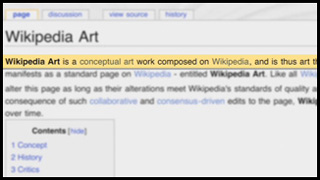
And, appropriately following on from yesterday’s post, a little intro
to the splendid Kildall/Stern Wikipedia Art project which is showing, as part
of a two person show at London’s Furtherfield gallery (formerly HTTP)
from this Friday.
(One individual piece by each artist too – promises to be a real treat)

Private view tonight 6:30 (Thurs.) – all welcome, maybe see you there.

This piece narrated in Stern’s breathless-puppy-dog-with-an-off-the-dial-IQ
trademark delivery with reassuringly measured interventions by the
no less smart & talented Kildall.

Edit by Foster Stilp, plus suitably keyed up and excited music by Stilp and
Kevin McGillivray, who together trade as Felixsofia