Betty Martins – When the Souls Arrive

when the souls arrive

I recently attended a fairly high profile art video festival,
which shall be nameless, and I came away feeling depressed.
There was some good work (indeed, some magnificent, not much, but some) but
on the whole it was just a dispiriting display of meretricious effects, sloppy thinking
and a striving for the quick impression; all pretty souless & forgettable stuff.
(Oh, and plus a lot of cliched tosh about the – yawn – “post-human”. Wasn’t post human,
most of it, so much as post-being-any-good)
Then, on the other hand, you come across something like this:
no in-your-faceness, modest, austere and subtle, makes you do a little bit of work,
but so, so worth spending time with.
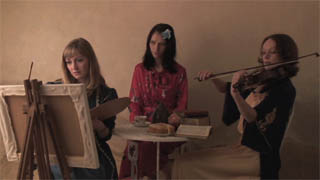
is the Brazilian video maker who made this small and perfect gem
– an account of the celebration of the Day of the Dead by expat Mexicans
living in London.
You can see the whole thing here (and I urge you to do so).
Betty Martins cheered me up considerably and I look forward to much more
work of this quality from her.

Cohen, Tarantino, Goffman

Dance Me
Dance Me To The End Of Love (clip, 1994, 0.5MB, 31 sec.)

Dance Me1
Dance Me To The End Of Love (1995, 34.1MB, 6:07 min.)

Leonard Cohen’s work has always walked a fine line
between kitsch & poetry.
Don’t get me wrong – the kitsch is like a dash of chilli,
gives the whole thing added piquancy & depth.
Check out these two videos for ‘Dance Me To The End Of Love’.
The first, the short clip, is the official video.
Now look at the second.
OK- first things first -just who is that playing the bridegroom?
Then, consider if this whole unofficial one ( by Aaron Goffman)
prolix & kitschy in some respects as it undoubtedly is,
doesn’t somehow do more justice to Cohen’s world !’

Jennifer Steinkamp – Mike Kelley

steinkamp_kelley
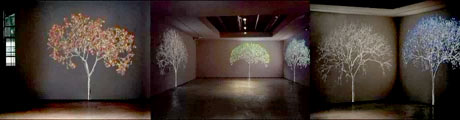
Mike Kelley (2007, 7.3 MB, 15 sec.)

‘Mike Kelley’ are high definition video projections of individual trees
with branches moving in a twirling pattern. Projected to fill the height
of the gallery’s walls, the images interact with the architecture of the gallery,
creating tension between the imaginary landscape and the physical space.

by Jennifer Steinkamp.

Sondheim – Prisoners

Prisoners
prisoners (2008, 25.4MB, 2:36 min)

Nearest thing to a Picasso we yet have, in my view.
Whatever history decides, there’s no denying one point
of Sondheim/Picasso commonality – an almost compulsive
productivity.
I’d push it further -they both constantly transform lead into
gold. Picasso & his seat & handlebars, Sondheim, for example,
these bits of video.
The music, a kind of hallucinogenic, shredded-up
slow funk/blues, is also particularly noteworthy.
Here, for good measure, is Alan’s accompanying rubric:

prisoners of motion capture, prisoners of west virginia

prisoners of caloric, froid, prisoners of gravitation
prisoners of art, mayhem, vandal, prisoners of desecration

o to be a prisoner of life again (above the clouds
o to be a prisoner of love again (within the waters
o to be a prisoner of truth again (beyond the earths
o to be a prisoner of dance again (before the fires

prisoners of fires, froid, prisoners of aerostat and transport
transport of prisoners, clouds, waters, earths, fluids

yes, prisoners of fluids, prisoners of fluids and places
prisoners of west virginia, of fluids, places, life, love,
truth and dance again

Toby Tatum on ‘The Golden Age’

the golden age
Toby Tatum on ‘The Golden Age’ (2011, 78MB, 4:38 min)

Toby Tatum, talking about his film The Golden Age, which we posted here
a couple of weeks back.
I’m always hungry for artists talking about process. Learn! Steal!

Yu-Chen Wang – Struggle for Existence

struggle_existence
Struggle for Existence (2004, 18MB, 1:58 min.)

“By linking Darwin’s “The truth of universal struggle for existence” with a Taiwanese children’s game, The video represents two individuals’ slaughter in the virtual battle field and reflects on the ideology of boundary dividing, self-defending patriotism and bellicosity.”
by – Yu-Chen Wang.

Ruth Catlow – overland

overland
overland (2010, 131MB, 2:58 min)

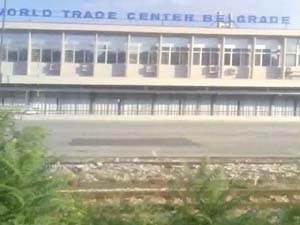
And sadly, the last in our little season of movies by Ruth Catlow. This is another
train movie, no conceptual underpinnings to speak of this time, just a beautiful,
bleached out pastels, lo-fi ( mobile?) account of the Serbian section of a journey by train to Istanbul
last year when she was refusing ‘to fly for art’, something more people should do more often if
the results here are anything to go by.
More from Ruth, of course, as she produces it…

Scritti Politti – pop sublimity

Word Girl
The Word Girl (1985, 7.62MB, 3:14 min)

Oh Patti
Oh Patti (1988, 20.3MB, 4:14 min)

Two of the most perfect pop songs ever made, the first from
1985’s Cupid & Psyche & the second from 1988’s Provision
(& which features a trumpet solo from Miles Davis of staggering
economy & otherworldly beauty).
Pet Sounds excepted, pop music just doesn’t come better.
The vids aren’t just an adjunct – of course they have historical
interest (that weird decade!), but there’s something fragile
& haunting & mysterious there which survives the occasional impossible
to overlook moment of naffness.
Wonderful.

Annie Pui Ling Lok

EP
EP (2008, 45MB, 2:29 min)

Anyone who has been lucky enough to see dancer & artist Annie Pui Ling Lok
do the former will know what a fruitful combination of fierce, almost austere,
intellect & yet sensitivity to the particular, the fragile & the human, to expect.
There’s such a sure hand at work here – the confidence in collaging
disparate material brings Marker to mind & although we’ve tagged it
‘experimental’, in one sense the piece is anything but -it’s so not
a technical exercise, but a rounded, resonant work of art.

Eric Lerner – Mr. Deja Vu


Eric Lerner – Mr. Deja Vu (2006, 27.2MB, 3:48)

From Eric Lerner‘s collection of Mr.CityMen.

Patrick Power – lights and darkness


Steamlight (2006, 16.2MB, 2:51)


Watauga (2007, 203.1MB, 26:23)

Two extraordinary pieces from Patrick Power.
Its as if the Qatsi trilogy found a way to use a videoblog as a testing ground.
This is much more than a test, though.
Some of the most important work I have seen in a while.
Beautifully touching randomized archives.
Pushing the limits of contemplative observation.
Taking time to visually visit other places.
There is so much beauty in reflections and the synchronicities of our minds.

Sample these two, then go visit the rest of his collection. Patrick makes the world watchable.

Edit: Sadly, Patrick Power passed away in 2007. This post was created to honor this man’s work, and now sadly, we must honor that work as his legacy.

More from Regina Célia Pinto

Paintings

Neste vídeo há uma grande delicadeza, uma fragilidade,
que não deve levar a pensar que essa peça de Regina Pinto
é de alguma forma ocasional ou menos artística.
Em vez disso, esse é o trabalho de um artista maduro,
sem nada a provar, e com a enorme liberdade que isso traz.
Um estudo de todo o corpo de seu trabalho evidencia
amplamente tudo isso e mostra quão profundamente
consistente e coerente ele se apresenta.
Poder-se-ia ainda acrescentar o quanto ele nos emociona,
o quanto é estranho e muito bonito.

There’s a delicacy, a fragility, about this piece
that shouldn’t lead one to think that Regina Célia Pinto’s
work is in any way casual or artless.
Rather, this is the work of a mature artist with
nothing to prove and the enormous freedom that brings.
A study of the whole body of her work
amply bears this out.
It shows just how consistent and deeply considered
it is and, one should add, how affecting, how strange
and how very beautiful.

Toby Tatum –The Golden Age

the golden age
The Golden Age (2011, 181MB, 5:34 min)

We’ve posted Toby Tatum’s work
before and it’s work with a definite charge to it and ambitious too.

I think this piece is more wholly successful than its predecessor but I’m still not totally convinced.
It’s something to do with the aim of conjuring a very precise & particular
dream-world which strikes me as an all-eggs-in-one-basket kind of approach,
in that the tiniest false note disrupts the sought for spell.
Therefore Tatum creates a very high bar indeed for himself and his performers.

If one compares similarly oneiric work by Cocteau, Lynch or Hadžihalilović,
however dense and rich the atmosphere gets, there is variation with humour
or banality preparing us for more poetry to come and somehow too, framing it,
setting it off.
That sounds more critical that I want to be for this is, in every respect, a
very nicely realised and haunting piece.

Next week, or the week after, we’ll post an interview with Tatum about his work.

Another from Ruth Catlow

as i looked up
travel images unseen (2011, 156MB, 6:01 min)

‘5 video clips taken on a simple video camera, through a window on a coach to the
plane from Istanbul and arriving in London by train. Selected by and stitched, unseen
by the creator who will never watch the video, ever.’

The gentlest conceptualism & quite, quite lovely too.
There’s something about knowing the premise that leaves one
very open – one could say innoculates one – to its formal consequences –
here a looseness which somehow gently stretches time, makes it grainier
but conversely sharpens our attention, perhaps to make up for the
maker’s own vow of abstention.
One more in the series to come.

Aī-Hz – My Miwoo

My Miwoo
My Miwoo [Tai Chi Weekend Control] (2007, 24.6MB, 50 secs)

Aī-Hz, real name Michael Renassia,
is a French visual performer living and working in Tokyo.
His site contains possibly my favourite biographical nugget ever:

‘He is using compositing software in a diverted way, and real-time mixing
instruments with the aim to create a noisy/pop universe…’

Now, who could possibly object to that?
This piece is rather lovely – the thing that totally makes it for me
is the epiphanic moment at the end when the music/animation stops &
the person appears ..there’s a haunting sense of time suspended..
So, for me, 10/10 for visuals.
I am pretty bored ,though, with the by-the-yard avant-dance music
that accompanies so much work of this kind..it’s not bad
or anything, just pedestrian…

Brian Kim Stefans – Difficult Beauty

vex1
Vex #1 (2006, 29.1MB, 2:08 min.)

vex5
Vex #5 (2006, 25.9MB, 1:09 min.)

ferrari dogs
Ferrari Dogs (2006, 25.9MB, 1:09 min.)

You know sometimes how when you first look at a work
you can’t process it immediately, it seems jumbled – wrong
& you’re tempted to dismiss it.
Then you live with it awhile & suddenly it leaps into focus &
you realise you’re in the presence of something much richer
& more rewarding than the things which did immediately fall into place?
Do you know that feeling?
Well, that’s how I felt as I prepared this post.
The work, by the artist & poet Brian Kim Stefans, snuck up
on me & then hit me over the head.
Furthermore, there’s still a puzzling quality to it all, for me:
the Ferrari Dogs piece seems like work of a different category
to the vex pieces somehow ( as does Manchurian Rainman on
the site. Check it. Now – what is that all about?)
Anyway – I’ll take mystery over glibness anyday – I look forward to more.

Abbie Hoffman and gefilte fish


Abbie Making Gefilte Fish (1973, 156.4MB, 21:04)

Footage of Abbie Hoffman making gefilte fish with Laura Cavestani
(who made the video) in his kitchen, 1973.
Like Abbie, I think art is in the everyday, and it sure is a fun
(and rather informative) twenty minutes if you’ve got it to spare.

Art for Abbie was education, constant revolution, evolution, and living for free.
Art and freedom were one in the same, inextricable from each other.
We miss you man.

Ruth Catlow – As I Looked Up…

as i looked up
As I Looked Up (2011, 32MB, 2:23 min)
A co-director of the formidable Furtherfield, Ruth Catlow charms
and something more – something to do with the urgency and vulnerability
of performance and the importance of memory, of a sense of place – in this
fragile & lovely elaboration of an Ivor Cutler song.
Things its difficult to put your finger on but which go right to our core;
pointing to – literally singing – those things being in the ‘artist’ job description…

First of three. Two more pieces, just as delicate, just as necessary, to come.

James Joyce has a Posse

james joyce has a posse
James Joyce has a Posse (2011, 32MB, 4:49 min)

And mentioning Curt Cloninger, as we did on Friday last, it’s nice to report he has made
a new video which is both gorgeous and engimatic, with a musicality which stems
not only from the actual sounds but the video’s very construction, that repeated
wistful, strange, ‘Portrait of the Artist’, title motif…
Cloninger is someone (Eddie Whelan the other who springs to mind) who has thoroughly incorporated
data-moshing as an expressive tool into their vocabulary, defying reports of its early death.
Poetry.

PS And just in passing – I’m fascinated by movies like this one, for which it’s very difficult
to create an adequate poster image.
Data-moshing is a particularly dynamic form of moving image work
where the motion is like the Cheshire Cat’s grin.
It’s not just data-moshing – it happens elsewhere.
It’s like some movies are, in some sense, “further away” in the line of image kinship
with the still.

Gov. Scott Walker gets checked, Mic Checked!

scott walker mic checked
Gov. Scott Walker gets checked, Mic Checked! (2011, 81MB, 3:45 min)

If you don’t feel inspired & cheered up by this tremendous video please do the checking
your pulse thing…
Stand Up Chicago

Annie Abrahams –Training for a Better World

angry women left
Angry Women (Left Panel/Clip) (2011, 188MB, 6:23 min)
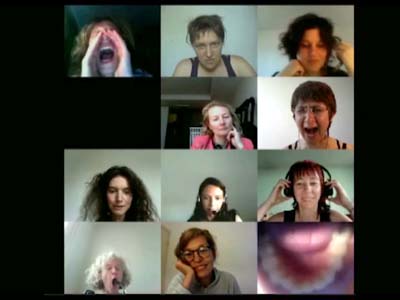
angry women left
Angry Women (Right Panel/Clip) (2011, 142MB, 6:33 min)

Here are a couple of extracts by Annie Abrahams, whose work we love here at DVblog, from her show Training For a Better World which is currently running at the Centre Régional d’Art Contemporain, Languedoc-Roussillon in Sète until the first of January 2012.
I’d seriously suggest that anyone physically able to do so should visit it – I travelled down from London in a day, stayed a night and then trekked back, all by train. Very pleasant it was too.

Abraham’s exhibition runs in tandem with another, of the works of French artist Catherine Gfeller; Gfeller on the ground floor and Abrahams on the first, and the formal similarities (though I think these are largely superficial, for reasons I’ll enlarge upon soon) – the use of both moving and still images, text, an intervention at some level in the mechanics , the whys and wherefores, of how one presents these as art in a gallery setting – make it a stimulating pairing.

Abraham’s selection includes four pieces which are essentially (with some qualifications) video. They are constructed out of the telematics performance territory that she has so signally staked out in the last few years but, she insists, are not documentations of those performances. I think she’s right to emphasise this distinction – although in one sense the pieces clearly do document things that happened in performance they are ultimately video pieces made performatively .

The show doesn’t consist of moving image work only. There are some prints, drawings and a minimalist installation consisting of a single photograph of a pair of married fire-fighters and a sound track of them reading (in an extraordinarily graceful and musical edit [and this is where in this piece any surface similarities to, say, Nauman find their limit. Grace. Grace and elegance throughout.]) a collaborative text on fear.

The moving image and the other pieces occupy different ends of what is mostly a long thin exhibition space and are connected –“tied” together by a “ribbon”- a very long, three or four inch high, strip, of black highlighted, collaboratively generated white text –on the theme of madness – running at floor level for some considerable distance.

It’s important to both acknowledge this distinctly bi-partite character and then to immediately forget about it, so intimate is the connection between the two halves.
Despite the disparate and apparently laissez-faire methodologies used in the generation of all the work and the huge level of trust in the participants evinced by Abrahams, one’s main impression is of a body of work which forms a tight unity both stylistically and in its preoccupations. (And I’d argue that the principal pre-occupation is the question of what it means, physically, socially, psychically, to be a human being. And, further, that this high seriousness –allied to a playfulness which veers from the childishly innocent to the Rabelaisian – is what ultimately gives this work its huge authority and significance and distinguishes it in kind from the technically well executed and often engaging work on the floor below.)

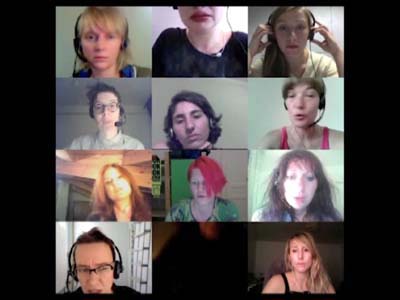
The jewel in the crown of the show is the video installation ‘Angry Women’, created by Abrahams and 22 other women of many nationalities (3 more , in fact, in total, 2 “backstage” assistants, and a performer who opted for silence throughout) speaking about, acting out, demonstrating, reflecting upon, their anger and its causes and triggers, on webcams at their different individual locations and in their native tongues, with the images being sent to a 3X4 grid, in a format that Abrahams has made her own. Because of the limits of even current streaming technology it was necessary to conduct two distinct performances, separated, in fact, by an interval of two months. The length of each was determined by a protocol where a minute’s silence by all participants signalled the end. This resulted in pieces of differing lengths the lack of synchronisation of which adds another layer of fragile grace to the final projections, projected large on adjacent walls around their common corner, with sound from the left image grid fed to the right speaker and vice versa.

The piece occupies most of a large rectangular space at the CRAC (with the video ‘Double Blind (love)’, a collaboration with Curt Cloninger we’ve savoured here before, in its performance incarnation, in the opposite corner and in its full and majestic 264 minute duration).

The impact is visceral – we face what feels like a wave of humanity, not so much in numbers, although 23 women is impressive, at least to this man, but in the infinite malleability of face and hand, of gesture and expression and of how these things might occupy a frame. Sometimes that frame will resemble a Giacometti portrait, with the subject appearing to recede into what seems to be endlessly deep space. At others red lips or an open mouth, sensual and terrifying by turns, occupy the whole of the space – and furthermore each cell is constantly in flux (because these are living, breathing, unpredictable, human beings). There’s something both of portraiture and of the dance at work here, and a kind of found poetry too (which the moving image work has in common with the collaborative texts at the other end of the exhibition). The combination of iron control, planning, foresight (the grid, the protocols) with the letting go and trust evident elsewhere – the phased lengths, the blank space for the person who didn’t turn up, the open performative structure – makes for something of great richness.
Additionally it’s clear that those performers who had previous experience of the format were consciously playing with and against their fellows – gestures are mirrored, sounds echoed, the fiction of looking elsewhere – to the side, or above – of making contact in and across the grid itself, is impressively sustained.

The angry women turn out to be at one and the same time very particular – unique – women and women in general too; the women in general turn out to be human beings in general (and general en masse because each so particular) and the human beings in general turn out to live here, or there, now, in this, one, our only, very particular, world – that mysterious, frightening and wonderful place.

Book your train/plane ticket now!

***

Voici quelques extraits par Annie Abrahams, dont nous aimons le travail ici à DVblog, de son exposition Training For a Better World qui se déroule actuellement au Centre Régional d’Art Contemporain, Languedoc-Roussillon à Sète jusqu’au premier janvier 2012.
Je suggère sérieusement de la visiter à quiconque qui est effectivement en mesure d’y aller – j’ai voyagé depuis Londres en une seule journée, je suis resté une nuit et j’ai fait le retour le lendemain, le tout par train. C’était très agréable.

L’exposition d’Abrahams fonctionne en tandem avec une autre, des œuvres de l’artiste française Catherine Gfeller; Gfeller au rez de chaussée et Abrahams au premier étage, et les similitudes formelles (bien que je pense qu’elles soient essentiellement superficiels, pour des raisons sur lesquelles je vais m’étendre bientôt) – l’utilisation à la fois de l’image fixe et de l’image en mouvement, du texte, l’intervention à un certain niveau dans la mécanique, les tenants et aboutissants, de la façon dont on présente celles ci en tant que de l’art dans le contexte d’une galerie – en font un jumelage stimulant.

La sélection d’Abrahams comprend quatre pièces qui sont essentiellement (avec certaines réserves) vidéo. Elles sont construites à partir du territoire de la performance télématique qu’elle a jalonné si singulièrement les dernières années, mais, elle insiste, ce ne sont pas des documentations de ces performances. Je pense qu’elle a raison de souligner cette distinction – bien que dans un sens les pièces documentent bel et bien ce qui est arrivé dans la performance, elles sont finalement des pièces vidéo réalisées performativement.

L’exposition ne consiste pas seulement d’images en mouvement. Il y a quelques imprimées, des dessins et une installation minimaliste composé d’une seule photo d’un couple de pompiers mariés et une piste sonore d’eux lisant (dans un montage extrêmement gracieuse et musicale [et c’est là que dans cette pièce toute similitude de surface à, disons, Nauman trouve son limite. Grace. Grâce et de l’élégance tout au long.]) un texte collaborative sur la peur.

L’image en mouvement et les autres pièces occupent des extrémités différents de ce qui est surtout un espace d’exposition longue et mince et sont reliés – “liées” par un “ruban” – une très longue, trois ou quatre pouces de haut, bande, de texte blanc, généré en collaboration, souligné en noir – sur le thème de la folie – se déroulant au niveau du sol sur une distance considérable.

Il est important de reconnaître ce caractère nettement bi-partite et ensuite de l’oublier immédiatement, tellement intime est la connexion entre les deux moitiés.
Malgré les méthodologies disparates et apparemment laissez-faire utilisées dans la production de tout le travail et l’énorme niveau de confiance aux participants manifesté par Abrahams, la principale impression est celle d’un corps de travail qui forme une unité serrée à la fois stylistique et dans ses préoccupations. (Et je dirais que la principale préoccupation est la question de ce qu’il signifie, physiquement, socialement, psychologiquement, d’être un être humain. Et, puis, que cette haute degré de sérieux, allié à un enjouement qui vire de l’innocence enfantine au rabelaisien – est, ce qui donne finalement ce travail son énorme autorité et importance et le distingue de sa nature du travail techniquement bien exécuté et souvent engageant de l’étage en dessous).

Le joyau de la couronne de l’exposition est l’installation vidéo «Angry Women», créé par Abrahams et 22 autres femmes de plusieurs nationalités, (en fait, 3 de plus au total, 2 assistantes de “secours”, et une performeuse qui a choisi de rester silencieuse jusqu’à la fin), parlant, actant, démontrant, réfléchissant à, leur colère et ses causes et déclencheurs, devant des webcams dans leurs locations individuellement différentes et dans leur langue maternelle, avec les images envoyées à une grille de 3X4, dans un format que Abrahams a fait le sien. En raison des limites des technologies de streaming, mêmes actuelles, il était nécessaire d’effectuer deux performances distinctes, en fait séparées par une période de deux mois. La longueur de chaque performance a été déterminé par un protocole où une minute de silence par toutes les participantes marquait la fin. Il en résulte des pièces de longueurs différentes dont le manque de synchronisation ajoute une autre couche de grâce fragile aux projections finales, projetées en grand sur des murs adjacents autour de leur coin commun, avec le son de l’ image grillée de gauche envoyé au haut-parleur droit et vice versa.

La pièce occupe la majeure partie d’un grand espace rectangulaire au CRAC (avec la vidéo «Double Blind (love)», une collaboration avec Curt Cloninger que nous avons savouré ici avant dans son incarnation performative, dans le coin opposé, dans sa durée totale et majestueuse de 264 minutes).

L’effet est viscérale – nous faisons face à ce qui ressemble à une vague de humanité, non pas tant en nombre, bien que 23 femmes est impressionnant, au moins à cet homme, mais dans l’incessante malléabilité du visage et des mains, du geste et de l’expression et de la façon dont ces choses peuvent occuper un cadre. Parfois, ce cadre ressemble à un portrait de Giacometti, avec le sujet apparaissant reculer dans ce qui semble être un espace profond infini. À d’autres moments, des lèvres rouges ou une bouche ouverte, sensuel et terrifiant à tour de rôle, occupent la totalité de l’espace – et en plus chaque cellule est constamment en mouvement (parce que ce sont des êtres humains vivantes, respirantes, imprévisibles). Il y a quelque chose à la fois du portrait et de la danse à l’œuvre ici, et aussi une sorte de poésie trouvée (ce que le travail d’image en mouvement a en commun avec les textes collaboratives à l’autre bout de l’exposition). La combinaison du contrôle de fer, de la planification, de la prévision (la grille, les protocoles) avec le laisser-aller et la confiance manifeste ailleurs – les longueurs phasées, l’espace noir pour la personne qui ne se présente pas, la structure performative ouverte – produit quelque chose d’une grande richesse.
En outre, il est clair que ces artistes qui ont eu une expérience antérieure du format ont joué sciemment avec et contre leurs partenaires – les gestes sont mises en miroir, des sons font écho, la fiction de regarder ailleurs – sur le côté ou au-dessus – la prise de contact dans et à travers la grille lui-même, est impressionnant et soutenue.

Les femmes en colère se révèlent être tout à la fois des femmes très particulier – unique – et des femmes en général aussi ; les femmes en général se révèlent être des êtres humains en général (et en général en masse parce que chacune si particulière) et les êtres humains en général s’avèrent vivre ici, ou là, maintenant, dans ce, un, notre seul, très particulier monde – cet endroit mystérieux, effrayant et merveilleux.

Réservez votre train / avion billet dès maintenant!

A Broad Way

a_broad_way
A Broad Way, Trailer (2007, 60.89 MB, 5:17 min)


Saul Goode
worked with 400 filmmakers to
document every corner of New York’s most
famous street, Broadway.

By Mica

Sam Renseiw – Change of Colour

Change of Colour
Change of Colour (2007, 6.16MB, 1:00 min)

Does what it says on the packaging & sublimely.
This is so beautiful.
A Lumière from Sam Renseiw.

Alan Sondheim – Two Movies

Beauty
Beauty (2007, 11.4MB, 1:04 min.)

Romania
Romania (2007, 19MB, 2:01 min.)

What to say, we’ve said it all, again & again, Sondheim’s
movies are a unique & indispensable body of work.
Specifically, anyone working in video on the net who
doesn’t know them is navigating blind.
For a free masterclass hop over to his site & work your
way through all the stuff with .mov or .mp4 extensions.
( I mean, don’t confine yourself to the movies but this
is dvblog)
You won’t have wasted your time.

Tired of the WC, Gulanny – KBSC505 vs WWFT

knbs_wwft
KBSC505 vs WWFT (clip) (2006, 27MB, 8:14 min.)

WeWorkForThem short was created as an extra for KNBSC505’s
Noise Driven Ambient Audio And Visuals DVD. Exploring the emotions, physical & mental
pain and illusions of bacteria this video follows 8 minutes from infection to cure.

Errol Morris: Donald Trump on Citizen Kane

trump_kane
Donald Trump on Citizen Kane (2004, 40.2MB, 3:22 min.)

by Errol Morris.
‘The last thing one would imagine Donald Trump talking about is Citizen Kane,
what many believe to the greatest film ever made, but here he is talking about
in one of the aborted projects by Errol Morris — like he has lived it, like he is a
reincarnation of Charles Foster Kane. The beauty is not just in the Errol Morris
meditative style or even what Trump has to say about Citizen Kane but what we
want to see. Mainly, that Trump’s life mirrors that of Kane and that this real life
epic character sees his own tragedy.
Talking about wealth, he says ‘In real life, wealth does in fact isolate you from other
people…it is a protective mechanism’. That quote speaks volumes. The salesman is
poking holes into his much marketed life. Asked on what advice he would give
Charles Foster Kane, Trump says boldly: ‘Get yourself a different woman!’.

Business – Junu Ahn

Business
Business (2007, 67.9MB, 9:33 min)

I find it easier to admire this piece, to respect its clear integrity,
than to actually like it much – it’s a pretty hardcore glitch
assemblage & it doesn’t let up …oooooh noooo… not at all
(Strikes me as a bit of a video analog for something like Lou Reed’s (in)famous
)
It’ll be interesting to see where Junu Ahn goes next…

Clouds by John Murphy

c1
Clouds…Courts (2007, 10MB, 4:45 min.)

c2
Clouds…Words (2007, 7.85MB, 3:35 min.)

John Murphy is an Irish artist living and working in Madrid Spain.
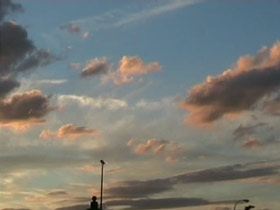
Clouds…Courts shows us the late afternoon sky and we hear
Craig Murray formerly UK’s Ambassador to Uzbekistan
speaking about torture and England’s role in the Iraq war.

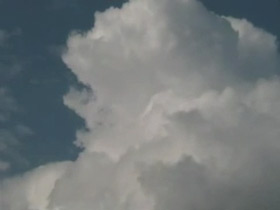
In Clouds…Words we hear about ways to die in Iraq, according
to a BBC journalist while watching the early spring sky in Madrid.

‘Erection’ by John Lennon & Yoko Ono

Erection John Lennon
Erection (1971, 180MB, 18:06 min.)

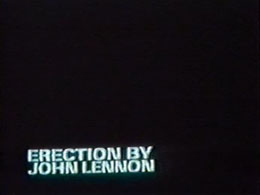
A nineteen-minute film by John and Yoko, which was made in London during
1970 and 1971. When John had heard that the London International Hotel was
to be built in Kensington, he sought permission to film its entire construction.
Once he’d obtained it he contacted the photographer Iain MacMillan and asked
him to take a series of photographs of the construction. MacMillan had a stills
camera and filmed the erection of the hotel from a fixed position for a period
of eighteen months.
The stills were presented in sequence in the film, which ended with a shot of the
completed hotel where all the lights were then turned off, leaving a black screen.
On the soundtrack Yoko sang two songs, ‘Airmale’ and ‘You’, using tapes of recordings
of Joe Jones Tone Deaf Music Co., which was, in fact, a number of toy percussion
instruments that played themselves, a squeaky style of sound devised by a former
associate of Yoke’s Fluxus days, Joe Jones. The hotel was situated at 147 Cromwell
Road and later became the London Swallow Hotel.

Celia Cooley – Occupy DC Interviews 10/10/2011

indian_movie.jpg
Occupy DC Interviews 10/10/2011 (2011, 73MB, 58 sec)

Demonstrating what we all might have said rhetorically, but really demonstrating it –
that a smart seven year old (with a little tech help from her parents)
can do a better job than any of the official media, Celia Cooley interviews
Occupy DC participants in a piece that both delights and makes one fiercely
proud to be one of the 99%.
Great job.