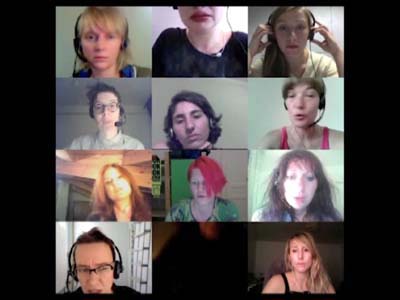
Ruth Catlow -Time is speeding up


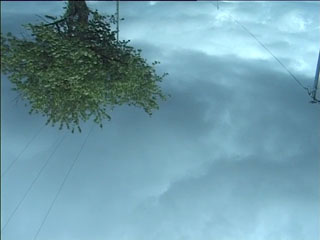
Time is speeding up (2016, 11MB, 1:00 min)

This is a beautiful piece, a distillation down to a minute of a three month installation by Ruth Catlow, artist and co-director of the marvellous Furtherfield.
She explains its premise and construction better than I can, so I’ll hand over to her:

This networked video performance and installation is about how life seems to speed up as we get older; based on the reflection that when I was one day old, a day was my whole life but on the second day one day was only half my life etc.
The work was commissioned for ‘We Are Not Alone’, an exhibition for 20-21 Visual Arts Centre, Scunthorpe, UK.


During exhibition opening hours between 23rd January -24th April 2016, viewers could watch a live looping video online. At the exhibition people could pose for the web cam, or might be caught looking at the video in which they were soon to be portrayed.
Using a computer programme called Geological Time Piece that I created with Gareth Foote a still webcam image was captured every 3-5 minutes during exhibition opening hours. The camera pointed at a wall in the gallery, upon which a changing text was displayed. The software added each image as a frame to a looping video, of fixed 3 minute duration. The frame density increased every 3 minutes, as each images was added to the video.
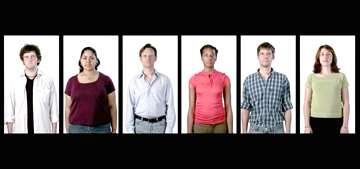
In the exhibition space full of movement – of light and shade and people coming and going – people could insert themselves into the video by standing between the webcam and the text. Over three months the human presences started to flicker and disappear and the moving image progressively conveyed a more geological sense of time, the arc of daylight moving through the space, the architecture, and other more static things came to dominate the image. The computer programme stopped running when the exhibition closed by which time the video contained over 3600 images. The final video runs for a minute at 60fps.

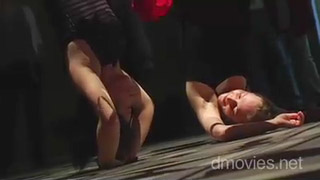
‘running to catch a train’ – a performance by Paula Musgrove


running to catch a train (2016, 103MB, 9:07 min)

I’m gently waking DVblog up to post this extraordinary piece of work from Paula Musgrove, with videography from Yasmin Cox (both year two Art & Design students at WSD where – transparency! – I currently teach.)
The performance took place at the private view of the end of year show and the video was then inserted as is,replacing the original performance soundtrack and joining the various physical outputs of the performance to form the substantive exhibition piece ( As you can see in the poster image.)
I think it is marvellous, subtle and profoundly moving work and I hope we will all hear a good deal more from Paula over the coming years.

Nicki Rolls – Dream Home & Don’t Know Y


Dream Home (2012, 61MB, 1:00 min)


Don’t Know Y (2010, 116MB, 2:23 min)

I first encountered Nikki Rolls’ work through Kerry Baldry’s splendid One Minutes series.( In fact we featured another piece by her in our very first post about that series)

As with so many of the artists included in that series she’s an amply justified curatorial choice;
her work is subtle, thought provoking and very beautiful.
She makes tiny ( or sometimes none, except to select) interventions into found (sometimes “found from herself”) images or footage which have a transformative effect and an expressive force much greater than one might have any right to predict. Beautiful.

Jim Punk & Antonio Mendoza – Dysleksic

dudeboat
dudeboat (2012, 2 MB, 11 secs)

misteriosoxxx
misteriosoxxx (2012, 4 MB, 41 secs)

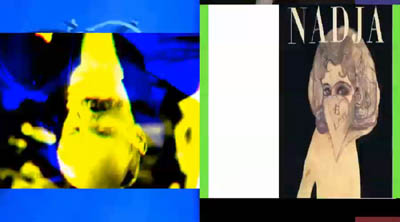
Slightly traducing the spirit of the project where
the two artists mix, hack and otherwise mutate
and abut up to 9 videos simutaneously in the same web page
as a (very welcome) online adjunct to the current Drawing Surrealism
show at LACMA, we’re featuring a couple of the component parts.
(Because we love both these artists and we want to publicise
everything they do, which is never, ever, dull.)
To view it properly go (and keep on going back) to the
project page and to learn more go here.

David Askevold – Nova Scotia Fires

Nova Scotia Fires
Nova Scotia Fires (1969, 5MB, 3:00 min)

I hadn’t, to my shame, heard of the late David Askevold until the Camden Arts Centre
put on a beautifully put together and gripping retrospective last year.
Here’s one of the pieces on show then. It’s not particularly great quality plus
it’s in a tiny window but it does conjure (perhaps an appropriately Askevoldian
choice of word) something of the impact -witty, smart and otherwordly – of his work.

* and there’s a good review of that here.

Alan Sondheim – Disappearing Body

whirl1
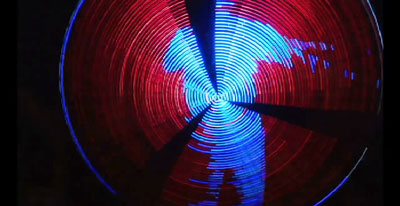
Disappearing Body (2012, 44MB, 1:02min loop)

Time marches on but some things don’t change and one of these is
our unbounded admiration here for the work of Alan Sondheim.
This is a perhaps a lollipop in comparison to some of his work but
it is, as always, rich and beautiful and lodges both in the conscious
mind and in our dreams.

Says Sondheim:

Mark Esper’s Two-Tone Enlightenment work forms the basis
of this short video. The screen presents shadows as positive,
not negative; infrared light forms the projection source
which is read and interpreted by revolving LEDs.

The body disappears. In the video, I imitated the effect
using video echo in an attempt to erase the body almost
entirely. Mark’s piece is brilliant, and the video is a
byproduct; I take advantage of the illumination to create
a somewhat clumsy series of movements.

Thus the mechanical is made virtual, and the virtual made
mechanical; such reversals form the core of theory povera.

Jeremy Bailey – Transhuman Dance Recital #1

transhuman.jpg
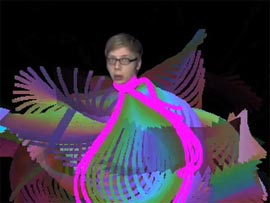
Transhuman Dance Recital #1 (2008, 56MB, 6:30 min.)

If Jeff Koons had fallen for the Microsoft Help Paperclip rather than
vacuum cleaners or La Cicciolina, presumably the result would have
looked a lot like: ”The Jeremy Bailey Show”.

Says Jeremy Bailey: “From now on I dedicate myself to finding better
ways for humans to dance”

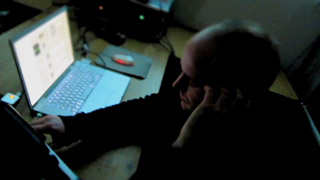
via Aram Bartholl – Magnotta SpeedShow

magnotta
Magnotta SpeedShow (2012, 20.4, 3:07 min)

Magnotta SpeedShow – A vanity surf performance.

“One week after Magnotta got caught we present a vanity surf performance at the exact same Internetcafe in Berlin where Magnotta was arrested while vanity surfing! Be invited to join and vanity surf yourself!”

“Killing is bad, mailing bodyparts is worse, vanity surfing (while getting caught) is cool!”

“Internet cafes are not just vaguely unglamorous places for ethnic minorities and communications challenged, they do have a genuinely bad reputation.” [Olia Lialina – ‘Still There’] Where else a social network killer can be caught? Of course in the Internet cafe!”

[shot and edited(!) on a smart phone ]

Internetcafe Helin, Karl-Marx-Straße 156, Berlin
Tuesday 12th of June, 2012, 8-10 pm

by Constant Dullaart, CuratingYoutube, Olia Lialina & Aram Bartholl

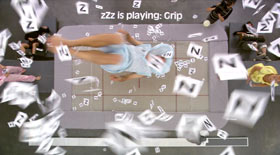
Roel Wouters – zZz – Grip

Grip
Grip (2007, 101 MB, 4:13 min.)

Grip is a video clip for the band zZz.
It is a one take, top shot video with trampoline gymnasts simulating
video effects, and has been recorded live as part of the opening “Nederclips”,
a showcase of Dutch videoclips at the Stedelijk Museum.
The important criteria were that the audience at the opening would be able to
witness the whole shoot, and that the videoclip would be added to the exhibition
immediately after the shoot.
The project developed by Roel Wouters.

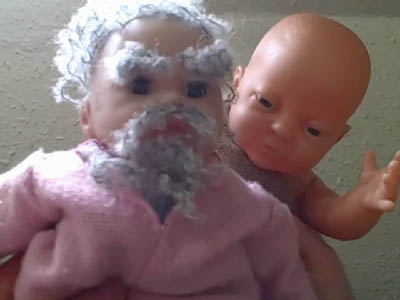
Dr Hairy – Mentoring

Floating Green Leaves
Mentoring (2012, 255MB, 16:01 min)

Final one in the present series of Edward Picot’s Dr Hairy videos.
Great stuff, which we’ve enjoyed a great deal.
We eagerly anticipate series #2, perhaps we could suggest The Return of Dr Hairy,
Dr Hairy’s Repeat Prescription or The Beard is Back.
Glad to see he’ll be putting in an artworld appearance at
the new Furtherfield Gallery in Finsbury Park, London.
Not to be missed if you’re in the area during the run of the show (not only
because Dr H is great but also because Furtherfield haven’t put together
a remotely dull show yet).

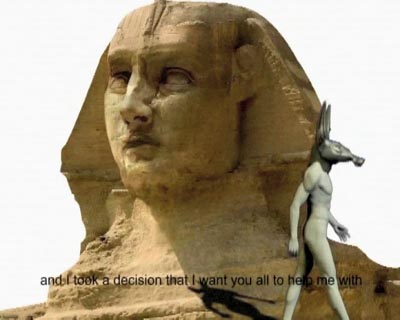
Khaled Hafez – <em>On Presidents and Superheroes</em>

On Presidents and Superheroes
On Presidents and Superheroes (2009, 7MB, 1:15 min)

Another piece from Manchester Cornerhouse’s excellent Subversion show.
This post is a collaboration with Furtherfield – they’re hosting ….

More Larissa Sansour – Happy Days

Larissa Sansour: Happy Days
Larissa Sansour: A Happy Days (2006, 13MB, 2:57 min)

Following on from the work we showed last week from the
excellent Subversions show, here’s another piece by
Larissa Sansour.
This is featured in the other UK show featuring work
from the Arabic speaking world, this time specifically
from artists with roots in Palestine, Navigations at
the Barbican in London.

There’s some tremendous work on show there, not least this
one – all the work Sansour I’ve so far seen has delighted me
by being much better than a verbal description might lead one
to expect. So with this one you might hear:

“To the tune of the theme from Happy Days Larissa Sansour
edits together stills of herself, a Palestinian woman,
in various locations in the occupied territories.”

And you might think:

“Ho-hum, seen it all, virtuous agit-prop, with the usual sledgehammer irony”

and you would be totally wrong.

Of course the irony is there, and anger, of course, but
there’s a lightness of treatment – the Sansour “character”,
the everyday found surrealism of some of the shots, the
little jokes (the titles: “The Palestinian”
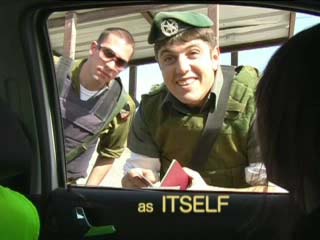
– “The Israeli Army as…Itself” &c.)
which, without negating any political content, makes the
whole thing richly human and a pleasure to watch and watch again.

Navigations is definitely worth a visit – there is a great variety
of very engaging work.
Apart from the two Sansour pieces there’s a tremendous semi-documentary
work
shot in a Miami auto paint and body shop by Shadi Habib Allah
Two complaints though – unlike the lovingly assembled and spacious show
in Manchester, Navigations feels like a somewhat cramped and token
footnote to the “proper business” of the Palestine Film Festival
publicity for it only appears on the Barbicam website in this context.
(Better than a couple of weeks back when a search for “Navigations” on the Barbican
website yielded precisely – nothing.)
This is disrespectful to artist moving image work in general and
also, I think, to the artists concerned.
Secondly the fact that it sits, looking a tad temporary, on the
busy walk-through mezzanine on four small identical screens, with long
compilation times, gives it an anthropological rather than an art
exhibition character, whilst the (yawn!) Bauhaus blockbuster takes place
upstairs in the galleries proper. This is again disrespectful to
the artists and specifically to them as Palestinian artists:
footnotes, curiosities, on the margins.
Work of this strength and diversity would have made a great large scale
show – Cornerhouse show that it can be done and how to do it very well.
What a shame that the Barbican, with all its resources, doesn’t
seem to understand both why and how it should have attempted something
similar.
Nonetheless, if in London, you should go!

Nathaniel Stern & Scott Kildall – Tweets in Space

Tweets in Space
Tweets in Space (2012, 52MB, 2:27 min)

Scott Kildall and Nathaniel Stern of Wikipedia Art return with another
project both odd, lyrical and utopian.
“Tweets in Space” will beam Twitter discussions from participants worldwide
towards GJ667Cc: a planet 22 light years away that apparently might support
earth-like life.
Anyone can take part, simply by adding #tweetsinspace to their tweets during
two performance times in September, when Stern and Kildall will be doing live
projections at the International Symposium on Electronic Art in New Mexico,
and boldly tweeting where none have tweeted before.

They say:
“This differs from every past alien transmission in that it is not only
a public performance, but also performs a public: it is a real-time
conversation between hopeful peers sending their thoughts to everywhere
and nowhere.
Our soon-to-be alien friends will receive unmediated thoughts and responses
about politics, philosophy, pop culture, dinner, dancing cats and everything
in between.
By engaging the millions of voices in the Twitterverse and dispatching them
into the larger Universe, “Tweets in Space” activates a potent discussion
about communication and life that traverses beyond our borders or understanding.
It promises more than could ever be delivered.”

This is their fundraising video – please consider making a donation to make the
project happen and also publicise and share it on lists, facebook, twitter, etc.

Subversion at Cornerhouse

Larissa Sansour: A Space Exodus
Larissa Sansour: A Space Exodus ( Clip) (2009, 7MB, 1:15 min)

Tarzan and Arab: Colourful Journey (Trailer)
Tarzan and Arab: Colourful Journey (Trailer) (2010, 11MB, 1:38 min)

Here are two clips from videos featured in the excellent Subversion show,
featuring artists from the Arabic speaking world, currently on (to 5th June) at
Manchester’s Cornerhouse.
It is carefully, elegantly and thoughtfully curated by Omar Kholeif, who writes:

“Like many of the artists I was looking at, I felt that collectively
curators and writers associated with the politically unstable Arab world were
being asked to step up and perform to an identity that the world wanted us to play.
With Subversion my aim was to do just the opposite. I worked with artists who
referenced this very language but who wanted to dissent, poke fun, critique
and re-define themselves as artists of the imagination, and not of any specific
social or political condition.”

It has to be said that this bending of the stick is eminently successful – none
of the works included has any taint of tokenism, they are rich with a poetry,
humour and humanity that cuts entirely across any notional cultural divide.
Where they do focus upon political subject matter (and one should not form the
impression that this is a show with, in any sense whatsoever, its political teeth pulled)
what delights is the richness and the playfulness with which this is done.
Larrisa Sansour’s “A Space Exodus” is both gentle and devastating.
Gentle, the Sansour persona (and we’ll have another piece of hers next week)
presented in the work, with the rather stylish space suit, the wistful smile and wave
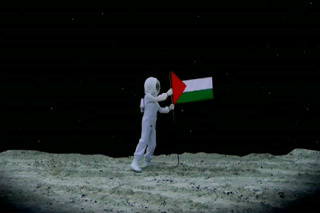
towards the far away earth, having planted the Palestinian flag on the moon:
“That’s one small step for Palestinians, one giant leap for mankind”.

Devastating when one sets this gentleness by the side of what we know of the Apartheid
wall, the illegal settlements, punishment demolition of Palestinian homes &c.
(Anyone who doubts the piece’s political impact should take a look at the vile racism
of some of the comments on the YouTube posting of this clip
– “Send all the Palestinians to the moon” &c.)

The other piece featured here is from the Gazan twins Ahmed and Mohamed Abu Nasser,
known professionally as “Tarzan and Arab”.
Although (in a disarming interview in which they come across a bit like a smiley
and un-terminally-corroded-by-snotty-cynicism younger version of the Chapmans)
they assert the piece is in some sense about internecine Palestinian conflict,
to me it reads more like a balletic paean of love to the cinema, to the
moving image (including perhaps the video game too – what do you think?).
Until last year Tarzan and Arab had never been to a cinema and have largely
been unable to attend screenings of their own works abroad.
In fact their first works, also shown at Cornerhouse, were old style film posters
for non-existent movies
, all given titles from the names of Israeli military
operations: Defensive Shield, Cast Lead &c.(as, indeed, their film has too).

There is a great deal more to this show, which covers diverse geographical slices
of the Arabic speaking world and where therefore the interaction between life
and art has a different tempo and character to the works by the Palestinian
artists discussed here.

And it’s all great – I don’t have space here to properly do the whole thing justice.
In particular, though, I do want to mention Akram Zaatari’s two luminously beautiful
films set in the milieu of gay life in Beirut – though again to outline them thus,
in one line, in terms of “topic”, is to oversimplify – we must distinguish between
ostensible topics and the dense, lyric and dazzling poetry which they engender.
Also Khaled Hafez’s wonderful short “On Presidents and Superheroes”
(yet another political context, that of a staggeringly prescient augury of a victorious
but still contested Egyptian revolution) but I simply am going to just mention it as I
hope to write something a little bit more extended about it when I post a clip here (soon!).

If you possibly can, do yourself a big favour and go and see this show; give
yourself plenty of time, there’s a lot to see and some of the moving image work
is quite lengthy (and hats off to Omar Kholeif for achieving installations of
works that are appropriate, thought provoking and, somewhat banally but importantly at my age, comfortable.)
If you’re travelling from out of town (and I urge you so to do, dear reader, I urge you)
you can also catch the tremendous Roger Ballen show at the Manchester Art gallery,
which is a whole other story.

I’ll be returning to Subversion both here and in a somewhat more extended piece
of writing for MIRAJ next year.

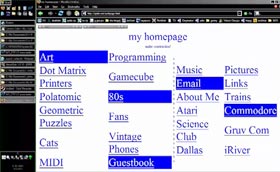
Paul Slocum – Time Lapse Homepage

tlh_web
Time Lapse Homepage (2003, 18.4 MB, 55 sec.)

Paul Slocum‘s Time-Lapse Homepage (2003) signifies through accretion.
This high-definition video is composed of 1,000 computer screenshots
of his homepage. Complete with an upbeat score that could easily be
a corporate jingle to promote a new technology, the stills display the
building, erosion, and occasional complete overhaul of an ever-evolving
Web site. This work provides a layered historical record of something
we tend to see only in discrete units-the appearance of a homepage on
any given day-while attempting to think through Web design in the
language of earlier time-based media.’

‘Want’ by MTAA & RSG

want
Want (clip) (2008, 74 MB, 2 min.)

Want was a new multiple channel algorithmic video installation as part of the exhibition
‘Live’ at the Beall Center for Art & Technology.
The life-sized six-screen video display uses custom software to monitor real time
Internet searches. When the software finds a programmed keyword, it triggers a
video clip of one of several actors/avatars who translates the virtual request to reality.

A soccer mom says,’I want French.’
A rocker dude says, ‘I want Star Trek Enterprise.’
A nondescript middle-aged guy says, ‘I want Little Girl.’
A girl says, ‘I want Forever.’

The six video screens are triggered almost concurrently, causing the voiced requests
to overlap. The result is an audio-visual cacophony of desire; an online echo chamber
of warped reality.

By MTAA and RSG.

Annie Abrahams –Training for a Better World

angry women left
Angry Women (Left Panel/Clip) (2011, 188MB, 6:23 min)
angry women left
Angry Women (Right Panel/Clip) (2011, 142MB, 6:33 min)

Here are a couple of extracts by Annie Abrahams, whose work we love here at DVblog, from her show Training For a Better World which is currently running at the Centre Régional d’Art Contemporain, Languedoc-Roussillon in Sète until the first of January 2012.
I’d seriously suggest that anyone physically able to do so should visit it – I travelled down from London in a day, stayed a night and then trekked back, all by train. Very pleasant it was too.

Abraham’s exhibition runs in tandem with another, of the works of French artist Catherine Gfeller; Gfeller on the ground floor and Abrahams on the first, and the formal similarities (though I think these are largely superficial, for reasons I’ll enlarge upon soon) – the use of both moving and still images, text, an intervention at some level in the mechanics , the whys and wherefores, of how one presents these as art in a gallery setting – make it a stimulating pairing.

Abraham’s selection includes four pieces which are essentially (with some qualifications) video. They are constructed out of the telematics performance territory that she has so signally staked out in the last few years but, she insists, are not documentations of those performances. I think she’s right to emphasise this distinction – although in one sense the pieces clearly do document things that happened in performance they are ultimately video pieces made performatively .

The show doesn’t consist of moving image work only. There are some prints, drawings and a minimalist installation consisting of a single photograph of a pair of married fire-fighters and a sound track of them reading (in an extraordinarily graceful and musical edit [and this is where in this piece any surface similarities to, say, Nauman find their limit. Grace. Grace and elegance throughout.]) a collaborative text on fear.

The moving image and the other pieces occupy different ends of what is mostly a long thin exhibition space and are connected –“tied” together by a “ribbon”- a very long, three or four inch high, strip, of black highlighted, collaboratively generated white text –on the theme of madness – running at floor level for some considerable distance.

It’s important to both acknowledge this distinctly bi-partite character and then to immediately forget about it, so intimate is the connection between the two halves.
Despite the disparate and apparently laissez-faire methodologies used in the generation of all the work and the huge level of trust in the participants evinced by Abrahams, one’s main impression is of a body of work which forms a tight unity both stylistically and in its preoccupations. (And I’d argue that the principal pre-occupation is the question of what it means, physically, socially, psychically, to be a human being. And, further, that this high seriousness –allied to a playfulness which veers from the childishly innocent to the Rabelaisian – is what ultimately gives this work its huge authority and significance and distinguishes it in kind from the technically well executed and often engaging work on the floor below.)

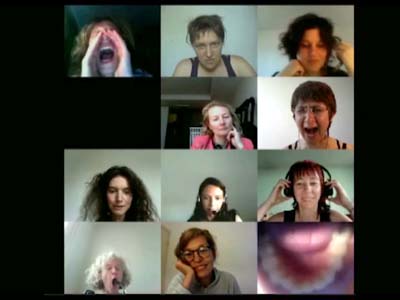
The jewel in the crown of the show is the video installation ‘Angry Women’, created by Abrahams and 22 other women of many nationalities (3 more , in fact, in total, 2 “backstage” assistants, and a performer who opted for silence throughout) speaking about, acting out, demonstrating, reflecting upon, their anger and its causes and triggers, on webcams at their different individual locations and in their native tongues, with the images being sent to a 3X4 grid, in a format that Abrahams has made her own. Because of the limits of even current streaming technology it was necessary to conduct two distinct performances, separated, in fact, by an interval of two months. The length of each was determined by a protocol where a minute’s silence by all participants signalled the end. This resulted in pieces of differing lengths the lack of synchronisation of which adds another layer of fragile grace to the final projections, projected large on adjacent walls around their common corner, with sound from the left image grid fed to the right speaker and vice versa.

The piece occupies most of a large rectangular space at the CRAC (with the video ‘Double Blind (love)’, a collaboration with Curt Cloninger we’ve savoured here before, in its performance incarnation, in the opposite corner and in its full and majestic 264 minute duration).

The impact is visceral – we face what feels like a wave of humanity, not so much in numbers, although 23 women is impressive, at least to this man, but in the infinite malleability of face and hand, of gesture and expression and of how these things might occupy a frame. Sometimes that frame will resemble a Giacometti portrait, with the subject appearing to recede into what seems to be endlessly deep space. At others red lips or an open mouth, sensual and terrifying by turns, occupy the whole of the space – and furthermore each cell is constantly in flux (because these are living, breathing, unpredictable, human beings). There’s something both of portraiture and of the dance at work here, and a kind of found poetry too (which the moving image work has in common with the collaborative texts at the other end of the exhibition). The combination of iron control, planning, foresight (the grid, the protocols) with the letting go and trust evident elsewhere – the phased lengths, the blank space for the person who didn’t turn up, the open performative structure – makes for something of great richness.
Additionally it’s clear that those performers who had previous experience of the format were consciously playing with and against their fellows – gestures are mirrored, sounds echoed, the fiction of looking elsewhere – to the side, or above – of making contact in and across the grid itself, is impressively sustained.

The angry women turn out to be at one and the same time very particular – unique – women and women in general too; the women in general turn out to be human beings in general (and general en masse because each so particular) and the human beings in general turn out to live here, or there, now, in this, one, our only, very particular, world – that mysterious, frightening and wonderful place.

Book your train/plane ticket now!

***

Voici quelques extraits par Annie Abrahams, dont nous aimons le travail ici à DVblog, de son exposition Training For a Better World qui se déroule actuellement au Centre Régional d’Art Contemporain, Languedoc-Roussillon à Sète jusqu’au premier janvier 2012.
Je suggère sérieusement de la visiter à quiconque qui est effectivement en mesure d’y aller – j’ai voyagé depuis Londres en une seule journée, je suis resté une nuit et j’ai fait le retour le lendemain, le tout par train. C’était très agréable.

L’exposition d’Abrahams fonctionne en tandem avec une autre, des œuvres de l’artiste française Catherine Gfeller; Gfeller au rez de chaussée et Abrahams au premier étage, et les similitudes formelles (bien que je pense qu’elles soient essentiellement superficiels, pour des raisons sur lesquelles je vais m’étendre bientôt) – l’utilisation à la fois de l’image fixe et de l’image en mouvement, du texte, l’intervention à un certain niveau dans la mécanique, les tenants et aboutissants, de la façon dont on présente celles ci en tant que de l’art dans le contexte d’une galerie – en font un jumelage stimulant.

La sélection d’Abrahams comprend quatre pièces qui sont essentiellement (avec certaines réserves) vidéo. Elles sont construites à partir du territoire de la performance télématique qu’elle a jalonné si singulièrement les dernières années, mais, elle insiste, ce ne sont pas des documentations de ces performances. Je pense qu’elle a raison de souligner cette distinction – bien que dans un sens les pièces documentent bel et bien ce qui est arrivé dans la performance, elles sont finalement des pièces vidéo réalisées performativement.

L’exposition ne consiste pas seulement d’images en mouvement. Il y a quelques imprimées, des dessins et une installation minimaliste composé d’une seule photo d’un couple de pompiers mariés et une piste sonore d’eux lisant (dans un montage extrêmement gracieuse et musicale [et c’est là que dans cette pièce toute similitude de surface à, disons, Nauman trouve son limite. Grace. Grâce et de l’élégance tout au long.]) un texte collaborative sur la peur.

L’image en mouvement et les autres pièces occupent des extrémités différents de ce qui est surtout un espace d’exposition longue et mince et sont reliés – “liées” par un “ruban” – une très longue, trois ou quatre pouces de haut, bande, de texte blanc, généré en collaboration, souligné en noir – sur le thème de la folie – se déroulant au niveau du sol sur une distance considérable.

Il est important de reconnaître ce caractère nettement bi-partite et ensuite de l’oublier immédiatement, tellement intime est la connexion entre les deux moitiés.
Malgré les méthodologies disparates et apparemment laissez-faire utilisées dans la production de tout le travail et l’énorme niveau de confiance aux participants manifesté par Abrahams, la principale impression est celle d’un corps de travail qui forme une unité serrée à la fois stylistique et dans ses préoccupations. (Et je dirais que la principale préoccupation est la question de ce qu’il signifie, physiquement, socialement, psychologiquement, d’être un être humain. Et, puis, que cette haute degré de sérieux, allié à un enjouement qui vire de l’innocence enfantine au rabelaisien – est, ce qui donne finalement ce travail son énorme autorité et importance et le distingue de sa nature du travail techniquement bien exécuté et souvent engageant de l’étage en dessous).

Le joyau de la couronne de l’exposition est l’installation vidéo «Angry Women», créé par Abrahams et 22 autres femmes de plusieurs nationalités, (en fait, 3 de plus au total, 2 assistantes de “secours”, et une performeuse qui a choisi de rester silencieuse jusqu’à la fin), parlant, actant, démontrant, réfléchissant à, leur colère et ses causes et déclencheurs, devant des webcams dans leurs locations individuellement différentes et dans leur langue maternelle, avec les images envoyées à une grille de 3X4, dans un format que Abrahams a fait le sien. En raison des limites des technologies de streaming, mêmes actuelles, il était nécessaire d’effectuer deux performances distinctes, en fait séparées par une période de deux mois. La longueur de chaque performance a été déterminé par un protocole où une minute de silence par toutes les participantes marquait la fin. Il en résulte des pièces de longueurs différentes dont le manque de synchronisation ajoute une autre couche de grâce fragile aux projections finales, projetées en grand sur des murs adjacents autour de leur coin commun, avec le son de l’ image grillée de gauche envoyé au haut-parleur droit et vice versa.

La pièce occupe la majeure partie d’un grand espace rectangulaire au CRAC (avec la vidéo «Double Blind (love)», une collaboration avec Curt Cloninger que nous avons savouré ici avant dans son incarnation performative, dans le coin opposé, dans sa durée totale et majestueuse de 264 minutes).

L’effet est viscérale – nous faisons face à ce qui ressemble à une vague de humanité, non pas tant en nombre, bien que 23 femmes est impressionnant, au moins à cet homme, mais dans l’incessante malléabilité du visage et des mains, du geste et de l’expression et de la façon dont ces choses peuvent occuper un cadre. Parfois, ce cadre ressemble à un portrait de Giacometti, avec le sujet apparaissant reculer dans ce qui semble être un espace profond infini. À d’autres moments, des lèvres rouges ou une bouche ouverte, sensuel et terrifiant à tour de rôle, occupent la totalité de l’espace – et en plus chaque cellule est constamment en mouvement (parce que ce sont des êtres humains vivantes, respirantes, imprévisibles). Il y a quelque chose à la fois du portrait et de la danse à l’œuvre ici, et aussi une sorte de poésie trouvée (ce que le travail d’image en mouvement a en commun avec les textes collaboratives à l’autre bout de l’exposition). La combinaison du contrôle de fer, de la planification, de la prévision (la grille, les protocoles) avec le laisser-aller et la confiance manifeste ailleurs – les longueurs phasées, l’espace noir pour la personne qui ne se présente pas, la structure performative ouverte – produit quelque chose d’une grande richesse.
En outre, il est clair que ces artistes qui ont eu une expérience antérieure du format ont joué sciemment avec et contre leurs partenaires – les gestes sont mises en miroir, des sons font écho, la fiction de regarder ailleurs – sur le côté ou au-dessus – la prise de contact dans et à travers la grille lui-même, est impressionnant et soutenue.

Les femmes en colère se révèlent être tout à la fois des femmes très particulier – unique – et des femmes en général aussi ; les femmes en général se révèlent être des êtres humains en général (et en général en masse parce que chacune si particulière) et les êtres humains en général s’avèrent vivre ici, ou là, maintenant, dans ce, un, notre seul, très particulier monde – cet endroit mystérieux, effrayant et merveilleux.

Réservez votre train / avion billet dès maintenant!
One Minute Movies and MIRAJ

indian_movie.jpg
Indian Movie [Declan Kilfeather] (2007, 3MB, 55 sec)

punch.jpg
Punch [Kerry Baldry] (1994, 30MB, 1:14 min)

landgauge.jpg
Land Gauge [Steven Ball] (1981/2008, 44MB, 1:21 min)

upside_down_world.jpg
Upside Down World [Marty St.James] (2008, 19MB, 1:25 min)

A dual purpose for this post.
I wrote a review of Vols. 1 to 4 of Kerry Baldry’s excellent One Minutes
project for a new journal, the Moving Image Review and Journal, due out soonish
(although the first issue is dated January 2012, I understand it’ll be out late this month)
and I thought it would be nice to post the pieces I discuss in it here.
So, here, with one exception, they are.
The second thing follows – just to encourage you, especially if you
are in Academia somewhere, to get a sub to this (or order it from your
library &c) – it’s going to be an interesting and useful resource.

The Cinema Effect: Realisms at Caixa Forum Madrid, Spain

cinema_effect_caixaforum
The Cinema Effect (2011, 44 MB, 5:28 min)

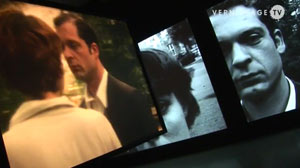
An exhibition that reflects on the influence and impact of cinema in constructing
our visual culture, highlighting how cinematographic language has taken on various
artistic forms including video and installation art. The show features work by Julian Rosefeldt,
Isaac Julien, Runa Islam, Kerry Tribe, Paul Chan, Omer Fast, Mungo Thomson and Ian Charlesworth.

The show has been curated by Kerry Brougher, Anne Ellegood, Kelly Gordon, and Kristen Hileman.
from VernissageTV.

Cory Arcangel – Phasing Dancing Stand Sculptures

modified_dancing_stands
Phasing Dancing Stand Sculptures (2010, 30 MB, 3:09 min)

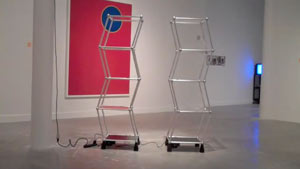
“Sculpture made from 2 over the counter “Dancing Stands” (the tacky kinetic product
display stands you can often see in down market stores) which have been modified to
spin at slightly different speeds. When these modified stands are placed next to each
other they go in and out of phase about every 4 minutes. I first showed a version of
these sculptures in my show “Creative Pursuits” at the University of Michigan Museum
of Art. This is a video of a version of these sculptures in action at my show The Sharper
Image
at the Museum of Contemporary Art Miami (the music is Dj Icey, a nod to Miami)”
By Cory Arcangel.

Wikipedia Art in London

intro.jpg
Wikipedia Art Intro (2011, 114MB, 2:29 min)

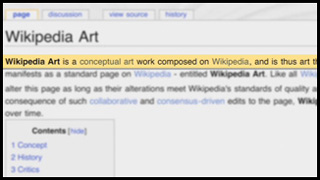
And, appropriately following on from yesterday’s post, a little intro
to the splendid Kildall/Stern Wikipedia Art project which is showing, as part
of a two person show at London’s Furtherfield gallery (formerly HTTP)
from this Friday.
(One individual piece by each artist too – promises to be a real treat)

Private view tonight 6:30 (Thurs.) – all welcome, maybe see you there.

This piece narrated in Stern’s breathless-puppy-dog-with-an-off-the-dial-IQ
trademark delivery with reassuringly measured interventions by the
no less smart & talented Kildall.

Edit by Foster Stilp, plus suitably keyed up and excited music by Stilp and
Kevin McGillivray, who together trade as Felixsofia

Talking About DVblog

evg_dvblog_talk.jpg
Electronic Village Galleries Talk 6th May 2011 (2011, 164MB, 32:14 min)

Gosh -where to start?
Awhile back we were approached to assemble a selection of
work from DVblog for screening at a gallery in the UK.
This reel then took on a bit of a life of its own, showing
at the museum of club culture in Hull, UK and at the Buffalo Literary Center, New York.
(of course ‘a life of its own’ is completely unfair – it got shown because real
human beings –Kerry Baldry and Martha Deed respectively – put work into making it happen.)
Then Kate Southworth, who is running a brilliant pilot project
involving showing digital work in village halls in Cornwall, in the extreme
south-west of the UK, asked if I’d be interested in curating something
and the reel immediately sprang to mind..

To cut a long story short it was shown at the second EVG event at
Zennor village hall on 7th May and I went down to talk (at some
length,
I notice with a certain degree of horror)
about digital video on the net, DVblog in particular and about the
artists involved in this selection.
Here, for better or for worse, is my talk, filmed, heroically, given my
restless delivery style, by Delpha Hudson.
If you’d like to reconstruct the programme for yourself it’s below, with links to
the original DVblog posts.

And if you’d be interested in screening it, please get in touch!
(We also have a reel of silent work which has been screened with
musical accompaniment and is available for more such outings.)

JimPunk, 2010: T

Cory Arcangel – UMMA Projects: Creative Pursuits

creative_pursuits
Creative Pursuits (2010, 12 MB, 1:03 min)

Images from Cory Arcangel show – Creative Pursuits at
the University of Michigan Museum of Art.

Sigmar Polke

sigmar_polke
Sigmar Polke Exhibition (2011, 48MB, 6:20 min.)

From VernissageTV.

Interview with Ubermorgen.com at DAM Gallery Berlin

interview_ubemorgen
Interview with Ubermorgen (2011, 41 MB, 6:51 min)

In Berlin, DAM Gallery presented two projects by the artist duo Ubermorgen.com.
The show featured a temporary WOPPOW flagship store featuring fashion with bullet
holes as trademarks and the Deephorizon project that presents oil paintings that are
directly linked to the BP oil spill. On the occasion of the opening of the exhibition,
VernissageTV met with ubermorgen.com

Nam June Paik: Venus / Art Cologne 2009

namjunepaik_venus
Nam June Paik: Venus (2009, 62 MB, 5:28 min)

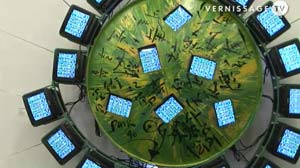
At Art Cologne 2009 Hans Mayer Gallery showed a piece by Nam June Paik,
a painted aluminium infrastructure with a multi painted satellite dish,
24 color TV sets and laser disc player. In this video, Hans Mayer gives us a
short introduction to the work. From VernissageTV.

Trisha Brown Interviewed

suess-map 2b
Interview with Trisha Brown (2007, 11 MB, 3:06)

Anyone in or near London should absolutely get to see the
“Laurie Anderson, Trisha Brown & Gordon Matta-Clark –
Pioneers of the Downtown Scene, New York 1970s”
show,
currently at the Barbican. It’s fantastic!
I was particularly lucky to be there when a performance of the
Trisha Brown ‘walking on walls’ piece happened (worth
ringing in advance to see what performances are on and when)
I knew it would be interesting but, somewhat to my surprise,
I was immediately & intensely emotionally engaged by it too, finding
it lump-in-the-throat-&-tear-in-the-eye moving…
Although we’re concentrating here on Trisha Brown with an interview
conducted in 2007 at the Documenta 12 event (and after you’ve
watched that, the Guardian has a nice audio slideshow about the
walking on walls piece), all three artists shine in this show.
It’s all great but particularly interesting are the rooms of drawings
related to their various performance practices.

Garrett Lynch performs Trav-erse

trav-erse_short
Trav-erse short (2011, 96 MB, 1:58 min)

This is shaping up to be Furtherfield fortnight & whyever not?
Here’s some footage I took there last Friday night, at the very entertaining
launch of the Art is Open Source/REFF – Roma Europa Fake Factory publication
& exhibition, (GO, if you’re in London) of a splendid performance by
Garrett Lynch of his Trav-erse, where he uses custom Max/MSP created software to
grab audio from an analogue world band receiver, manipulate and remix it.
I was struck both by the simplicity of the idea and the effectiveness of
its execution – a neat concept but also an excellent ear at work.
The sound from my stills cam video was unusable (shame, it sounded great
there) so in the latter section I’ve dubbed on sound from
an earlier performance of the piece in Cardiff, Wales in 2008.

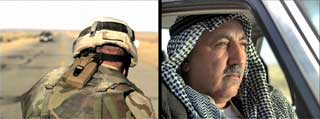
Omer Fast – The Casting

omer_fast_thecasting
Omer Fast – The Casting (2008, 38 MB, 3:29 min)

Omer Fast, discusses his 2008 Whitney Biennial work, The Casting (2007),
a four-channel video featuring a young American army sergeant who recounts
two stories

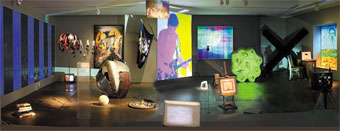
Tony Oursler – Studio: 7 Months of My Aesthetic Education (Plus Some)

met_speedup_07
7 Months of My Aesthetic Education (2005, 14 MB, 1:45 min.)

Speed up documentation from Tony Oursler‘s installation, “Studio: Seven Months of My
Aesthetic Education (Plus Some)” at the Metropolitan Museum of Art in 2005.
It combined video, sound, music and poetry to create environments that truly reflect the dissolving
boundaries of twenty-first-century culture. The work is inspired by Courbet