Ruth Catlow -Time is speeding up


Time is speeding up (2016, 11MB, 1:00 min)

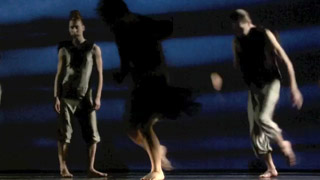
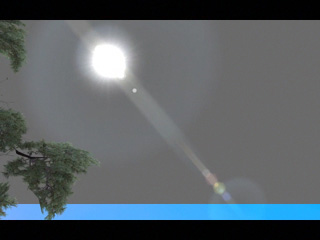
This is a beautiful piece, a distillation down to a minute of a three month installation by Ruth Catlow, artist and co-director of the marvellous Furtherfield.
She explains its premise and construction better than I can, so I’ll hand over to her:

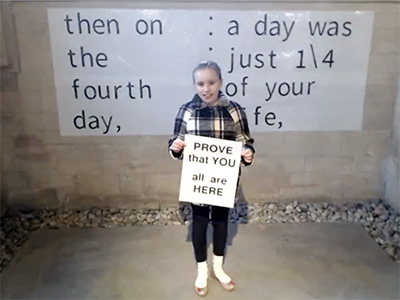
This networked video performance and installation is about how life seems to speed up as we get older; based on the reflection that when I was one day old, a day was my whole life but on the second day one day was only half my life etc.
The work was commissioned for ‘We Are Not Alone’, an exhibition for 20-21 Visual Arts Centre, Scunthorpe, UK.


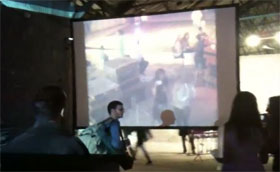
During exhibition opening hours between 23rd January -24th April 2016, viewers could watch a live looping video online. At the exhibition people could pose for the web cam, or might be caught looking at the video in which they were soon to be portrayed.
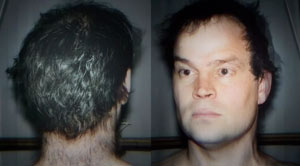
Using a computer programme called Geological Time Piece that I created with Gareth Foote a still webcam image was captured every 3-5 minutes during exhibition opening hours. The camera pointed at a wall in the gallery, upon which a changing text was displayed. The software added each image as a frame to a looping video, of fixed 3 minute duration. The frame density increased every 3 minutes, as each images was added to the video.
In the exhibition space full of movement – of light and shade and people coming and going – people could insert themselves into the video by standing between the webcam and the text. Over three months the human presences started to flicker and disappear and the moving image progressively conveyed a more geological sense of time, the arc of daylight moving through the space, the architecture, and other more static things came to dominate the image. The computer programme stopped running when the exhibition closed by which time the video contained over 3600 images. The final video runs for a minute at 60fps.

Steven Ball – Boundary Cyclone Transaction


Boundary Cyclone Transaction (2013, 233 MB, 6:46 min)

There’s an odd mixture, in varying quantities, of bone dry wit and
a strain of almost ecstatic lyricism in the work of Steven Ball.
This is combined with an interest in formal governing devices
(how much they actually govern and how much it is part of the
expressive character of the works that they should appear
to so do I don’t know)
Steven, I’m delighted to say, made this piece especially to
be unveiled here on DVblog and it was something worth waiting for.
I append some of his notes to the piece.

****************************************************************

“Lists remind us that no matter how fluidly a system may operate,
its members nevertheless remain utterly isolated, mutual aliens.
Ontographical cataloging hones a virtue: the abandonment of
anthropocentric narrative coherence in favor of worldly detail.”

“…ontography is a practice of increasing the number and density
[of things], one that sometimes opposes the minimalism of contemporary
art. Instead of removing elements to achieve the elegance of simplicity,
ontography adds (or simply leaves) elements to accomplish the realism
of multitude. It is a practice of exploding the innards of things.”
– Ian Bogost, Alien Phenomonology

Imagine this as a premiss:

the world as it appears is only as it appears to you
and perhaps
the world
actually
appears in arbitrary order

Boundary Cyclone Transaction takes Ian Bogost’s characterisation
of the ontographic list and uses it as a process by which to
auto-construct a picture of a non-human, which is perhaps to
say alien, world, or at least one such as can be constructured
using material found on or through the internet. As such it
also presents a fragment of what might be considered as th
e consciousness of the internet as manifested in image, sound and text.

The video consists of collections of image sequences, written words,
spoken words and sounds. The order in which each of those elements
presents themselves to the viewer has been determined randomly,
therefore any juxtaposition of the elements is entirely arbitrary.
The words used are nouns, i.e. they are things, objects, they
were selected using a random word generator. The sounds consist
mostly of recording of environmental phenomena, such as weather
or recordings of cosmic energies, generally speaking non-human
sounds. The image sequences are all found online and consist of
landscapes, insects, animals, images of microscopic organisms
and viruses, astronomical image, in other words also largely
non-human. Both sounds and images were found through using
keyword searches. It was important in the making of the work
for the elements to be as removed from what I might customarily
intentionally select, for them to be as far away from the
familiarity of the (my) everyday, as possible.

Alienation is a state arising from objects in the world, as they
present themselves inevitably arbitrarily and without a coherent
narrative. In this video the use of random processes aims to
make coherence impossible, or as difficult as possible, while
still, due to the linear and temporal nature of its reception,
will still self-organise into a kind of self-coherent ecosystem.
The longer term aim is for this video to be realised in performance,
to perform itself, using software to randomly order the playback
sequence of the discrete elements and media objects (images,
words, sounds) for every iteration.

Jim Punk & Antonio Mendoza – Dysleksic

dudeboat
dudeboat (2012, 2 MB, 11 secs)

misteriosoxxx
misteriosoxxx (2012, 4 MB, 41 secs)

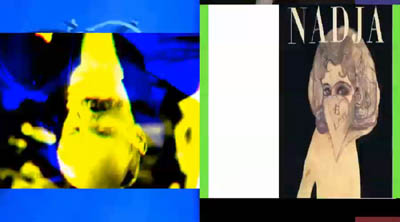
Slightly traducing the spirit of the project where
the two artists mix, hack and otherwise mutate
and abut up to 9 videos simutaneously in the same web page
as a (very welcome) online adjunct to the current Drawing Surrealism
show at LACMA, we’re featuring a couple of the component parts.
(Because we love both these artists and we want to publicise
everything they do, which is never, ever, dull.)
To view it properly go (and keep on going back) to the
project page and to learn more go here.

Gabriel Klasmer – Efes One

efesone
Efes One (2001, 71MB, 6 min.)

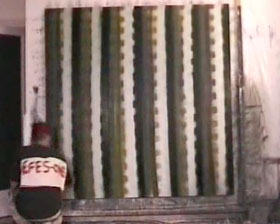
Slapstick documentation of artist Gabriel Klasmer doing
his processed abstract paintings in 2001.

Netbehaviour Mailing List Fractal Excerpt

gun_has_no_trigger
Netbehaviour Mailing List Fractal [Excerpt] (2012, 5MB, 59 secs)

From Claude Heiland-Allen:
Seven years of archives for this mailing list filtered down
to the most often occurring 1000 words of 4 letters or more,
in an infinite fractal zoom – each word is made up of the
words that most likely follow it.

We love the Netbehaviour list & this, splendid & bonkers both, does just
what it says on the tin with that excellent institution – we’ve posted
the minute long version here but if that whets your appetite for more
there’s an hour long version at archive.org.

Curt Cloninger: Again (I Wish I Was A Fool For You)

Again (I Wish I Was A Fool For You) #1
Again (I Wish I Was A Fool For You): 9:23-9:26 pm (2012, 70MB, 2:27 min)

Again (I Wish I Was A Fool For You) #3
Again (I Wish I Was A Fool For You): 10:08-10:10 pm (2012, 64MB, 2:33 min)

I love (and increasingly so) Curt Cloninger’s work.
The wonderful series of gif/flash/loop/glitch/kitchen sink audio visual poems on his site, his forays into
datamoshing and his series of live performative/endurance pieces
which, sprouting like green shoots from a rather austere central
European branch manage to be filled with light and nuance and a
-how shall I put it -… a joy which is earned, which is not trivial,
and to which we are invited and which arises out of a heightened sense
of ourselves and of others as embodied beings and of our necessary interconnections…

Here’s Curt’s account of a recent piece, a collaboration with his wife Julie,
for which we post two pieces of documentation. (I don’t know whether Curt sees
them as simply that. I think they are quite lovely in themselves – certainly the video
piece derived from Curt and Annie Abraham’s telematic collab Double Blind,
featured here previously certainly has artistic legs of its own and perhaps should
be taken as something of a precedent.)

Anyway, over to you Curt:

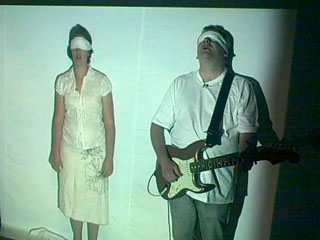
“A 3 Hour performance by Curt and Julie Cloninger. Julie is pre-recorded
on video singing for ten minutes along with Curt playing Rhodes piano.
Her video and audio are then projected and looped in the performance space
while Curt sings and plays guitar live. Both are blindfolded.
A duet across time. The repeated excerpt is from the Richard and
Linda Thompson song “For Shame of Doing Wrong.
Performed at the Black Mountain College campus during the 2012 reHappening festival“.

Christina McPhee – Shed

christina_mcPhee_shed
Shed (2011, 24 MB, 4:33 min)

Shed is a long-term video and drawing project.
Christina McPhee talks about ‘Shed’ and her work in general.
from VernissageTV.

Steven Hoskins – 15 Years

15years
15 Years (2011, 60 MB, 3:08 min)

Reverse aging transformation of a 15 year self-portrait sequence
of Dan Hanna, forming the basis for the movie “StartStop” (2009).
Edited in HD. Used is 32 channel split screen asynchrony to create the illusion of flow.
By Steven Hoskins.

Estella Cumberford – Friendsource14

Friendsource14.jpg
Friendsource14 (2011, 21MB, 1:18 min)

This piece, by Estella Cumberford, is great on a whole number of fronts.
Firstly it’s really nicely made.
The images walk that difficult line between
telling us too much and too little, and the audio
(processed, apparently, in GarageBand) is well judged,
well executed and more than a little engaging.
You wouldn’t guess from the piece’s surface simplicity
(first impressions only of course, anyway. Examine it closely
and see how hand-made and un-algorithmic it is)
the layers of structuring and processing that went into
it but I can’t help feeling these do manifest in the sense of
its coherence, richness and general success as a work of art.
The text was sourced & assembled from status updates on F******* of
14 of the artist’s friends. This then read by her & processed as noted.
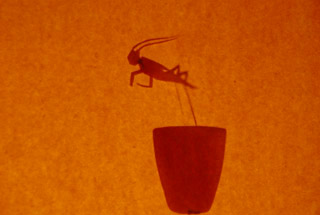
The images were then grown (organic metaphors seem somehow
particularly apposite) out of this text and rendered by a kind of
shadow screen technique.
It’s an exquisite piece of work.
Transparency dictates I tell you that I teach Estella
at Writtle. (I use the word teach loosely -as with most of
the students we have an absorbing and on-going dialogue.)
It’s work like this that makes that part of my life so rewarding.

Ruth Catlow – Landscape

love_is_a_wave.jpg
Landscape (2011, 114MB, 3:12 min)

Ravishing piece of work from my friend and colleague Ruth Catlow
who is also co-director of the indispensible Furtherfield.org

We’ve been talking a lot amongst ourselves and with our students about
continuities across art history and about hybrid techniques which
meld both the ancient and the newest.
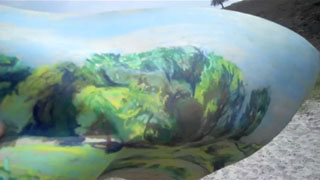
Filmed in the New Forest, this piece (apart from its great beauty)
is an exemplar of this approach and pathbreaking in its way.
(More so than much which, dull-eyed, shouts and waves the latest thing
from the rooftops.)
The oldest kind of mark making, delicately but robustly realised,
captured on a tiny portable video camera in a semi-performative
way and then networked…
Beautiful and nourishing both.

Trisha Brown Interviewed

suess-map 2b
Interview with Trisha Brown (2007, 11 MB, 3:06)

Anyone in or near London should absolutely get to see the
“Laurie Anderson, Trisha Brown & Gordon Matta-Clark –
Pioneers of the Downtown Scene, New York 1970s”
show,
currently at the Barbican. It’s fantastic!
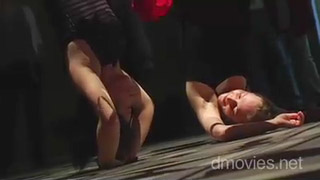
I was particularly lucky to be there when a performance of the
Trisha Brown ‘walking on walls’ piece happened (worth
ringing in advance to see what performances are on and when)
I knew it would be interesting but, somewhat to my surprise,
I was immediately & intensely emotionally engaged by it too, finding
it lump-in-the-throat-&-tear-in-the-eye moving…
Although we’re concentrating here on Trisha Brown with an interview
conducted in 2007 at the Documenta 12 event (and after you’ve
watched that, the Guardian has a nice audio slideshow about the
walking on walls piece), all three artists shine in this show.
It’s all great but particularly interesting are the rooms of drawings
related to their various performance practices.

Eleanor Suess – Map 2b

suess-map 2b
Map 2b (1996, 33 MB, 1:29min)

We’ve got hold of a few movies spanning nearly 15 years from
Eleanor Suess who has staked out a very interesting position on the
borders of architecture and fine art (and specifically film/video art).
We’ll start with an early, and rather ravishing, handmade piece:

“Using a 16mm handmade film technique a DOLA/OS map of Perth
is transformed into a spatial surface. The territory of the drawing
is explored and navigated, the gridlines dominating the optical
soundtrack, marking the speed of the film as it passes in front
of the viewer

Steven Ball – Aroundabout: Second Person Present

aroundabout
Aroundabout: Second Person Present (2011, 117MB, 4 min, silent)

Extracted from a longer work made for Steven Ball’s
Aroundabout blog


“I also showed it as part of a presentation of material from
Aroundabout I did at City Methodologies at the Slade,
where it was displayed looped continuously on a flat
screen monitor face up on the floor, while I ‘performed’
the blog with Powerpoint!”

Some of these expanded cinema folk do relish a challenge!

Even truncated & divorced from its performative context it stands
as a splendid bit of structural/formalist film/vid poetry.

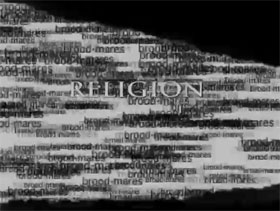
Omer Golan – Religion

omer_golan_religion
Religion (2010, 8 MB, 1:28 min.)

“‘Religion’ is based on a language text corpus containing about 140,000 words.
With Cycling74’s Max/Msp/Jitter, I created a virtual canvas for my video that is
covered with random text from the corpus. Then used this canvas to mask a clip
of animation that I’ve prepared for that purpose, allowing only text to appear where
pixels in the original animation were moving. My goal was to give the entire clip
random text textures that are aesthetic, recognizable and unreadable.”
By Omer Golan. Sound collage: Itamar Kav Tal.

Oliver Laric – 2010 Clip Arts

mathematics
2010 Clip Arts (2010, 20MB, 3:21 min)

Stunningly executed, but, for me at least, somewhat vacuous
sequel to his 787 Clip Arts of 2006.
From oliverlaric.com

Omer Golan – Non-Linear Creation

non_linear
Non-Linear Creation (2010, 58 MB, 3:16 min.)

Installation at ‘Fresh Paint 3‘ in Old Jaffa Port, Israel. the project is based on a live
camera input where the video camera is mounted above a the projection screen.
“The thought behind “Non-Linear Creation” is to think about video as some sort
of a “streaming deck of cards” which I shuffled again and again in real time using
Cycling74’s Max. I collected in a memory buffer the latest 60 cards/video frames,
shuffled them and played the outcome in 30 frames per second. The result is a video in
which the viewer is in constant, unnatural, flickering present, as it is reflected in the video.”
By Omer Golan.

Nuit blanches 2010 Metz, France with DIEZ and paradigme

328074091
Nuit blanches 2010 – DIEZ and paradigme (2010, 41 MB, 1:55 min.)

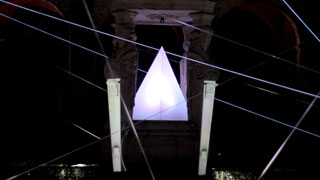
Collaboration of Video mapping, light and sound installation, done for
Nuit blanches 2010 Metz.
Audio Visual design by paradigme.
Scenography and video mapping by DIEZ.

2 More from Lumière et Son

Helicoptics Farewell
Helicoptics Farewell (2010, 16MB, 1:02 min.)

Seas of Weighing
Seas of Weighing (2010, 10MB, 1:07 min.)

Original post

Last week’s

Lumière et Son Bow Out

checkout art fairs
Checkout Art Fairs (2010, 8MB, 1:07 min.)

Blotting Paper
Blotting Paper (2010, 13MB, 1:06 min.)

I hadn’t realized that the splendid Lumière et Son project, which
we’ve raved about here before, was a time limited thing
but, sadly, yes & they’ve posted their last, which we repost here
above.
We’ve grabbed a few more, which we’ll post in the near future, but
do yourselves a favour and go & wallow in their site now…

Rick Silva – Krummholz Formation

krummholz formation
Krummholz Formation (2010, 112MB, 16:48 min)

It’s always a pleasure to post new work from Rick Silva here
and this piece is no exception.
His work has been heading somewhere strange, gripping
and utterly his own for some time now.
I find this loyalty to a very personal vision both admirable
and exemplary. I’m fascinated to see whether further development
along this path is possible or whether there will at some point be a sharp
change of direction.
(Once again with this piece I really want to see it
in a gallery -nobody is more adept or at home at work for the net than Silva
but I can’t help feeling that this work needs space and distance…)

Jasper Elings – From Xerox to Xerox

first line
From Xerox to Xerox (2010, 20MB, 8 secs)

Copy of a copy using 133 different Xerox machines…
No idea whether it’s meant to be ravishing but it is.
Ravishing. Delicate, blink-and-you-miss-it & ravishing.
From Jasper Elings.