Jack Goldstein – Metro-Goldwyn-Mayer (1975, 16.2MB, 2:10)
An endlessly cyclical Hollywood, summed up in two minutes,
over thirty years ago. Still relevant and all too real.
Jack Goldstein – Metro-Goldwyn-Mayer (1975, 16.2MB, 2:10)
An endlessly cyclical Hollywood, summed up in two minutes,
over thirty years ago. Still relevant and all too real.
Film Portrait (1972, 31MB, 11:45 min.)
La Cartomancienne (1932, 13MB, 12 min.)
This is a memoir and the last film made by artist and filmmaker Jerome Hill.
I also found ‘La Cartomancienne’, one of his earliest film experiments.
By Mica

Martha Rosler – Semiotics of a Kitchen (1975, 18.3MB, 6:29)
An A-Z look at the tools of a kitchen, of domesticity,
of the self in the midst of frustrated ennui.
Historically significant feminist performance art that reminds us,
“When the woman speaks, she names her own oppression.”
Rosler is one of my favorites.

Abbie Making Gefilte Fish (1973, 156.4MB, 21:04)
Footage of Abbie Hoffman making gefilte fish with Laura Cavestani
(who made the video) in his kitchen, 1973.
Like Abbie, I think art is in the everyday, and it sure is a fun
(and rather informative) twenty minutes if you’ve got it to spare.
Art for Abbie was education, constant revolution, evolution, and living for free.
Art and freedom were one in the same, inextricable from each other.
We miss you man.
‘White Flood’ – clip 1 (1940-2, 1.1 MB, 30 sec.)
‘A Child Went Forth’ – clip (1940-2, 1.4 MB, 30 sec.)
‘White Flood’ – clip 2 (1940-2, 661 KB, 29 sec.)
Easily the most interesting of all Brecht’s composer collaborators
& in flat contradiction to the current myth spread by those
who dislike his politics, by far the better composer than the rather
dull Weill, Hanns Eisler’s keen intellect turned to questions of film in his
exile in the USA in the early forties.
Under the auspices of the New School & funded by the Rockefeller foundation
Eisler conducted an intensive investigation of the relationship between
film & music , often involving him writing new music to already existing footage.
You can see some of this footage here – but what you really need to do is to listen.
There is no-one who could not learn something from the amazing way Eisler
deploys music here.
After the project, Eisler went on to write, with Theodore Adorno,
himself no slouch intellectually (& also a practicing composer),
one of the key books on music & the movies –‘Composing for the Films’
These clips come from the website for a new edition of the book
released with a companion DVD documenting much of the Rockefeller experimentation.
Indispensable.
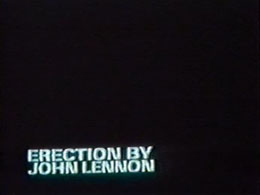
Erection (1971, 180MB, 18:06 min.)
A nineteen-minute film by John and Yoko, which was made in London during
1970 and 1971. When John had heard that the London International Hotel was
to be built in Kensington, he sought permission to film its entire construction.
Once he’d obtained it he contacted the photographer Iain MacMillan and asked
him to take a series of photographs of the construction. MacMillan had a stills
camera and filmed the erection of the hotel from a fixed position for a period
of eighteen months.
The stills were presented in sequence in the film, which ended with a shot of the
completed hotel where all the lights were then turned off, leaving a black screen.
On the soundtrack Yoko sang two songs, ‘Airmale’ and ‘You’, using tapes of recordings
of Joe Jones Tone Deaf Music Co., which was, in fact, a number of toy percussion
instruments that played themselves, a squeaky style of sound devised by a former
associate of Yoke’s Fluxus days, Joe Jones. The hotel was situated at 147 Cromwell
Road and later became the London Swallow Hotel.
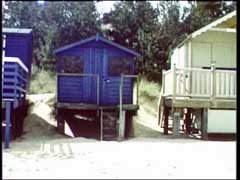
British Beach Hut Miscellany(2006, 5.2MB, 1:36 min)
Made by Giles Perkins. Shot on Super 8 & digitally edited.
English pastoral loveliness with a conceptual/formalist twist,
which resolves to… English pastoral loveliness.
Lovely!

Occupy DC Interviews 10/10/2011 (2011, 73MB, 58 sec)
Demonstrating what we all might have said rhetorically, but really demonstrating it –
that a smart seven year old (with a little tech help from her parents)
can do a better job than any of the official media, Celia Cooley interviews
Occupy DC participants in a piece that both delights and makes one fiercely
proud to be one of the 99%.
Great job.
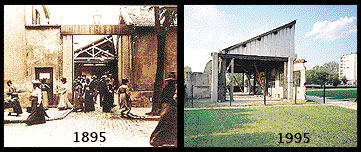
La sortie des ouvriers de l’usine Lumière à Lyon (1895, 2MB, 46 sec.)
The year is 1895. The “Hangar” was the first set in the history of Cinematography and
can be seen here in “La Sortie de l’usine Lumière”, Lumière’s first film.
from the fantastic site – Institut Lumière.
Joan Brossa, the Catalan poet, artist, performer and polymath,
who died in 1998, deserves to be more widely
known in the rest of the world.
I’ve often thought his work, in particular the visual
poems, prefigured much of the art of the early days
of the net (but mostly better: terser, wittier, riskier –
I think Brossa would have loved the net).
This elegant & delightful performance ( ‘Fi’ is Catalan
for ‘End’, in this context The End) was recorded
in Barcelona eight months before his death.
It requires a little patience; the reward being that
it can be viewed many more than one time, so it
seems like an appropriate thing to leave you with
over the summer.
Remember we’re always delighted to look at new work,
so if you’re making moving image yourself,
or you happen across great stuff don’t hesitate
to send us links.
We’re back on Monday, September the 26th – in
the meantime we wish you all a happy and relaxing summer.
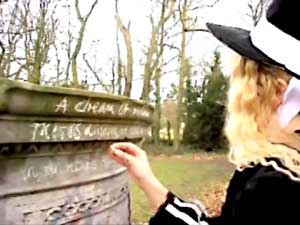
A Walk with Jane Austen (1999, 144MB, 12:20 min)
‘the work is about exploring the veracity of history and of time,
and its constructs (in this case especially the notion of
“bodice-ripping” romance genres).
Playing with text and in-authenticity, the intention was to engage
an audience with notions of historical construction of women;
their facts and fictions, and the possibility of re-visioning histories.
– Delpha Hudson
Engaging hybrid of site specific performance and movie making,
the somewhat improvisatory quality lending it all a pleasantly
languid & unhurried air.
At the very end the sun joins in to striking effect & I love the rogue
arm at our right as the spectators leave.
Hudson is a charismatic & commanding performer –
we’ll have another of her performance pieces here in the Autumn.
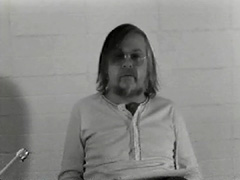
Baldessari Sings LeWitt (excerpt) (1972, 30.5MB, 3:38 min)
In which John Baldessari sings Sol LeWitt’s
sentences on conceptual art.
From the indispensible Ubuweb.
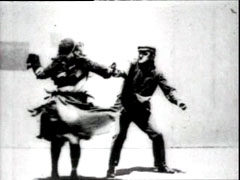
A Tough Dance (1902, 7.1MB, 47 sec.)
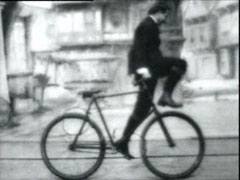
Bicycle Trick Riding (1899, 5.5MB, 37 sec.)
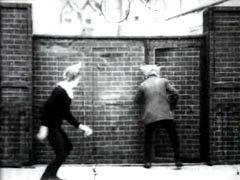
Three Acrobats (1899, 5.4MB, 36 sec.)
Three exhilarating chunks of early movie making from the
Library of Congress online collection of variety stage motion pictures.
I particularly love the deeply strange A ‘Tough’ Dance.
There’s also a great early animation collection on the LOC site.
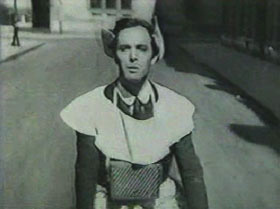
Un chien andalou (1929, 156MB, 15:40 min.)
This is just the source.
Can you imagine Cocteau, Deren, later Hitchcock & Cronenberg
without this?
Oh..more:- the whole of cinema would have a great gaping bloody gap
in it & what was left would be dull dull dull & Black Francis wouldn’t have been
able to write ‘Debaser’.
It simply prised open the language.
Afterwards, Bunuel went on to make some of the sharpest, most provocative
& disturbing films of the 20th century & Dali went on to
…well… be Dali.
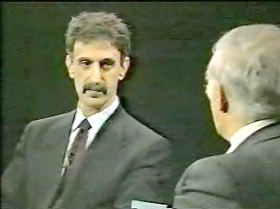
Frank Zappa on Crossfire (1986, 49MB, 21:17 min)
from – del.icio.us
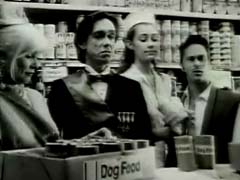
Well Did You Evah? (1990, 14.2MB, 3:45 min)
Staying with Monday’s Iggy Pop theme, maybe you’re all
totally familiar with this but I never saw
it before & I think it is great .
Here he duets with Debbie Harry on the
Cole Porter song Well Did You Evah? as part of an
AIDS fundraiser from 1990.
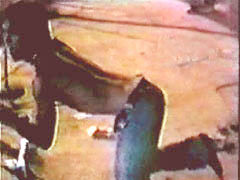
Iggy, Cincinnati, 1970 (1970, 28.7MB, 5:05 min.)
Layer upon layer of skin-tingling wonder & bizarreness
(is that a word?) from Iggy & the Stooges in 1970,
long before he discovered car insurance.
It doesn’t get any better than this.
From the excellent WFMU’s Beware of the Blog.

Gavito & Plazaola (n/k, 13.5MB, 3:44 min.)
‘The secret of tango is in this moment of improvisation that
happens between step and step. It is to make the impossible thing
possible: to dance silence. This is essential to learn in tangodance,
the real dance, that of the silence, of following the melody.’
– Carlos Gavito
Watch the late Carlos Gavito & his partner Maria Plazaola
play havoc with the space time continuum in this extraordinary
piece in which time slows down, speeds up & actually comes to a
halt at least once.
Mesmerizing.
[ Found on this very strange tango site with lots more videos]
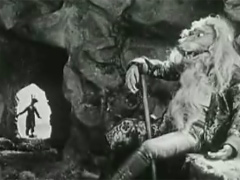
Le Lion Devenu Vieux (1932, 3.5MB, 1:04 sec.)
Ladislas Starewitch is often credited with inventing stop motion animation
as we know it, though so are several other people. It depends on what fits
into your definition of stop motion.
Certainly he was probably the first to actually make little figures and move
them frame by frame in an attempt to duplicate lifelike movement of actual
living things. it was because he was filming beetles and found that the hot
lights made them lethargic, so he made his own little beetles asrealistically
as possible and animated them instead.
This gave birth to further projects with very lifelike but sometimes partially
anthropomorphic (human-like) animals.
from – Darkstrider.
By Mica. (thanks Adam)
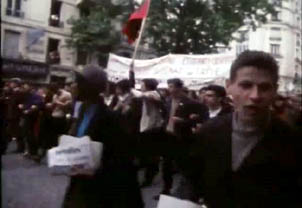
Departure (2009, 34 MB, 4:24 min)
I love this video for two, apparently almost entirely independent
(but maybe, in some strange, deep way, connected) reasons.
First – the music is great. I listen very little popular music these
days (which is why I’m 2 years late with this) as most of it, even
(especially!) the so called indie stuff gives the impression of
having been focus-grouped into bland submission before being let
limply loose not to offend anyone.
This, contrariwise, oozes life & not-giving-a-fuck from every note
(especially the splendidly slightly out of tune vocals; but it’s all a joy).
Secondly, director of the video, Kate Thomas, about whom I know
nothing and could find out no more, had the totally brilliant idea
of simply stringing together some footage of French students
and workers standing up for themselves against the riot cops in 68.
If this all doesn’t make you weep with barely suppressed joy please
check your pulse.
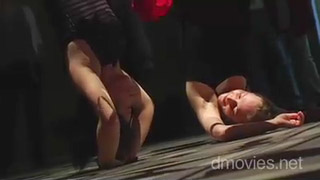
Interview with Trisha Brown (2007, 11 MB, 3:06)
Anyone in or near London should absolutely get to see the
“Laurie Anderson, Trisha Brown & Gordon Matta-Clark –
Pioneers of the Downtown Scene, New York 1970s” show,
currently at the Barbican. It’s fantastic!
I was particularly lucky to be there when a performance of the
Trisha Brown ‘walking on walls’ piece happened (worth
ringing in advance to see what performances are on and when)
I knew it would be interesting but, somewhat to my surprise,
I was immediately & intensely emotionally engaged by it too, finding
it lump-in-the-throat-&-tear-in-the-eye moving…
Although we’re concentrating here on Trisha Brown with an interview
conducted in 2007 at the Documenta 12 event (and after you’ve
watched that, the Guardian has a nice audio slideshow about the
walking on walls piece), all three artists shine in this show.
It’s all great but particularly interesting are the rooms of drawings
related to their various performance practices.
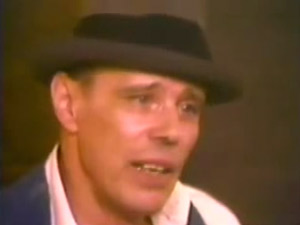
Joseph Beuys – Transformer (1979, 10 MB, 3 min)
Excerpt from a 60-minute documentary featuring avant-garde
German artist Joseph Beuys during a 1979 exhibit at the
Guggenheim Museum in New York City.
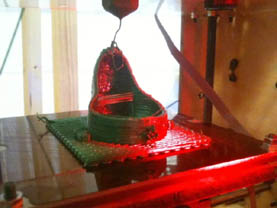
Duchamp’s Fountain (2011, 93MB, 1:59 min, silent)
Fascinating bit of footage from Kev Flanagan arising out
of a piece of work by Rob Myers (together with Curt Cloninger one
of the two smartest people I know) –here’s the original post
from his blog to give some context.
The whole thing sparked an interesting discussion on the Furtherfield
(see Monday’s post) originated Netbehaviour list this week.
Samuel Beckett‘s only venture into the medium of cinema, Film was written
in 1963 and filmed in New York in the summer of 1964, directed by
Alan Schneider and featuring Buster Keaton. For the shooting Mr.
Beckett made his only trip to America. The film, which has no dialogue,
takes its basis Berkeley’s notion esse est percepti that is, to be is to be perceived.
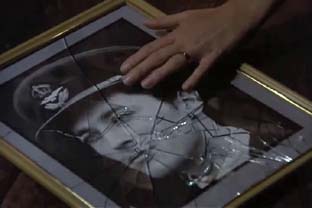
Touch Me (2011, 562KB , 2:00 min)
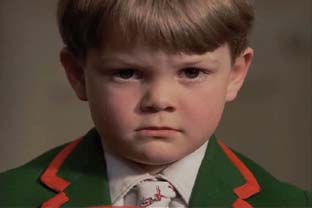
Hear Me (2011, 12MB, 1:11 min)
Second two parts of TOM (an instrumental rock opera remix in four parts)
by Curt Cloninger, of which we posted the first two last week.
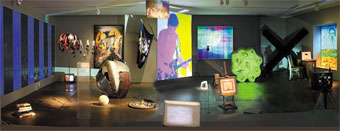
7 Months of My Aesthetic Education (2005, 14 MB, 1:45 min.)
Speed up documentation from Tony Oursler‘s installation, “Studio: Seven Months of My
Aesthetic Education (Plus Some)” at the Metropolitan Museum of Art in 2005.
It combined video, sound, music and poetry to create environments that truly reflect the dissolving
boundaries of twenty-first-century culture. The work is inspired by Courbet
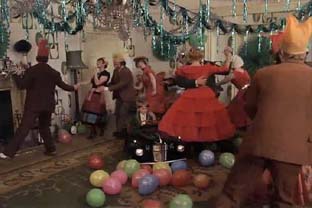
Feel Me (2011, 11MB, 1:03 min)
Two parts of a rather good new work –
TOM (an instrumental rock opera remix in four parts)
by Curt Cloninger, of whom we are fans.
He remixes the 1975 film of the Who’s rock opera Tommy to striking effect.
I can’t imagine crossing the road to see the original, even for free, but
here Curt’s sense of beauty, drama and balance – which have served him
well in a number of works and projects involving remix/appropriation, notably
his fantastic playdamage project –
redeem banality to something genuinely affecting.
More next week.
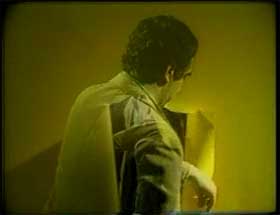
Three Transitions (1973, 7 MB, 1:32 min.)
Peter Campus presents three introspective self-portraits that incorporate his dry humor.
Campus uses basic techniques of video technology and his own image to create
succinct, almost philosophical metaphors for the psychology of the self, articulating
transformations of internal and external selves, illusion and reality.

Alice in Wonderland (1903, 136MB, 9:32)
Enthralling first ever screen version of Alice in Wonderland
from 1903, lovingly restored by the folks at the BFI.
There’s no-one –no-one – who could not learn
something about film-making from this gem.
Nine minutes of sheer, grinning-with-joy delight.
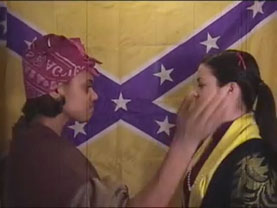
Blown Away(2003, 3MB, 52 secs)
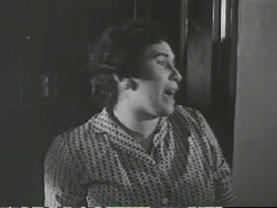
Mental Profiling (2003, 7MB, 2:15min)
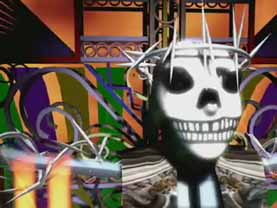
The New Saint of Louisiana (2003, 4MB, 41 secs)
Three more from Patrick Lichty.
Again- hard to believe these were made seven long digital years* ago.
Not a lot to add, except I approve his taste for Tuvan throat singing.
*Digital years a bit like dog years, of course.