Ruth Catlow -Time is speeding up


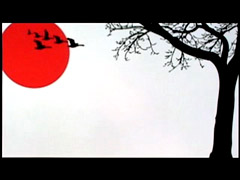
Time is speeding up (2016, 11MB, 1:00 min)

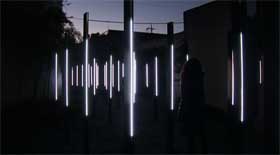
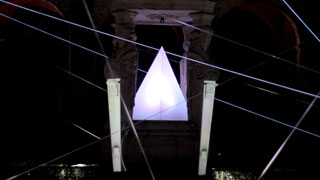
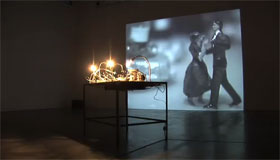
This is a beautiful piece, a distillation down to a minute of a three month installation by Ruth Catlow, artist and co-director of the marvellous Furtherfield.
She explains its premise and construction better than I can, so I’ll hand over to her:

This networked video performance and installation is about how life seems to speed up as we get older; based on the reflection that when I was one day old, a day was my whole life but on the second day one day was only half my life etc.
The work was commissioned for ‘We Are Not Alone’, an exhibition for 20-21 Visual Arts Centre, Scunthorpe, UK.


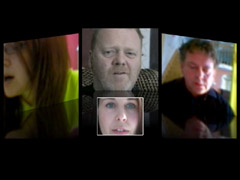
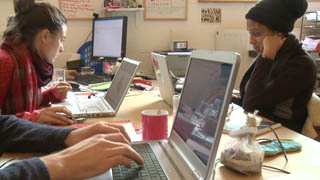
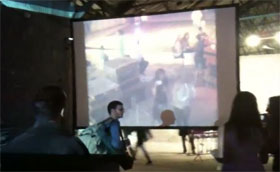
During exhibition opening hours between 23rd January -24th April 2016, viewers could watch a live looping video online. At the exhibition people could pose for the web cam, or might be caught looking at the video in which they were soon to be portrayed.
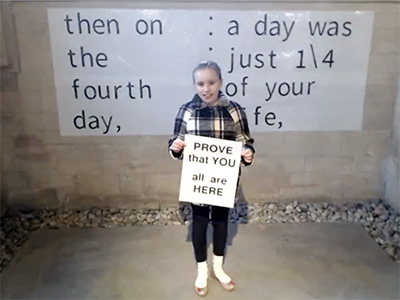
Using a computer programme called Geological Time Piece that I created with Gareth Foote a still webcam image was captured every 3-5 minutes during exhibition opening hours. The camera pointed at a wall in the gallery, upon which a changing text was displayed. The software added each image as a frame to a looping video, of fixed 3 minute duration. The frame density increased every 3 minutes, as each images was added to the video.
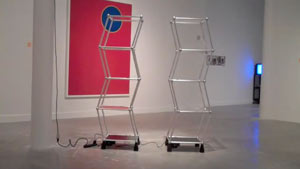
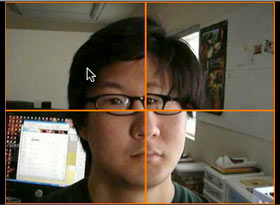
In the exhibition space full of movement – of light and shade and people coming and going – people could insert themselves into the video by standing between the webcam and the text. Over three months the human presences started to flicker and disappear and the moving image progressively conveyed a more geological sense of time, the arc of daylight moving through the space, the architecture, and other more static things came to dominate the image. The computer programme stopped running when the exhibition closed by which time the video contained over 3600 images. The final video runs for a minute at 60fps.

The Story of Stuff


The Story of Stuff (2008, 54.1MB, 21:20)

The Story of Stuff with Annie Leonard is a twenty
minute video about waste, recycling, corporations,
and sustainability. Even a radical like me finds it
occasionally heavy-handed, but then, this is serious
stuff. Nicely done, worth the twenty minutes you’d
otherwise spend watching crap TV, no?

Pieces of OiZ


Christoph Brunner – schwarzenbergplatz (2005, 9.8MB, 0:46)


Christoph Brunner – schwarzenbergplatz 2 (2005, 13.5MB, 1:03)

Orte in Zeiten is a filmmaking process conceived
by Christoph Brunner that continuously re-exposes film
to make surreal loops of space and time.
These two clips were taken during the development
of OiZ, which roughly translates to “places in time”.

Eddo Stern – Best…flame war…Ever


Eddo Stern – Best…flame war…Ever (2007, 32MB, 12:08)

Even the non-gamers (that includes me – and I think everyone
else here at DVblog) will appreciate this one from Eddo Stern.

A Map Comes to Life


Andersen M Studio – A Map Comes to Life (2006, 11.4MB, 2:20)

Incredible stop-motion animation from London’s
Andersen M Studio. Much of their video work is
in the same style, but why switch it up when
they’re so talented in this specialized way?
Inspiring and fun.

Adam Mufti – Garden Cities of the Future


Adam Mufti – Garden Cities of the Future (2008, 53MB, 7:19)

Remarkable, hypnotic work from the incredibly talented Adam Mufti.
Part meditation on modern life, part perhaps futuristic foreboding,
this piece sort of leaves me speechless, though I fear a lack of
editorializing might portray lukewarm feelings.
It’s really just that I’d rather a viewer experience this on his/her own.
I thought I’d watched a 3 minute piece – only when posting this did
I discover the actual runtime is more than double what it seems.
In this case, that’s exceptional.
The video also features the voice of London actress Juliet Rylance.
The whole thing, the composition, the editing, all of it: truly stunning,
took my breath away. Find a quiet spot and enjoy.

Lucy Mills – Sunday Afternoon Narcissism

sunday afternoon narcissism
Sunday Afternoon Narcissism (2012, 190MB, 2:46 min)

Hypnotic and disorientating chunk of enchantment from London artist
Lucy Mills.
Only one cavil and that’s the title – the self-deprecation involved might
serve to camouflage the actual richness of this piece, at least from the
casual viewer*.

Let’s be optimistic and assume careful viewing, which work of
this quality certainly merits.

* Although, on reflection, the ‘Sunday Afternoon’ also suggests a certain
dreamy languor quite in keeping with just how gently ravishing it all is.

PSST! Pass it on…


DRIFT SLICYCLE POPPED! (2007, 11MB, 1:59)


LOQUACIOUS EYESICLE WILD-BITES (2007, 14.9MB, 2:34)

PSST gets designers, animators, and directors together for
collaborative film projects every year. Their main concern
is process, which they explain comes from a fusion of the
Dadaist game Exquisite Corpse and the sometimes childhood
game, Telephone.
Whatever their theory, their annual collections are stellar.

3 from Alan Sondheim

me.jpg
me (2008, 12MB, 1:06 min loop)

slbarrier.jpg
slbarrier (2008, 33.1 MB, 4:32 min.)

elo1.jpg
elo1 (2008, 46.3 MB, 5:26 min.)

Three from 2008. As always, utterly watchable and quite unparallelled.
PS I’m going to post beneath a text piece by Sondheim from around the
time the movies were made, not because it has any direct
relevance to them (though of course it has relevance)
but because it’s great & a further demonstration, if such were required,
of his range of technique and vision…

she can MOVE FRUIT FROM ONE KIND OF TREE TO ANOTHER
she can MAKE OTHERS FALL ASLEEP OR WAKE AT WILL
she can MAKE FIRE BLAZE FROM WEAPONS
she can FLY THROUGH AIR
she can SEE THROUGH WALLS
she can TRANSFORM A CAVE INTO A PALACE AND SEAL THE EXITS
she can REMOVE THE TUSKS AND TRUNK FROM AN ELEPHANT AND RESTORE THEM
she can MAKE A KING SPEECHLESS AND RESTORE HIS SPEECH
she can GENERATE DEMONS AND COMPLETE DEMONS
she can END DROUGHT AND HEAL ILLNESS
she can SUBDUE LIONS AND TIGERS AND BRING THEM TO FAITH
she can REMOVE ARMS AND LEGS FROM SOLDIERS AND RESTORE THEM
she knows ALL LANGUAGES AND ALL DOCTRINES
she can EAT ENDLESSLY AND DRY UP WELL SPRINGS AND RESTORE THEM
she can CUT OFF HER HEAD AND FLY THROUGH THE AIR AND RESTORE IT
she can MOVE A BUFFALO AND HER CALF BACK TO THEIR HOME
she is SAFE FROM ONE HUNDRED THOUSAND BLOWS WITH CUDGEL AND ARROW
she can TURN AROUND ARROWS IN FULL FLIGHT
she can TURN INTO AN OLD WOMAN AND BACK AGAIN
she can SEE THINGS ANYWHERE IN THE WORLD
she knows ALL FUTURE AND ALL PAST EVENTS
she meditates FOR DAYS ON END WITHOUT SLEEP OR DRINK OR FOOD
she can HOLD SEVEN HUNDRED UMBRELLAS ABOVE HER WITHOUT TOUCHING THEM
she can RAISE THE DEAD AND RESTORE THEM TO DEATH
she can BE IN SEVERAL PLACES AT ONCE
she can TRAVEL INSTANTANEOUSLY FROM ONE PLACE TO ANOTHER
she can MAKE SMALL THINGS ENORMOUS AND ENORMOUS THINGS SMALL
she can MAKE DEVOTIONAL IMAGES CRUMBLE AND RESTORE THEM
she can CARRY A TEMPLE ON HER BACK
she can CLIMB ENDLESS STAIRS AND OTHERS CANNOT FOLLOW HER
she fits THOUSANDS OF PEOPLE INTO A TINY CORNER OF A CAVE OR HOUSE
she disappears AND APPEARS AT WILL
she conquers DEATH
she eats CORPSES URINE EXCREMENT SEMEN MENSTRUAL BLOOD
her slightest MOVEMENT TRANSFORMS WORLDS
her dance CREATES AND ANNIHILATES WORLD
she loosens BOUND ANIMALS AND RELEASES THEM
she can WALK ON WATER AND WALK THROUGH FLAMES
she can CAUSE THE EARTH TO QUAKE AND FLOWERS TO FALL LIKE RAIN
she can DISCOVER HIDDEN TREASURES
she can WALK THROUGH WALLS AND CLIFFS
she can SEAL CAVES AND CREATE GREAT HALLS WITHIN THEM
she can MAKE HERSELF INVISIBLE AND MAKE HERSELF VISIBLE AGAIN
she can CREATE OVERWHELMING TEMPESTS
she can SUBDUE SNAKES AND OTHER WILD ANIMALS
she can SING PERFECT SONGS OF HER OWN DEVISING
she can ALLEVIATE THE SUFFERINGS OF THE ELDERLY
she can ALLEVIATE THE SUFFERINGS OF THE POOR
she can SCORCH CLOTHES AND RESTORE THEM
she can READ MINDS CLOSE BY AND AT A DISTANCE
she can EAT ANY SORT OF IMPURITIES
she can LAUGH AN EIGHT FOLD LAUGHTER
she can DRAW STELES AND JEWELS FROM THE GROUND
she can ERECT VAST PALACES AT AN INSTANT
she extracts POISON FROM WATER AND WALKS THROUGH BLAZING FLAMES
she can CHOOSE THE DATE AND TIME OF HER DEATH
she can MAKE DRUMS AND MUSICAL INSTRUMENTS TO SOUND BY THEMSELVES
her steps MEASURE GREAT OR TINY DISTANCES AT HER WILL
her gaze CAN SHATTER AND RESTORE ANYTHING
she can TRANSFORM HERSELF INTO A SKELETON AND A RAINBOW BODY
her gaze CAN OPEN CAVES IN SOLID ROCK AND SEAL THEM AGAIN
she remembers HER PAST AND FUTURE BIRTHS
she can TARRY WITH CONSORTS WITH OR WITHOUT ELABORATION
she can SELF ILLUMINATE
she can WALK AIMLESSLY DAY AND NIGHT
she can SPREAD THE SCENT OF PERFUMES IN EVERY DIRECTION
she can SIT LIE OR WALK IN MID AIR
she can WEAR APRONS OF BONES
she is FLEET FOOTED
she changes THE COLOR OF HER BODY AT WILL

White Glove Tracking


White Glove Tracking (2007, 45.5MB, 7:34)

At a televised special in March 1983, Michael Jackson
debuted what would later become known as his
signature Moonwalk. He wore a shiny jacket,
cuffed pants, and a sparkling little white glove
while gyrating around the stage. It’s nearly
impossible to deny the brilliance of Billy Jean,
and there it was – in some kind of larger than
life, glittery manifestation of the zeitgeist.
All very exciting, no?
But tracking Jacko’s glove – this collection of videos
known under the umbrella White Glove Tracking
is an unparalleled feat, as are the resulting
remixes. 10,060 frames were tracked, the
data was collectively gathered, and all of the
source code was made available online.
Coding ensued. Here are the highlights so far.

Nathaniel Stern & Scott Kildall – Tweets in Space

Tweets in Space
Tweets in Space (2012, 52MB, 2:27 min)

Scott Kildall and Nathaniel Stern of Wikipedia Art return with another
project both odd, lyrical and utopian.
“Tweets in Space” will beam Twitter discussions from participants worldwide
towards GJ667Cc: a planet 22 light years away that apparently might support
earth-like life.
Anyone can take part, simply by adding #tweetsinspace to their tweets during
two performance times in September, when Stern and Kildall will be doing live
projections at the International Symposium on Electronic Art in New Mexico,
and boldly tweeting where none have tweeted before.

They say:
“This differs from every past alien transmission in that it is not only
a public performance, but also performs a public: it is a real-time
conversation between hopeful peers sending their thoughts to everywhere
and nowhere.
Our soon-to-be alien friends will receive unmediated thoughts and responses
about politics, philosophy, pop culture, dinner, dancing cats and everything
in between.
By engaging the millions of voices in the Twitterverse and dispatching them
into the larger Universe, “Tweets in Space” activates a potent discussion
about communication and life that traverses beyond our borders or understanding.
It promises more than could ever be delivered.”

This is their fundraising video – please consider making a donation to make the
project happen and also publicise and share it on lists, facebook, twitter, etc.

Joan Healy: Deranged, but in a Good Way


Sithair

Sithair (2007, 6.4MB, 1:49 min)

Cyberskin
Cyber Skin (2007, 38.8MB, 3:05 min)

Meat Market
Meat Market (2007, 39.6MB, 7:14 min)

I was lucky enough to see young Irish artist Joan Healy
present her work at a 2008 DATA event in Dublin.
It was strange.
First off, consciously or not, she has this innocent
butter-wouldn’t-melt-in-my-mouth demeanour and then she
shows this.. er..stuff
Documented here, in ascending order of weirdness, there’s a performance piece
where she transforms her hair into a musical instrument,
a piece where she satirises the current bio-art fashion by
getting into a box, exposing some of her back (the installation
claims this is especially grown cyber-skin)
& then attempting to draw to screen the patterns the punters trace
out on her.
Last is ..well.. (vegans avert your eyes), electronically assisted dancing meat
– you know.. chops.. steaks.. & the like..
After she gave her talk I said to her I thought her work was ‘utterly deranged’
She smiled sweetly and said she would take it as a compliment.
It was.

‘Want’ by MTAA & RSG

want
Want (clip) (2008, 74 MB, 2 min.)

Want was a new multiple channel algorithmic video installation as part of the exhibition
‘Live’ at the Beall Center for Art & Technology.
The life-sized six-screen video display uses custom software to monitor real time
Internet searches. When the software finds a programmed keyword, it triggers a
video clip of one of several actors/avatars who translates the virtual request to reality.

A soccer mom says,’I want French.’
A rocker dude says, ‘I want Star Trek Enterprise.’
A nondescript middle-aged guy says, ‘I want Little Girl.’
A girl says, ‘I want Forever.’

The six video screens are triggered almost concurrently, causing the voiced requests
to overlap. The result is an audio-visual cacophony of desire; an online echo chamber
of warped reality.

By MTAA and RSG.

Gabriel Shalom – Small Room Tango

Small Room Tango
Small Room Tango (2007, 7.9MB, 3:43 min.)

Anyone who has attempted this kind of video-sampling-whilst-letting-the-
audio-determine-the-structure will now just how extremely bloody
difficult & fiddly
it all is.
Hats off bigtime, then, to Gabriel Shalom, who not only makes it look
natural & easy but even squeezes poetry from it.

ASCII Rock – Yoshi Sodeoka

LedZepplinWholeLottaLove
Whole Lotta Love by Led Zeppelin (2003, 20 MB, 4:14 min.)

vh-unchained
Unchained by Van Halen (2003, 18 MB, 3:21 min.)

Ascii Rock by Yoshi Sodeoka is a brilliant example of the genre of ASCII art, which creates still images and videos entirely out of alphabetic and numeric characters (ASCII stands for American Standard Code for Information Interchange, a common format for text files in computers and on the Internet that represents alphabetic and numeric characters as binary numbers)

Cory Arcangel – Urbandale

urbandale
Urbandale (2000, 43MB, 7:30 min.)

“Urbandale”, an ASCII/ANSI movie by Cory Arcangel.
“Filmed at Urbandale Plaza in the eastern suburbs of Buffalo N.Y.,
“urbandale” is a study of America’s suburban sprawl stripped to its barest
essentials and void of unnecessary contemporary cultural influence. This
film captures the sly, bland smile strip plazas cast at modern culture.
The film, rendered in text, focuses on the repetitive motion of food
stuffs being cooked in the lobby of a discount department store.”

Urbandale” is a 2000 commission of New Radio and Performing Arts, Inc
for its Turbulence project.

Annie Abrahams –Training for a Better World

angry women left
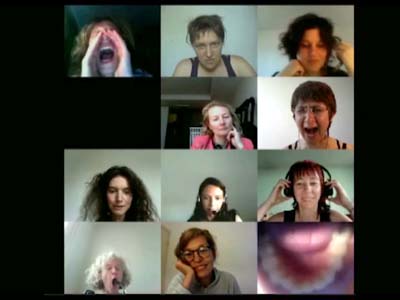
Angry Women (Left Panel/Clip) (2011, 188MB, 6:23 min)
angry women left
Angry Women (Right Panel/Clip) (2011, 142MB, 6:33 min)

Here are a couple of extracts by Annie Abrahams, whose work we love here at DVblog, from her show Training For a Better World which is currently running at the Centre Régional d’Art Contemporain, Languedoc-Roussillon in Sète until the first of January 2012.
I’d seriously suggest that anyone physically able to do so should visit it – I travelled down from London in a day, stayed a night and then trekked back, all by train. Very pleasant it was too.

Abraham’s exhibition runs in tandem with another, of the works of French artist Catherine Gfeller; Gfeller on the ground floor and Abrahams on the first, and the formal similarities (though I think these are largely superficial, for reasons I’ll enlarge upon soon) – the use of both moving and still images, text, an intervention at some level in the mechanics , the whys and wherefores, of how one presents these as art in a gallery setting – make it a stimulating pairing.

Abraham’s selection includes four pieces which are essentially (with some qualifications) video. They are constructed out of the telematics performance territory that she has so signally staked out in the last few years but, she insists, are not documentations of those performances. I think she’s right to emphasise this distinction – although in one sense the pieces clearly do document things that happened in performance they are ultimately video pieces made performatively .

The show doesn’t consist of moving image work only. There are some prints, drawings and a minimalist installation consisting of a single photograph of a pair of married fire-fighters and a sound track of them reading (in an extraordinarily graceful and musical edit [and this is where in this piece any surface similarities to, say, Nauman find their limit. Grace. Grace and elegance throughout.]) a collaborative text on fear.

The moving image and the other pieces occupy different ends of what is mostly a long thin exhibition space and are connected –“tied” together by a “ribbon”- a very long, three or four inch high, strip, of black highlighted, collaboratively generated white text –on the theme of madness – running at floor level for some considerable distance.

It’s important to both acknowledge this distinctly bi-partite character and then to immediately forget about it, so intimate is the connection between the two halves.
Despite the disparate and apparently laissez-faire methodologies used in the generation of all the work and the huge level of trust in the participants evinced by Abrahams, one’s main impression is of a body of work which forms a tight unity both stylistically and in its preoccupations. (And I’d argue that the principal pre-occupation is the question of what it means, physically, socially, psychically, to be a human being. And, further, that this high seriousness –allied to a playfulness which veers from the childishly innocent to the Rabelaisian – is what ultimately gives this work its huge authority and significance and distinguishes it in kind from the technically well executed and often engaging work on the floor below.)

The jewel in the crown of the show is the video installation ‘Angry Women’, created by Abrahams and 22 other women of many nationalities (3 more , in fact, in total, 2 “backstage” assistants, and a performer who opted for silence throughout) speaking about, acting out, demonstrating, reflecting upon, their anger and its causes and triggers, on webcams at their different individual locations and in their native tongues, with the images being sent to a 3X4 grid, in a format that Abrahams has made her own. Because of the limits of even current streaming technology it was necessary to conduct two distinct performances, separated, in fact, by an interval of two months. The length of each was determined by a protocol where a minute’s silence by all participants signalled the end. This resulted in pieces of differing lengths the lack of synchronisation of which adds another layer of fragile grace to the final projections, projected large on adjacent walls around their common corner, with sound from the left image grid fed to the right speaker and vice versa.

The piece occupies most of a large rectangular space at the CRAC (with the video ‘Double Blind (love)’, a collaboration with Curt Cloninger we’ve savoured here before, in its performance incarnation, in the opposite corner and in its full and majestic 264 minute duration).

The impact is visceral – we face what feels like a wave of humanity, not so much in numbers, although 23 women is impressive, at least to this man, but in the infinite malleability of face and hand, of gesture and expression and of how these things might occupy a frame. Sometimes that frame will resemble a Giacometti portrait, with the subject appearing to recede into what seems to be endlessly deep space. At others red lips or an open mouth, sensual and terrifying by turns, occupy the whole of the space – and furthermore each cell is constantly in flux (because these are living, breathing, unpredictable, human beings). There’s something both of portraiture and of the dance at work here, and a kind of found poetry too (which the moving image work has in common with the collaborative texts at the other end of the exhibition). The combination of iron control, planning, foresight (the grid, the protocols) with the letting go and trust evident elsewhere – the phased lengths, the blank space for the person who didn’t turn up, the open performative structure – makes for something of great richness.
Additionally it’s clear that those performers who had previous experience of the format were consciously playing with and against their fellows – gestures are mirrored, sounds echoed, the fiction of looking elsewhere – to the side, or above – of making contact in and across the grid itself, is impressively sustained.

The angry women turn out to be at one and the same time very particular – unique – women and women in general too; the women in general turn out to be human beings in general (and general en masse because each so particular) and the human beings in general turn out to live here, or there, now, in this, one, our only, very particular, world – that mysterious, frightening and wonderful place.

Book your train/plane ticket now!

***

Voici quelques extraits par Annie Abrahams, dont nous aimons le travail ici à DVblog, de son exposition Training For a Better World qui se déroule actuellement au Centre Régional d’Art Contemporain, Languedoc-Roussillon à Sète jusqu’au premier janvier 2012.
Je suggère sérieusement de la visiter à quiconque qui est effectivement en mesure d’y aller – j’ai voyagé depuis Londres en une seule journée, je suis resté une nuit et j’ai fait le retour le lendemain, le tout par train. C’était très agréable.

L’exposition d’Abrahams fonctionne en tandem avec une autre, des œuvres de l’artiste française Catherine Gfeller; Gfeller au rez de chaussée et Abrahams au premier étage, et les similitudes formelles (bien que je pense qu’elles soient essentiellement superficiels, pour des raisons sur lesquelles je vais m’étendre bientôt) – l’utilisation à la fois de l’image fixe et de l’image en mouvement, du texte, l’intervention à un certain niveau dans la mécanique, les tenants et aboutissants, de la façon dont on présente celles ci en tant que de l’art dans le contexte d’une galerie – en font un jumelage stimulant.

La sélection d’Abrahams comprend quatre pièces qui sont essentiellement (avec certaines réserves) vidéo. Elles sont construites à partir du territoire de la performance télématique qu’elle a jalonné si singulièrement les dernières années, mais, elle insiste, ce ne sont pas des documentations de ces performances. Je pense qu’elle a raison de souligner cette distinction – bien que dans un sens les pièces documentent bel et bien ce qui est arrivé dans la performance, elles sont finalement des pièces vidéo réalisées performativement.

L’exposition ne consiste pas seulement d’images en mouvement. Il y a quelques imprimées, des dessins et une installation minimaliste composé d’une seule photo d’un couple de pompiers mariés et une piste sonore d’eux lisant (dans un montage extrêmement gracieuse et musicale [et c’est là que dans cette pièce toute similitude de surface à, disons, Nauman trouve son limite. Grace. Grâce et de l’élégance tout au long.]) un texte collaborative sur la peur.

L’image en mouvement et les autres pièces occupent des extrémités différents de ce qui est surtout un espace d’exposition longue et mince et sont reliés – “liées” par un “ruban” – une très longue, trois ou quatre pouces de haut, bande, de texte blanc, généré en collaboration, souligné en noir – sur le thème de la folie – se déroulant au niveau du sol sur une distance considérable.

Il est important de reconnaître ce caractère nettement bi-partite et ensuite de l’oublier immédiatement, tellement intime est la connexion entre les deux moitiés.
Malgré les méthodologies disparates et apparemment laissez-faire utilisées dans la production de tout le travail et l’énorme niveau de confiance aux participants manifesté par Abrahams, la principale impression est celle d’un corps de travail qui forme une unité serrée à la fois stylistique et dans ses préoccupations. (Et je dirais que la principale préoccupation est la question de ce qu’il signifie, physiquement, socialement, psychologiquement, d’être un être humain. Et, puis, que cette haute degré de sérieux, allié à un enjouement qui vire de l’innocence enfantine au rabelaisien – est, ce qui donne finalement ce travail son énorme autorité et importance et le distingue de sa nature du travail techniquement bien exécuté et souvent engageant de l’étage en dessous).

Le joyau de la couronne de l’exposition est l’installation vidéo «Angry Women», créé par Abrahams et 22 autres femmes de plusieurs nationalités, (en fait, 3 de plus au total, 2 assistantes de “secours”, et une performeuse qui a choisi de rester silencieuse jusqu’à la fin), parlant, actant, démontrant, réfléchissant à, leur colère et ses causes et déclencheurs, devant des webcams dans leurs locations individuellement différentes et dans leur langue maternelle, avec les images envoyées à une grille de 3X4, dans un format que Abrahams a fait le sien. En raison des limites des technologies de streaming, mêmes actuelles, il était nécessaire d’effectuer deux performances distinctes, en fait séparées par une période de deux mois. La longueur de chaque performance a été déterminé par un protocole où une minute de silence par toutes les participantes marquait la fin. Il en résulte des pièces de longueurs différentes dont le manque de synchronisation ajoute une autre couche de grâce fragile aux projections finales, projetées en grand sur des murs adjacents autour de leur coin commun, avec le son de l’ image grillée de gauche envoyé au haut-parleur droit et vice versa.

La pièce occupe la majeure partie d’un grand espace rectangulaire au CRAC (avec la vidéo «Double Blind (love)», une collaboration avec Curt Cloninger que nous avons savouré ici avant dans son incarnation performative, dans le coin opposé, dans sa durée totale et majestueuse de 264 minutes).

L’effet est viscérale – nous faisons face à ce qui ressemble à une vague de humanité, non pas tant en nombre, bien que 23 femmes est impressionnant, au moins à cet homme, mais dans l’incessante malléabilité du visage et des mains, du geste et de l’expression et de la façon dont ces choses peuvent occuper un cadre. Parfois, ce cadre ressemble à un portrait de Giacometti, avec le sujet apparaissant reculer dans ce qui semble être un espace profond infini. À d’autres moments, des lèvres rouges ou une bouche ouverte, sensuel et terrifiant à tour de rôle, occupent la totalité de l’espace – et en plus chaque cellule est constamment en mouvement (parce que ce sont des êtres humains vivantes, respirantes, imprévisibles). Il y a quelque chose à la fois du portrait et de la danse à l’œuvre ici, et aussi une sorte de poésie trouvée (ce que le travail d’image en mouvement a en commun avec les textes collaboratives à l’autre bout de l’exposition). La combinaison du contrôle de fer, de la planification, de la prévision (la grille, les protocoles) avec le laisser-aller et la confiance manifeste ailleurs – les longueurs phasées, l’espace noir pour la personne qui ne se présente pas, la structure performative ouverte – produit quelque chose d’une grande richesse.
En outre, il est clair que ces artistes qui ont eu une expérience antérieure du format ont joué sciemment avec et contre leurs partenaires – les gestes sont mises en miroir, des sons font écho, la fiction de regarder ailleurs – sur le côté ou au-dessus – la prise de contact dans et à travers la grille lui-même, est impressionnant et soutenue.

Les femmes en colère se révèlent être tout à la fois des femmes très particulier – unique – et des femmes en général aussi ; les femmes en général se révèlent être des êtres humains en général (et en général en masse parce que chacune si particulière) et les êtres humains en général s’avèrent vivre ici, ou là, maintenant, dans ce, un, notre seul, très particulier monde – cet endroit mystérieux, effrayant et merveilleux.

Réservez votre train / avion billet dès maintenant!
Business – Junu Ahn

Business
Business (2007, 67.9MB, 9:33 min)

I find it easier to admire this piece, to respect its clear integrity,
than to actually like it much – it’s a pretty hardcore glitch
assemblage & it doesn’t let up …oooooh noooo… not at all
(Strikes me as a bit of a video analog for something like Lou Reed’s (in)famous
)
It’ll be interesting to see where Junu Ahn goes next…

Harddisko – Noise & Disturbances Amplifier System

Harddisko
Harddisko (2007, 29MB, 1:29 min.)

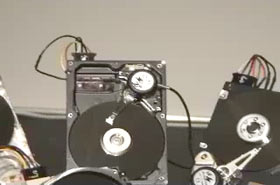
Harddisko is an installation piece by Valentina Vuksic dealing with raw
computer sounds. Rhythmic noises are evoked from sixteen
hard drives, orchestrated through simple power circuits.
By cutting each disk’s power in varying sequences and amplifying its
particular sound characteristics, an unpredictable acoustic
and visual interplay emerges.

Andrew Norman Wilson #4

flowspottest6.jpg
Flow Spot Test #6 (2011, 18MB, 3:34 min)

“Just downloading apps at my Blanc Laptop Cart when all
of a sudden BenJi, an old teammate from XpresSpa shows up.
He happens to be subcontracted now by the American Airlines
subsidiary AffinityAlliance as an evaluator of potential for their
Oneworld Alliance codeshare lounges (of which FlowSpot is the
newest member).”

See Monday and Tuesday’s posts.

Andrew Norman Wilson #3

network_research.jpg
Network Research (2011, 75MB, 2:11 min)

See Monday’s post.

Andrew Norman Wilson #2

FlowSpotTest5s.jpg
Flow Spot Test #5 (2011, 57MB, 2:03 min)

“Just having my early afternoon session of Body-Work with
Nnah, my Body-Designer.”

Says ANW, of the FlowSpot Tests:

For a large-scale exhibition at the School of the Art Institute of Chicago
I created a color coordinated airport/hotel/mall/bank/spa/biennial lounge to
offer a site of relaxation and bodily engagement in an exhibition dominated
by isolated, sellable art objects.
All lounge products were purchased through online transactions (mostly
Target and Walmart), and were returned at the end of the exhibition.
My dystopic science fiction news video Global Countdown played on
a 55” flat panel monitor.
On opening night, visitors to FlowSpot could register for massages from
licensed massage therapists. While participants received massages they
could not see anything and listened to my directors commentary of the
Global Countdown video. The commentary consists of very basic visual
descriptions, with the goal being that the person receiving the massage
can visualize the video in their minds.
Throughout the duration of the exhibition, I used the lounge as a science
fiction video set to make “FlowSpot Tests.” In these videos I engaged
with the lounge both conceptually and materially in a color coordinated
outfit.
Contact me if you are interested in opening a FlowSpot in your airport,
hotel, mall, bank, spa, biennial, gallery, cultural center, or any other
space that you own/lease/use.

See also.

Andrew Norman Wilson – Webinars & FlowSpot Tests

anxiety_about_relationships_between_friendship_and_business.jpg
Anxiety About Relationships Between Friendship and Business (2011, 11MB, 2:41 min)

I’m so taken with Andrew Norman Wilson’s work I’m going to devote
the whole first week of this DVblog season to it.

He initially sent us a longish piece, Networking with Andrew Norman Wilson
made with Nicholas O’Brien of Bad At Sports.
It’s wonderful but pretty huge so you should definitely go and
look at the Vimeo version there.

On Monday, Weds and Friday of this week we’ll post smaller
pieces extracted from that (but without the commentary or
‘interview’ as it is styled elsewhere [-the text on the BAS page linked above]) ,
On Tuesday and Thursday we’ll post two of Wilson’s FlowSpot Tests
with some accompanying explanation from him.

I find this work in general very exciting because it does a lot
of interesting, nuanced and often rather funny (and I’m in favour of funny
there are very few great works of art which contain no funny at all)
and intially apparently contradictory things.

Let me give you my take on it.
The Webinars are all composed entirely of footage sourced from Pond5
“the worlds stock media marketplace” . The FlowSpot Tests are performative
pieces involving bizarre consumer items sourced from e-bay and wallmart and
deployed in a 21st Century updating of silent movie Lloyd-Keaton-Chaplin
deadpan involving, too, a certain degree of slapstick
and displaying a deliciously calibrated sense of the ridiculous.
The Webinars (a least when one takes account of their titles and certainly viewed
in the light of the commentary from “networking”) are a kind of consumerist
reductio-ad-absurdam.
The intent is celarly in some sense satirical but the pieces take risks in
that they don’t stop and end in critique – there is an understanding of
how toxically compelling some of this imagery is and to some extent they
toy with celebrating this.
Wilson is clearly a natural movie maker. He doesn’t restrain himself from
visual flourishes and jokes which are by no means integral to any
satirical case but make the pieces more fun to watch.
(The distortion effects applied to objects in the periphery of the
action in FlowSpot Test #5 are a case in point.)
Additionally, and most impressively, there is a muddying of the
waters in Networking… (and by implication the
Webinars and FlowSpot Tests) whereby
cogent and apparently straightforward philosophising is allowed
to cross pollinate/contaminate with the satire and vice versa,
leaving the viewer with -ahem- work to do.
This work is not glib; it takes risks – in order to maintain its
high level potency it risks misunderstanding.

A look at Wilson’s CV shows a spell spent working for a
labour union and I read the impulse behind these pieces
as radically anti-commodification and corporate mind rot.
Agit-prop, thankfully, it’s not, but “something rich and strange”
– radical art for interesting times to come.
Nice to see this when so many younger artists seem to be
tempted by a career orientated and somewhat cynical celebration
of that same deadend emptiness.

Sondheim – Unmissable , Unmatchable

native_dancer
Native Dancer (2011, 92MB, 2:08 min)

Genbush
Genbush (2006, 17MB, 6:03 min)

Two pieces from Alan Sondheim -one we originally posted in 2006
and one very recent. The new piece –Native Dancer
is a particularly affecting example of recent motion capture/avatar work.
It properly forms part of a triptych but I think it is the outstanding of the
three and I’m going to exercise curatorial perogative & post it singly.
It enchants me -I don’t know exactly why, I think the reasons could be
quite banal -there’s something of the children’s TV sci-fi epic about it perhaps…
Don’t know, just love it.
And here’s what we originally said about the other piece, which I see no reason to change:

Humor is perhaps not a quality that springs immediately
to mind when discussing the work of Alan Sondheim.
Wrong! His work is saturated in it, often a species of

graveyard or gallows wit.
Here, though, he just lets loose, plays.
But the man is incapable of doing anything that doesn’t
resonate with layer upon layer of meaning too!

Monument (If it Bleeds It Leads) – Caleb Larsen

Monument
Monument (2006, 3MB, 1:53 min)

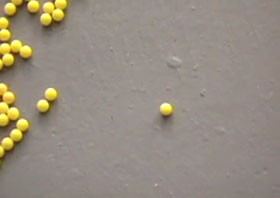
Monument, a computer program continuously scans the headlines
of 4,500 English-language news sources around the world, looking
for people who have been reported killed. Each time it finds an article,
an algorithm determines the number of deaths, and instructs a ceiling-mounted
mechanism built from Legos to drop one yellow BB per person.
by Caleb Larsen.

Takashi Kawashima – Seasons

Seasons
Seasons (2006, 60.4MB, 15:25 min)

Work of heart-stopping delicacy & beauty from
Takashi Kawashima.

Some Very Sad News

November
November (2006, 80.1MB, 9:41 min)

Last week we heard the shocking & terrible news
of the untimely death of Patrick Simons, half, with
Kate Southworth, of the artistic (and life) partnership,
Glorious Ninth.
He was a smart, imaginative, funny and warm person.
As a memorial we’re re-posting here a performance piece
they made a few years back with Ruth Catlow and
Marc Garrett of Furtherfield.
Appropriately you can read a tribute to Patrick from Ruth
and Marc here.
We’d like to express our deepest condolences to Kate, Bella and Aphra.

Here’s the copy from the original post in June 2007:

An enchanting piece of networked performance from
Kate Southworth & Patrick Simons a.k.a Glorious Ninth
with Ruth Catlow & Marc Garrett from the indispensable
Furtherfield.org

I’ve admired Kate & Patrick’s work for a long time,
partly for its sheer visceral beauty, but there’s
an integrity, too, to what they do, a doggedness &
a willingness, recently in particular, to take risks -to
follow their instincts.
I think it pays off richly here.
Here’s a technical, blow by blow description.
Read it then forget it & just go with the strange &
compelling rhythms of the piece:

NOVEMBER
is a performance that utilises peer-to-peer instant messaging
technology, and the participants were able to see and hear each other on their
computers throughout. Working with their own pre-chosen texts, each
participant alternated between reading aloud and listening, amending and
improvising their performances in response to each other. At times a
cacophony of competing voices, the performance was a spontaneous and
unrehearsed encounter, exposing moments of vulnerability, intimacy, connection
and rhythm.

Celebrating Halloween and the changing of the season, four
participants met online to exchange collected data whilst eating prepared
garlic.
NOVEMBER is a networked performative encounter, recorded simultaneously
from Cornwall and London, UK.

Laser Tag – The Graffiti Research Lab

laser tag
laser tag (2006, 17.6MB, 4 min.)

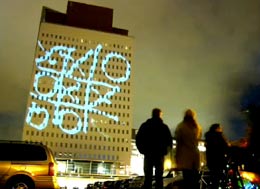
The Graffiti Research Lab is dedicated to outfitting graffiti writers,
artists and protestors with open source tools for urban communication.

Jimmy Wales – Wikipedia:Technologies of Cooperation

jimmywales
Wikipedia:Technologies of Cooperation (2005, 70 MB, 1:30 hr.)

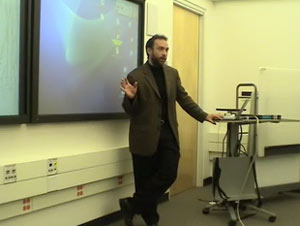
Lecture at Stanford University on Wikipedia by founder Jimmy Wales.

Steven Hoskins – 15 Years

15years
15 Years (2011, 60 MB, 3:08 min)

Reverse aging transformation of a 15 year self-portrait sequence
of Dan Hanna, forming the basis for the movie “StartStop” (2009).
Edited in HD. Used is 32 channel split screen asynchrony to create the illusion of flow.
By Steven Hoskins.