Morrisa Maltz – an interesting intersection of art & commerce

mofonemeandzac
Saved By The Bell/Mofones (2011, 33MB, 54 secs)

The title of this post being words that seldom pass my lips but which in this case
are entirely to the point.
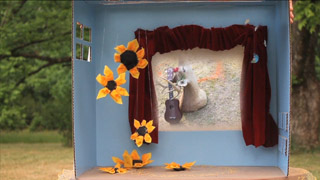
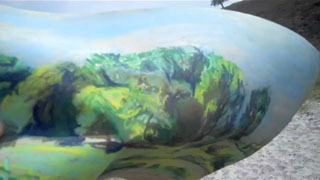
The splendidly creative video artist Morrisa Maltz whose work we’ve been delighted
to feature here several times made these..um..arty-i-phone holders, which are, it has
to be said, rather good and to cut a long story short their commercial potential was
spotted and now she is a C….E….O & Urban Outfitters are selling her stuff.
I hope she spends all of any money she makes on giving herself time to make more of the
very smart and fetching art videos she’s so good at.
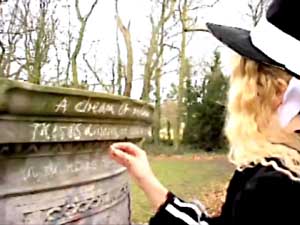
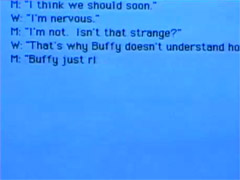
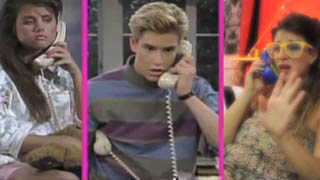
Anyway this is a promotional vid for the moFones, lovingly carved from “Saved by the Bell”.
She even does marketing classily.

Merry

a christmas medley from barnsley town centre
A Christmas Medley From Barnsley Town Centre (2011, 87MB, 1:29 min)

Normally we don’t post our own work here but I couldn’t resist this.
Also – it was a gift; no editing, just the take. (OK. I turned down the brightness
& jacked up the contrast a little.)
Barnsley is actually the friendliest of places, with a grumpy, wry, cheerfulness born of
generations of working-class solidarity, especially in the pits, though it’s now
ravaged by the cuts and closures of the past years.
From me & Doron, Happy Holidays and looking forward to a better world next year.
We’re taking a small holiday break & we’ll be back with something rather splendid
from Morrisa Maltz on January 2nd.

Betty Martins – When the Souls Arrive

when the souls arrive
When the Souls Arrive (2011, 72MB, 2:40 min)

I recently attended a fairly high profile art video festival,
which shall be nameless, and I came away feeling depressed.
There was some good work (indeed, some magnificent, not much, but some) but
on the whole it was just a dispiriting display of meretricious effects, sloppy thinking
and a striving for the quick impression; all pretty souless & forgettable stuff.
(Oh, and plus a lot of cliched tosh about the – yawn – “post-human”. Wasn’t post human,
most of it, so much as post-being-any-good)
Then, on the other hand, you come across something like this:
no in-your-faceness, modest, austere and subtle, makes you do a little bit of work,
but so, so worth spending time with.
is the Brazilian video maker who made this small and perfect gem
– an account of the celebration of the Day of the Dead by expat Mexicans
living in London.
You can see the whole thing here (and I urge you to do so).
Betty Martins cheered me up considerably and I look forward to much more
work of this quality from her.

Ruth Catlow – overland

overland
overland (2010, 131MB, 2:58 min)

And sadly, the last in our little season of movies by Ruth Catlow. This is another
train movie, no conceptual underpinnings to speak of this time, just a beautiful,
bleached out pastels, lo-fi ( mobile?) account of the Serbian section of a journey by train to Istanbul
last year when she was refusing ‘to fly for art’, something more people should do more often if
the results here are anything to go by.
More from Ruth, of course, as she produces it…

Scritti Politti – pop sublimity

Word Girl
The Word Girl (1985, 7.62MB, 3:14 min)

Oh Patti
Oh Patti (1988, 20.3MB, 4:14 min)

Two of the most perfect pop songs ever made, the first from
1985’s Cupid & Psyche & the second from 1988’s Provision
(& which features a trumpet solo from Miles Davis of staggering
economy & otherworldly beauty).
Pet Sounds excepted, pop music just doesn’t come better.
The vids aren’t just an adjunct – of course they have historical
interest (that weird decade!), but there’s something fragile
& haunting & mysterious there which survives the occasional impossible
to overlook moment of naffness.
Wonderful.

Annie Pui Ling Lok

EP
EP (2008, 45MB, 2:29 min)

Anyone who has been lucky enough to see dancer & artist Annie Pui Ling Lok
do the former will know what a fruitful combination of fierce, almost austere,
intellect & yet sensitivity to the particular, the fragile & the human, to expect.
There’s such a sure hand at work here – the confidence in collaging
disparate material & although we’ve tagged it
‘experimental’, in one sense the piece is anything but -it’s so not
a technical exercise, but a rounded, resonant work of art.

Dali on Picasso/Prévert goes shopping

Dali on Picasso
Picasso – I salute you, I embrace you! (2006, 3MB, 29 sec)

Prevert
Prévert goes postcard shopping (2005, 10MB, 1:22 min)

Two gems from the excellent website of the French
Institut National de l’Audiovisuel , featuring two figures
associated with surrealism, the poet Jacques Prévert &
(seen here on crackingly deranged form) the artist Salvador Dali

More from Regina Célia Pinto

Paintings
Painting (2007, 11 MB, 43 Sec)

Neste vídeo há uma grande delicadeza, uma fragilidade,
que não deve levar a pensar que essa peça de Regina Pinto
é de alguma forma ocasional ou menos artística.
Em vez disso, esse é o trabalho de um artista maduro,
sem nada a provar, e com a enorme liberdade que isso traz.
Um estudo de todo o corpo de seu trabalho evidencia
amplamente tudo isso e mostra quão profundamente
consistente e coerente ele se apresenta.
Poder-se-ia ainda acrescentar o quanto ele nos emociona,
o quanto é estranho e muito bonito.

There’s a delicacy, a fragility, about this piece
that shouldn’t lead one to think that Regina Célia Pinto’s
work is in any way casual or artless.
Rather, this is the work of a mature artist with
nothing to prove and the enormous freedom that brings.
A study of the whole body of her work
amply bears this out.
It shows just how consistent and deeply considered
it is and, one should add, how affecting, how strange
and how very beautiful.

Toby Tatum –The Golden Age

the golden age
The Golden Age (2011, 181MB, 5:34 min)

We’ve posted Toby Tatum’s work
before and it’s work with a definite charge to it and ambitious too.

I think this piece is more wholly successful than its predecessor but I’m still not totally convinced.
It’s something to do with the aim of conjuring a very precise & particular
dream-world which strikes me as an all-eggs-in-one-basket kind of approach,
in that the tiniest false note disrupts the sought for spell.
Therefore Tatum creates a very high bar indeed for himself and his performers.

If one compares similarly oneiric work by Cocteau, Lynch or Hadžihalilović,
however dense and rich the atmosphere gets, there is variation with humour
or banality preparing us for more poetry to come and somehow too, framing it,
setting it off.
That sounds more critical that I want to be for this is, in every respect, a
very nicely realised and haunting piece.

Next week, or the week after, we’ll post an interview with Tatum about his work.

Another from Ruth Catlow

as i looked up
travel images unseen (2011, 156MB, 6:01 min)

‘5 video clips taken on a simple video camera, through a window on a coach to the
plane from Istanbul and arriving in London by train. Selected by and stitched, unseen
by the creator who will never watch the video, ever.’

The gentlest conceptualism & quite, quite lovely too.
There’s something about knowing the premise that leaves one
very open – one could say innoculates one – to its formal consequences –
here a looseness which somehow gently stretches time, makes it grainier
but conversely sharpens our attention, perhaps to make up for the
maker’s own vow of abstention.
One more in the series to come.

Brian Kim Stefans – Difficult Beauty

vex1
Vex #1 (2006, 29.1MB, 2:08 min.)

vex5
Vex #5 (2006, 25.9MB, 1:09 min.)

ferrari dogs
Ferrari Dogs (2006, 25.9MB, 1:09 min.)

You know sometimes how when you first look at a work
you can’t process it immediately, it seems jumbled – wrong –
& you’re tempted to dismiss it.
Then you live with it awhile & suddenly it leaps into focus &
you realise you’re in the presence of something much richer
& more rewarding than the things which did immediately fall into place?
Do you know that feeling?
Well, that’s how I felt as I prepared this post.
The work, by the artist & poet Brian Kim Stefans, snuck up
on me & then hit me over the head.
Furthermore, there’s still a puzzling quality to it all, for me:
the Ferrari Dogs piece seems like work of a different category
to the vex pieces somehow ( as does Manchurian Rainman on
the site. Check it. Now – what is that all about?)
Anyway – I’ll take mystery over glibness anyday – I look forward to more.

Ruth Catlow – As I Looked Up…

as i looked up
As I Looked Up (2011, 32MB, 2:23 min)
A co-director of the formidable Furtherfield, Ruth Catlow charms
and something more – something to do with the urgency and vulnerability
of performance and the importance of memory, of a sense of place – in this
fragile & lovely elaboration of an Ivor Cutler song.
Things its difficult to put your finger on but which go right to our core;
pointing to – literally singing – those things being in the ‘artist’ job description…

First of three. Two more pieces, just as delicate, just as necessary, to come.

James Joyce has a Posse

james joyce has a posse
James Joyce has a Posse (2011, 32MB, 4:49 min)

And mentioning Curt Cloninger, as we did on Friday last, it’s nice to report he has made
a new video which is both gorgeous and engimatic, with a musicality which stems
not only from the actual sounds but the video’s very construction, that repeated
wistful, strange, ‘Portrait of the Artist’, title motif…
Cloninger is someone (Eddie Whelan the other who springs to mind) who has thoroughly incorporated
data-moshing as an expressive tool into their vocabulary, defying reports of its early death.
Poetry.

PS And just in passing – I’m fascinated by movies like this one, for which it’s very difficult
to create an adequate poster image.
Data-moshing is a particularly dynamic form of moving image work
where the motion is like the Cheshire Cat’s grin.
It’s not just data-moshing – it happens elsewhere.
It’s like some movies are, in some sense, “further away” in the line of image kinship
with the still.

Annie Abrahams –Training for a Better World

angry women left
Angry Women (Left Panel/Clip) (2011, 188MB, 6:23 min)
angry women left
Angry Women (Right Panel/Clip) (2011, 142MB, 6:33 min)

Here are a couple of extracts by Annie Abrahams, whose work we love here at DVblog, from her show Training For a Better World which is currently running at the Centre Régional d’Art Contemporain, Languedoc-Roussillon in Sète until the first of January 2012.
I’d seriously suggest that anyone physically able to do so should visit it – I travelled down from London in a day, stayed a night and then trekked back, all by train. Very pleasant it was too.

Abraham’s exhibition runs in tandem with another, of the works of French artist Catherine Gfeller; Gfeller on the ground floor and Abrahams on the first, and the formal similarities (though I think these are largely superficial, for reasons I’ll enlarge upon soon) – the use of both moving and still images, text, an intervention at some level in the mechanics , the whys and wherefores, of how one presents these as art in a gallery setting – make it a stimulating pairing.

Abraham’s selection includes four pieces which are essentially (with some qualifications) video. They are constructed out of the telematics performance territory that she has so signally staked out in the last few years but, she insists, are not documentations of those performances. I think she’s right to emphasise this distinction – although in one sense the pieces clearly do document things that happened in performance they are ultimately video pieces made performatively .

The show doesn’t consist of moving image work only. There are some prints, drawings and a minimalist installation consisting of a single photograph of a pair of married fire-fighters and a sound track of them reading (in an extraordinarily graceful and musical edit [and this is where in this piece any surface similarities to, say, Nauman find their limit. Grace. Grace and elegance throughout.]) a collaborative text on fear.

The moving image and the other pieces occupy different ends of what is mostly a long thin exhibition space and are connected –“tied” together by a “ribbon”- a very long, three or four inch high, strip, of black highlighted, collaboratively generated white text –on the theme of madness – running at floor level for some considerable distance.

It’s important to both acknowledge this distinctly bi-partite character and then to immediately forget about it, so intimate is the connection between the two halves.
Despite the disparate and apparently laissez-faire methodologies used in the generation of all the work and the huge level of trust in the participants evinced by Abrahams, one’s main impression is of a body of work which forms a tight unity both stylistically and in its preoccupations. (And I’d argue that the principal pre-occupation is the question of what it means, physically, socially, psychically, to be a human being. And, further, that this high seriousness –allied to a playfulness which veers from the childishly innocent to the Rabelaisian – is what ultimately gives this work its huge authority and significance and distinguishes it in kind from the technically well executed and often engaging work on the floor below.)

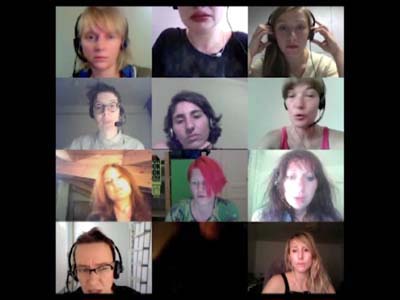
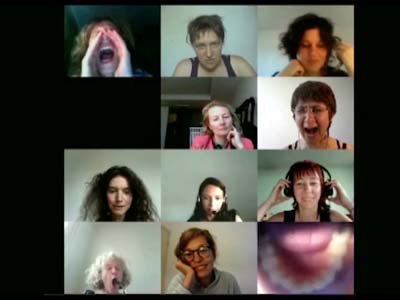
The jewel in the crown of the show is the video installation ‘Angry Women’, created by Abrahams and 22 other women of many nationalities (3 more , in fact, in total, 2 “backstage” assistants, and a performer who opted for silence throughout) speaking about, acting out, demonstrating, reflecting upon, their anger and its causes and triggers, on webcams at their different individual locations and in their native tongues, with the images being sent to a 3X4 grid, in a format that Abrahams has made her own. Because of the limits of even current streaming technology it was necessary to conduct two distinct performances, separated, in fact, by an interval of two months. The length of each was determined by a protocol where a minute’s silence by all participants signalled the end. This resulted in pieces of differing lengths the lack of synchronisation of which adds another layer of fragile grace to the final projections, projected large on adjacent walls around their common corner, with sound from the left image grid fed to the right speaker and vice versa.

The piece occupies most of a large rectangular space at the CRAC (with the video ‘Double Blind (love)’, a collaboration with Curt Cloninger we’ve savoured here before, in its performance incarnation, in the opposite corner and in its full and majestic 264 minute duration).

The impact is visceral – we face what feels like a wave of humanity, not so much in numbers, although 23 women is impressive, at least to this man, but in the infinite malleability of face and hand, of gesture and expression and of how these things might occupy a frame. Sometimes that frame will resemble a Giacometti portrait, with the subject appearing to recede into what seems to be endlessly deep space. At others red lips or an open mouth, sensual and terrifying by turns, occupy the whole of the space – and furthermore each cell is constantly in flux (because these are living, breathing, unpredictable, human beings). There’s something both of portraiture and of the dance at work here, and a kind of found poetry too (which the moving image work has in common with the collaborative texts at the other end of the exhibition). The combination of iron control, planning, foresight (the grid, the protocols) with the letting go and trust evident elsewhere – the phased lengths, the blank space for the person who didn’t turn up, the open performative structure – makes for something of great richness.
Additionally it’s clear that those performers who had previous experience of the format were consciously playing with and against their fellows – gestures are mirrored, sounds echoed, the fiction of looking elsewhere – to the side, or above – of making contact in and across the grid itself, is impressively sustained.

The angry women turn out to be at one and the same time very particular – unique – women and women in general too; the women in general turn out to be human beings in general (and general en masse because each so particular) and the human beings in general turn out to live here, or there, now, in this, one, our only, very particular, world – that mysterious, frightening and wonderful place.

Book your train/plane ticket now!

***

Voici quelques extraits par Annie Abrahams, dont nous aimons le travail ici à DVblog, de son exposition Training For a Better World qui se déroule actuellement au Centre Régional d’Art Contemporain, Languedoc-Roussillon à Sète jusqu’au premier janvier 2012.
Je suggère sérieusement de la visiter à quiconque qui est effectivement en mesure d’y aller – j’ai voyagé depuis Londres en une seule journée, je suis resté une nuit et j’ai fait le retour le lendemain, le tout par train. C’était très agréable.

L’exposition d’Abrahams fonctionne en tandem avec une autre, des œuvres de l’artiste française Catherine Gfeller; Gfeller au rez de chaussée et Abrahams au premier étage, et les similitudes formelles (bien que je pense qu’elles soient essentiellement superficiels, pour des raisons sur lesquelles je vais m’étendre bientôt) – l’utilisation à la fois de l’image fixe et de l’image en mouvement, du texte, l’intervention à un certain niveau dans la mécanique, les tenants et aboutissants, de la façon dont on présente celles ci en tant que de l’art dans le contexte d’une galerie – en font un jumelage stimulant.

La sélection d’Abrahams comprend quatre pièces qui sont essentiellement (avec certaines réserves) vidéo. Elles sont construites à partir du territoire de la performance télématique qu’elle a jalonné si singulièrement les dernières années, mais, elle insiste, ce ne sont pas des documentations de ces performances. Je pense qu’elle a raison de souligner cette distinction – bien que dans un sens les pièces documentent bel et bien ce qui est arrivé dans la performance, elles sont finalement des pièces vidéo réalisées performativement.

L’exposition ne consiste pas seulement d’images en mouvement. Il y a quelques imprimées, des dessins et une installation minimaliste composé d’une seule photo d’un couple de pompiers mariés et une piste sonore d’eux lisant (dans un montage extrêmement gracieuse et musicale [et c’est là que dans cette pièce toute similitude de surface à, disons, Nauman trouve son limite. Grace. Grâce et de l’élégance tout au long.]) un texte collaborative sur la peur.

L’image en mouvement et les autres pièces occupent des extrémités différents de ce qui est surtout un espace d’exposition longue et mince et sont reliés – “liées” par un “ruban” – une très longue, trois ou quatre pouces de haut, bande, de texte blanc, généré en collaboration, souligné en noir – sur le thème de la folie – se déroulant au niveau du sol sur une distance considérable.

Il est important de reconnaître ce caractère nettement bi-partite et ensuite de l’oublier immédiatement, tellement intime est la connexion entre les deux moitiés.
Malgré les méthodologies disparates et apparemment laissez-faire utilisées dans la production de tout le travail et l’énorme niveau de confiance aux participants manifesté par Abrahams, la principale impression est celle d’un corps de travail qui forme une unité serrée à la fois stylistique et dans ses préoccupations. (Et je dirais que la principale préoccupation est la question de ce qu’il signifie, physiquement, socialement, psychologiquement, d’être un être humain. Et, puis, que cette haute degré de sérieux, allié à un enjouement qui vire de l’innocence enfantine au rabelaisien – est, ce qui donne finalement ce travail son énorme autorité et importance et le distingue de sa nature du travail techniquement bien exécuté et souvent engageant de l’étage en dessous).

Le joyau de la couronne de l’exposition est l’installation vidéo «Angry Women», créé par Abrahams et 22 autres femmes de plusieurs nationalités, (en fait, 3 de plus au total, 2 assistantes de “secours”, et une performeuse qui a choisi de rester silencieuse jusqu’à la fin), parlant, actant, démontrant, réfléchissant à, leur colère et ses causes et déclencheurs, devant des webcams dans leurs locations individuellement différentes et dans leur langue maternelle, avec les images envoyées à une grille de 3X4, dans un format que Abrahams a fait le sien. En raison des limites des technologies de streaming, mêmes actuelles, il était nécessaire d’effectuer deux performances distinctes, en fait séparées par une période de deux mois. La longueur de chaque performance a été déterminé par un protocole où une minute de silence par toutes les participantes marquait la fin. Il en résulte des pièces de longueurs différentes dont le manque de synchronisation ajoute une autre couche de grâce fragile aux projections finales, projetées en grand sur des murs adjacents autour de leur coin commun, avec le son de l’ image grillée de gauche envoyé au haut-parleur droit et vice versa.

La pièce occupe la majeure partie d’un grand espace rectangulaire au CRAC (avec la vidéo «Double Blind (love)», une collaboration avec Curt Cloninger que nous avons savouré ici avant dans son incarnation performative, dans le coin opposé, dans sa durée totale et majestueuse de 264 minutes).

L’effet est viscérale – nous faisons face à ce qui ressemble à une vague de humanité, non pas tant en nombre, bien que 23 femmes est impressionnant, au moins à cet homme, mais dans l’incessante malléabilité du visage et des mains, du geste et de l’expression et de la façon dont ces choses peuvent occuper un cadre. Parfois, ce cadre ressemble à un portrait de Giacometti, avec le sujet apparaissant reculer dans ce qui semble être un espace profond infini. À d’autres moments, des lèvres rouges ou une bouche ouverte, sensuel et terrifiant à tour de rôle, occupent la totalité de l’espace – et en plus chaque cellule est constamment en mouvement (parce que ce sont des êtres humains vivantes, respirantes, imprévisibles). Il y a quelque chose à la fois du portrait et de la danse à l’œuvre ici, et aussi une sorte de poésie trouvée (ce que le travail d’image en mouvement a en commun avec les textes collaboratives à l’autre bout de l’exposition). La combinaison du contrôle de fer, de la planification, de la prévision (la grille, les protocoles) avec le laisser-aller et la confiance manifeste ailleurs – les longueurs phasées, l’espace noir pour la personne qui ne se présente pas, la structure performative ouverte – produit quelque chose d’une grande richesse.
En outre, il est clair que ces artistes qui ont eu une expérience antérieure du format ont joué sciemment avec et contre leurs partenaires – les gestes sont mises en miroir, des sons font écho, la fiction de regarder ailleurs – sur le côté ou au-dessus – la prise de contact dans et à travers la grille lui-même, est impressionnant et soutenue.

Les femmes en colère se révèlent être tout à la fois des femmes très particulier – unique – et des femmes en général aussi ; les femmes en général se révèlent être des êtres humains en général (et en général en masse parce que chacune si particulière) et les êtres humains en général s’avèrent vivre ici, ou là, maintenant, dans ce, un, notre seul, très particulier monde – cet endroit mystérieux, effrayant et merveilleux.
Réservez votre train / avion billet dès maintenant!
Alan Sondheim – Two Movies

Beauty
Beauty (2007, 11.4MB, 1:04 min.)

Romania
Romania (2007, 19MB, 2:01 min.)

What to say, we’ve said it all, again & again, Sondheim’s
movies are a unique & indispensable body of work.
Specifically, anyone working in video on the net who
doesn’t know them is navigating blind.
For a free masterclass hop over to his site & work your
way through all the stuff with .mov or .mp4 extensions.
( I mean, don’t confine yourself to the movies but this
is dvblog)
You won’t have wasted your time.

Business – Junu Ahn

Business
Business (2007, 67.9MB, 9:33 min)

I find it easier to admire this piece, to respect its clear integrity,
than to actually like it much – it’s a pretty hardcore glitch
assemblage & it doesn’t let up …oooooh noooo… not at all
(Strikes me as a bit of a video analog for something like Lou Reed’s (in)famous
)
It’ll be interesting to see where Junu Ahn goes next…

Hanns Eisler – ‘Composing for the Films’

White Flood clip 1
‘White Flood’ – clip 1 (1940-2, 1.1 MB, 30 sec.)

A Child Went Forth clip
‘A Child Went Forth’ – clip (1940-2, 1.4 MB, 30 sec.)

White Flood clip 2
‘White Flood’ – clip 2 (1940-2, 661 KB, 29 sec.)

Easily the most interesting of all Brecht’s composer collaborators
& in flat contradiction to the current myth spread by those
who dislike his politics, by far the better composer than the rather
dull Weill, Hanns Eisler’s keen intellect turned to questions of film in his
exile in the USA in the early forties.
Under the auspices of the New School & funded by the Rockefeller foundation
Eisler conducted an intensive investigation of the relationship between
film & music , often involving him writing new music to already existing footage.
You can see some of this footage here – but what you really need to do is to listen.
There is no-one who could not learn something from the amazing way Eisler
deploys music here.
After the project, Eisler went on to write, with Theodore Adorno,
himself no slouch intellectually (& also a practicing composer),
one of the key books on music & the movies –‘Composing for the Films’
These clips come from the website for a new edition of the book
released with a companion DVD documenting much of the Rockefeller experimentation.
Indispensable.

Celia Cooley – Occupy DC Interviews 10/10/2011

indian_movie.jpg
Occupy DC Interviews 10/10/2011 (2011, 73MB, 58 sec)

Demonstrating what we all might have said rhetorically, but really demonstrating it –
that a smart seven year old (with a little tech help from her parents)
can do a better job than any of the official media, Celia Cooley interviews
Occupy DC participants in a piece that both delights and makes one fiercely
proud to be one of the 99%.
Great job!
By Celia Cooley.

One Minute Movies and MIRAJ

indian_movie.jpg
Indian Movie [Declan Kilfeather] (2007, 3MB, 55 sec)

punch.jpg
Punch [Kerry Baldry] (1994, 30MB, 1:14 min)

landgauge.jpg
Land Gauge [Steven Ball] (1981/2008, 44MB, 1:21 min)

upside_down_world.jpg
Upside Down World [Marty St.James] (2008, 19MB, 1:25 min)

I wrote a review of Vols. 1 to 4 of Kerry Baldry’s excellent One Minutes
project for a new journal, the Moving Image Review and Journal, and I thought it would be nice to post the pieces I discuss in it here.

2 from Jack Ryan

RyanJ_I_Fell_For_You.jpg
I Fell for You (2011,8MB, 1:00 min)

TraitThreshHoldcompressed.jpg
Threshold (2011, 86MB, 3:29 min)

I Fell For You:

‘My early artistic ideas came from a 3-year experience as
a commercial fisherman in Alaska. At the time, my work
centered on ideas consistent with the locale: hermetic
fabulousness, escape, odyssey, and the sublime.
Todayperversities of the sublime continue to influence the
way I shape projects. A consensual explanation of the
contemporary sublime would acknowledge that there are
thresholds of human perception and a desire to explore these
thresholds connecting ourselves to a greater environment of
understanding and awareness. At the root of my work is
an interest in human experience.’

Threshold:

‘Borrowing from fluxus films Threshold is filmed in Iceland
and the Oregon Coast and made for a project with The
Archer Gallery.
The video takes place where land meets sea, where the
landscape moves from vertical to horizontal, and
associatively between life (verticality) and death (horizontality)’

I’m guessing the club formed by the intersection of the sets of
experimental video makers and of former commercial fishermen
in Alaska is a fairly exclusive one.
Jack Ryan upholds its honor in these two exhilarating
(but totally uningratiating, no puppy-dog-eyes here) pieces.
I especially love “I fell…”.
Very bracing.

Andrew Norman Wilson #5

the_incorporation_of_demands_for_liberation.jpg
The Incorporation of Demands for Liberation (2011, 13MB, 3:24 min)

Brilliant!

Last piece from ANW, for the moment, although we
certainly hope to feature more in the future –
some of the most original and exciting work I’ve seen recently.

For some context see Monday’s post.

Andrew Norman Wilson #4

flowspottest6.jpg
Flow Spot Test #6 (2011, 18MB, 3:34 min)

“Just downloading apps at my Blanc Laptop Cart when all
of a sudden BenJi, an old teammate from XpresSpa shows up.
He happens to be subcontracted now by the American Airlines
subsidiary AffinityAlliance as an evaluator of potential for their
Oneworld Alliance codeshare lounges (of which FlowSpot is the
newest member).”

See Monday and Tuesday’s posts.

Andrew Norman Wilson #2

FlowSpotTest5s.jpg
Flow Spot Test #5 (2011, 57MB, 2:03 min)

“Just having my early afternoon session of Body-Work with
Nnah, my Body-Designer.”

Says ANW, of the FlowSpot Tests:

For a large-scale exhibition at the School of the Art Institute of Chicago
I created a color coordinated airport/hotel/mall/bank/spa/biennial lounge to
offer a site of relaxation and bodily engagement in an exhibition dominated
by isolated, sellable art objects.
All lounge products were purchased through online transactions (mostly
Target and Walmart), and were returned at the end of the exhibition.
My dystopic science fiction news video Global Countdown played on
a 55” flat panel monitor.
On opening night, visitors to FlowSpot could register for massages from
licensed massage therapists. While participants received massages they
could not see anything and listened to my directors commentary of the
Global Countdown video. The commentary consists of very basic visual
descriptions, with the goal being that the person receiving the massage
can visualize the video in their minds.
Throughout the duration of the exhibition, I used the lounge as a science
fiction video set to make “FlowSpot Tests.” In these videos I engaged
with the lounge both conceptually and materially in a color coordinated
outfit.
Contact me if you are interested in opening a FlowSpot in your airport,
hotel, mall, bank, spa, biennial, gallery, cultural center, or any other
space that you own/lease/use.

See also.

Andrew Norman Wilson – Webinars & FlowSpot Tests

anxiety_about_relationships_between_friendship_and_business.jpg
Anxiety About Relationships Between Friendship and Business (2011, 11MB, 2:41 min)

I’m so taken with Andrew Norman Wilson’s work I’m going to devote
the whole first week of this DVblog season to it.

He initially sent us a longish piece, Networking with Andrew Norman Wilson
made with Nicholas O’Brien of Bad At Sports.
It’s wonderful but pretty huge so you should definitely go and
look at the Vimeo version there.

On Monday, Weds and Friday of this week we’ll post smaller
pieces extracted from that (but without the commentary or
‘interview’ as it is styled elsewhere [-the text on the BAS page linked above]) ,
On Tuesday and Thursday we’ll post two of Wilson’s FlowSpot Tests
with some accompanying explanation from him.

I find this work in general very exciting because it does a lot
of interesting, nuanced and often rather funny (and I’m in favour of funny –
there are very few great works of art which contain no funny at all)
and intially apparently contradictory things.

Let me give you my take on it.
The Webinars are all composed entirely of footage sourced from Pond5
“the worlds stock media marketplace” . The FlowSpot Tests are performative
pieces involving bizarre consumer items sourced from e-bay and wallmart and
deployed in a 21st Century updating of silent movie Lloyd-Keaton-Chaplin
deadpan involving, too, a certain degree of slapstick
and displaying a deliciously calibrated sense of the ridiculous.
The Webinars (a least when one takes account of their titles and certainly viewed
in the light of the commentary from “networking”) are a kind of consumerist
reductio-ad-absurdam.
The intent is celarly in some sense satirical but the pieces take risks in
that they don’t stop and end in critique – there is an understanding of
how toxically compelling some of this imagery is and to some extent they
toy with celebrating this.
Wilson is clearly a natural movie maker. He doesn’t restrain himself from
visual flourishes and jokes which are by no means integral to any
satirical case but make the pieces more fun to watch.
(The distortion effects applied to objects in the periphery of the
action in FlowSpot Test #5 are a case in point.)
Additionally, and most impressively, there is a muddying of the
waters in Networking… (and by implication the
Webinars and FlowSpot Tests) whereby
cogent and apparently straightforward philosophising is allowed
to cross pollinate/contaminate with the satire and vice versa,
leaving the viewer with -ahem- work to do.
This work is not glib; it takes risks – in order to maintain its
high level potency it risks misunderstanding.

A look at Wilson’s CV shows a spell spent working for a
labour union and I read the impulse behind these pieces
as radically anti-commodification and corporate mind rot.
Agit-prop, thankfully, it’s not, but “something rich and strange”
– radical art for interesting times to come.
Nice to see this when so many younger artists seem to be
tempted by a career orientated and somewhat cynical celebration
of that same deadend emptiness.

Joan Brossa – Fi

brossa.jpg
Fi (2011, 51MB, 9:57 min)

Joan Brossa, the Catalan poet, artist, performer and polymath,
who died in 1998, deserves to be more widely
known in the rest of the world.
I’ve often thought his work, in particular the visual
poems, prefigured much of the art of the early days
of the net (but mostly better: terser, wittier, riskier –
I think Brossa would have loved the net).
This elegant & delightful performance ( ‘Fi’ is Catalan
for ‘End’, in this context The End) was recorded
in Barcelona eight months before his death.

It requires a little patience; the reward being that
it can be viewed many more than one time, so it
seems like an appropriate thing to leave you with
over the summer.
Remember we’re always delighted to look at new work,
so if you’re making moving image yourself,
or you happen across great stuff don’t hesitate
to send us links.

We’re back on Monday, September the 26th – in
the meantime we wish you all a happy and relaxing summer.

Delpha Hudson – A Walk with Jane Austen

a_walk_with_jane_austen1.jpg
A Walk with Jane Austen (1999, 144MB, 12:20 min)

‘the work is about exploring the veracity of history and of time,
and its constructs (in this case especially the notion of
“bodice-ripping” romance genres).
Playing with text and in-authenticity, the intention was to engage
an audience with notions of historical construction of women;
their facts and fictions, and the possibility of re-visioning histories.

– Delpha Hudson

Engaging hybrid of site specific performance and movie making,
the somewhat improvisatory quality lending it all a pleasantly
languid & unhurried air.
At the very end the sun joins in to striking effect & I love the rogue
arm at our right as the spectators leave.
Hudson is a charismatic & commanding performer –
we’ll have another of her performance pieces here in the Autumn.

2 from Jess Loseby

Arms Race
Arms Race (2007, 1.85MB, 1:02 min)

Handbag Surveillance
Handbag Surveillance (2007, 4.18MB, 2:05 min)

Anyone lucky enough to have already encountered Jess Loseby’s artwork
online or in a gallery will have realised immediately what a thoughtful,
courageous & dextrous artist she is. She hasn’t been so active of late &
her excellent site is offline now due to her continuing ill health
(although it is possible to explore it somewhat using the wayback machine).
This is a real loss: there is a warmth & humanity to her work
– an ability to find beauty in the ordinary, the overlooked
( & in our still sexist society, these categories often overlapping
with the domestic, the feminine) – which one often looks for in vain elsewhere.
Her work doesn’t strut, it enchants, (& then maybe sticks a
big fuck-off hatpin into you).
Video making isn’t central to what she does, but when she does it
she does it with all the qualities noted above.
Enjoy & learn.

Music for Handbag Surveillance by Clive Loseby.

We at DVblog join with many of her friends in wishing Jess well
and look forward to her return to active art making.

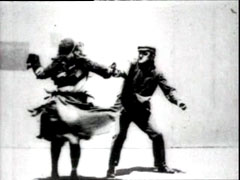
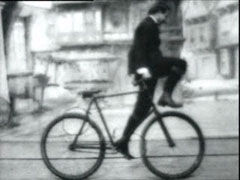
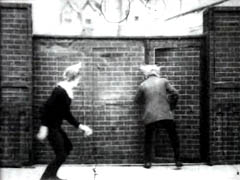
Cutting Edge Cinema

Lunch
A Tough Dance (1902, 7.1MB, 47 sec.)

Lunch
Bicycle Trick Riding (1899, 5.5MB, 37 sec.)

Lunch
Three Acrobats (1899, 5.4MB, 36 sec.)

Three exhilarating chunks of early movie making from the
Library of Congress online collection of variety stage motion pictures.
I particularly love the deeply strange A ‘Tough’ Dance.
There’s also a great early animation collection on the LOC site.

Martin Archer live at The Grapes

Martin Archer
Martin Archer Live at The Grapes, Sheffield (2006, 85.8MB, 9:52 min)

Great vid made by Jonny Drury of Martin Archer, a unique
& towering figure in British (here I was going to interpolate experimental but that
doesn’t really do justice to the intensely personal soundworld Archer has
forged over the years – a combination of fierce poetry, a huge
intellectual range & hunger & a love affair with sound & how it
can be ordered & dis-ordered & where one now feels he knows
exactly where he’s going, so experimental feels in a way
like an impertinence) music of the past 25 years,
performing at The Grapes pub in his home town of Sheffield, UK.

Super Dog

superdog.jpg
Super Dog (2011, 20MB, 1:58 min)

You might remember that Pink Tall Bike brought
to you here previously by Mike Stoddart.
Now that gentle and slightly skewed sensibility*
brings you Super Dog.

*Not weird enough to qualify for surreal exactly,
but there is something about the way he makes them
that is, enough to notice (or to feel in one’s bones),
delightfully loopy & off kilter…

Some Very Sad News

November
November (2006, 80.1MB, 9:41 min)

Last week we heard the shocking & terrible news
of the untimely death of Patrick Simons, half, with
Kate Southworth, of the artistic (and life) partnership,
Glorious Ninth.
He was a smart, imaginative, funny and warm person.
As a memorial we’re re-posting here a performance piece
they made a few years back with Ruth Catlow and
Marc Garrett of Furtherfield.
We’d like to express our deepest condolences to Kate, Bella and Aphra.

Here’s the copy from the original post in June 2007:

An enchanting piece of networked performance from
Kate Southworth & Patrick Simons a.k.a Glorious Ninth
with Ruth Catlow & Marc Garrett from the indispensable
Furtherfield.org

I’ve admired Kate & Patrick’s work for a long time,
partly for its sheer visceral beauty, but there’s
an integrity, too, to what they do, a doggedness &
a willingness, recently in particular, to take risks -to
follow their instincts.
I think it pays off richly here.
Here’s a technical, blow by blow description.
Read it then forget it & just go with the strange &
compelling rhythms of the piece:

NOVEMBER
is a performance that utilises peer-to-peer instant messaging
technology, and the participants were able to see and hear each other on their
computers throughout. Working with their own pre-chosen texts, each
participant alternated between reading aloud and listening, amending and
improvising their performances in response to each other. At times a
cacophony of competing voices, the performance was a spontaneous and
unrehearsed encounter, exposing moments of vulnerability, intimacy, connection
and rhythm.

Celebrating Halloween and the changing of the season, four
participants met online to exchange collected data whilst eating prepared
garlic.
NOVEMBER is a networked performative encounter, recorded simultaneously
from Cornwall and London, UK.

Eddie Whelan/Ruby Kendrick Do Me Right

domeright.jpg
Do Me Right (2011, 62MB, 2:25 min)

Gosh! this is lovely and Gosh! Eddie Whelan is talented & capable.
We’ve admired his data-moshing skills on a number of occasions
but the man clearly has range and whats the word? – yes –
application
. This vid for Ruby Kendrick looks so light and easy
and yet one jusy knows what it cost in time and effort
(and inspiration).
Oh -but worth it, so worth it.

Dr Hairy – Appraisal Parts 1 & 2

appraisalpart1.jpg
Appraisal Part #1 (2011, 232MB, 10:14 min)

appraisalpart2.jpg
Appraisal Part #2 (2011, 151MB, 9:40 min)

Edward Picot’s bizarre and wonderful Dr Hairy series, the adventures of a hirsute
UK general practitioner coping with NHS (the NHS we love, don’t misunderstand us)
bureaucracy, continues with these first two episodes of Appraisal.
Picot’s comic timing just gets better & better (& occasionally strays into some
almost Beckettian territory) – it’s fascinating to watch a long
project like this unfold. If you missed the preceding episodes they’re here (as are some other
gems, some equally amusing, some altogether different in style and mood)

Two from Marcin Rychlicki

C Point Video
C Point (2011, 32MB, 1:15 min)

cyberhero
Cyber Hero (2011, 43MB, 1:25 min)

My name is Marcin Rychlicki, , I’m 29 years old and
I live in Warsaw. For nearly three years I’ve been
creating videos for the Internet under the names
DJ Gacmaster and GacPax. An important element
of my movies is music. For some of them ,
for example, ‘Cyber Hero’, I composed it myself.
I’m trying to combine traditional music video with
the unconventionality of video art. From 2001
to 2006 I was a drummer in hardcore band C. Point.
I made this video for one of our songs: ‘Today’

*****************************************************

Both pieces great but C Point is a particular delight.
(My prejudice showing through of course, but I don’t
generally associate this musical genre with the kind
of gentle wit on display here.)
Not sure I completely understand Cyber Hero which is
apparently some sort of rejoinder to this (Huh?), but I
love the music.

Regina Célia Pinto –Andante Grazioso

andante_grazioso1.jpg
Andante Grazioso (2011, 26MB, 3:47 min)

Gosto muito do trabalho de Regina Pinto, simples e elegante
na superfície, ele toca o coração (e acopla a mente) e,
aparentemente, é isso que nos prende.
Esta profundidade lúcida, a embalagem luminosa do diário,
não é conseguida sem trabalho, mas Regina é demasiado
cuidadosa e modesta (no comportamento, não na ambição)
mas, visivelmente, está fazendo algo difícil, e este fato é,
ele próprio, parte de sua arte. Encantador!

Like so much of Regina Célia Pinto’s work, simple and elegant
on the surface, this touches the heart (and engages the mind)
seemingly without effort.
Of course ‘seemingly’ is the catch. This lucid depth, the luminous
encapsulation of the everyday, is not achieved without labour,
but Regina is too careful and modest (in demeanour, not ambition) an
artist to make heavy weather of it, and this fact is itself part of her art.
Lovely!

Emily Murdoch – Before Honeymoon

Before Honeymoon
Before Honeymoon (2011, 29MB, 1:39 min)

Another piece from a Writtle student, this from Emily Murdoch.
I think this is tremendous not only technically (I especially love the use of light)
but aesthetically too. It clearly owes a debt to Lewis Klahr but one can
see a very distinctive individual voice emerging too.
I do hope Emily continues to make art (and in particular moving image).
I find her work rich and moving.

Delpha Hudson – Out With Mother

out_with_mother.jpg
Out With Mother (2011, 73MB, 1:32 min)

I’m oscillating between finding this piece by Delpha Hudson really rather
beautiful and rather chilling (or both).
It’s perhaps the ambguity which makes it so effective, difficult to get a
precise fix on.
There’s no doubting that it’s a smart piece of work. I love the dual tempo thing
with the scene in the background unfolding slowly behind the more anxious and
busier foreground.
I’m assuming the speech like sound *is* sampled from an actual child -again the ambiguity
arising from, on the one hand its near musicality and on the other the
inevitable and immediate visceral response (certainly from anyone who’s ever had kids)
it provokes is a point adding to the richness of the thing.
Great. More from Delpha soon.

Wikipedia Art in London

intro.jpg
Wikipedia Art Intro (2011, 114MB, 2:29 min)

And, appropriately following on from yesterday’s post, a little intro
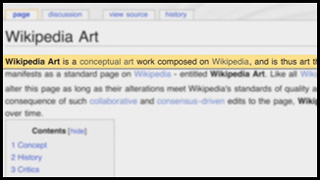
to the splendid Kildall/Stern Wikipedia Art project which is showing, as part
of a two person show at London’s Furtherfield gallery (formerly HTTP)
from this Friday.
(One individual piece by each artist too – promises to be a real treat)

Private view tonight 6:30 (Thurs.) – all welcome, maybe see you there.

This piece narrated in Stern’s breathless-puppy-dog-with-an-off-the-dial-IQ
trademark delivery with reassuringly measured interventions by the
no less smart & talented Kildall.

Edit by Foster Stilp, plus suitably keyed up and excited music by Stilp and
Kevin McGillivray, who together trade as Felixsofia

Estella Cumberford – Friendsource14

Friendsource14.jpg
Friendsource14 (2011, 21MB, 1:18 min)

This piece, by Estella Cumberford, is great on a whole number of fronts.
Firstly it’s really nicely made.
The images walk that difficult line between
telling us too much and too little, and the audio
(processed, apparently, in GarageBand) is well judged,
well executed and more than a little engaging.
You wouldn’t guess from the piece’s surface simplicity
(first impressions only of course, anyway. Examine it closely
and see how hand-made and un-algorithmic it is)
the layers of structuring and processing that went into
it but I can’t help feeling these do manifest in the sense of
its coherence, richness and general success as a work of art.
The text was sourced & assembled from status updates on F******* of
14 of the artist’s friends. This then read by her & processed as noted.
The images were then grown (organic metaphors seem somehow
particularly apposite) out of this text and rendered by a kind of
shadow screen technique.
It’s an exquisite piece of work.
Transparency dictates I tell you that I teach Estella
at Writtle. (I use the word teach loosely -as with most of
the students we have an absorbing and on-going dialogue.)
It’s work like this that makes that part of my life so rewarding.

Talking About DVblog

evg_dvblog_talk.jpg
Electronic Village Galleries Talk 6th May 2011 (2011, 164MB, 32:14 min)

Gosh -where to start?
Awhile back we were approached to assemble a selection of
work from DVblog for screening at a gallery in the UK.
This reel then took on a bit of a life of its own, showing
at the museum of club culture in Hull, UK and at the Buffalo Literary Center, New York.
(of course ‘a life of its own’ is completely unfair – it got shown because real
human beings –Kerry Baldry, Martha Deed and Kate Southworth respectively – put work into making it happen.)
involving showing digital work in village halls in Cornwall, in the extreme
south-west of the UK, asked if I’d be interested in curating something
and the reel immediately sprang to mind..

To cut a long story short it was shown at the second EVG event at
Zennor village hall on 7th May and I went down to talk (at some
length,
I notice with a certain degree of horror)
about digital video on the net, DVblog in particular and about the
artists involved in this selection.
Here, for better or for worse, is my talk, filmed, heroically, given my
restless delivery style, by Delpha Hudson.
If you’d like to reconstruct the programme for yourself it’s below, with links to
the original DVblog posts.

And if you’d be interested in screening it, please get in touch!
(We also have a reel of silent work which has been screened with
musical accompaniment and is available for more such outings.)

JimPunk, 2010: T

Ruth Catlow – Landscape

love_is_a_wave.jpg
Landscape (2011, 114MB, 3:12 min)

Ravishing piece of work from my friend and colleague Ruth Catlow
who is also co-director of the indispensible Furtherfield.org

We’ve been talking a lot amongst ourselves and with our students about
continuities across art history and about hybrid techniques which
meld both the ancient and the newest.
Filmed in the New Forest, this piece (apart from its great beauty)
is an exemplar of this approach and pathbreaking in its way.
(More so than much which, dull-eyed, shouts and waves the latest thing
from the rooftops.)
The oldest kind of mark making, delicately but robustly realised,
captured on a tiny portable video camera in a semi-performative
way and then networked…
Beautiful and nourishing both.

Rick Silva – recap

Recap -trailer
Recap (trailer) (2006, 7.18MB, 1:12 min)

Says Rick Silva:
‘Recap is a remix of the cult classic graffiti movie
Wild Style (1982) where every piece of graffiti in
the original film has been digitally crossed out and tagged over
with the Recap tag.’

The full piece is available on DVD as an 82 minute video loop.

I find this piece intriguing. I’m pretty friendly to formalism –
it’s amazing what beauty & interest a good algorithm
(in the broadest sense) can deliver.
But here Rick Silva seems to have taken steps to eliminate
…perhaps too strong…rather…to render difficult…
the emergence (partly because the original looks so great,
haven’t seen it, so even the trailer is, for me, quite irritating,
because by definition it covers up
[and maybe this
is the point – I think the setting & hence the mode of viewing
probably make a huge difference – I could see this working
brilliantly in a gallery where one takes in some of it & moves
on, digesting, but I think I would rather have extensive dental
work than sit & watch it as movie
] what
I long to see
.) of casual beauty.

Good though!
I don’t mean to be negative!
Better than bland of course, anytime!

Josh Weinstein – “Cross Examination”

Cross Examination
Cross Examination (2005, 44 MB, 5:40 min)

Made in 2005, this is a really extraordinary piece for lots of reasons:

(1) It’s so carefully made ( & must have taken no little work)
(2) The chutzpah quotient is almost 100%
(3) There is more here than meets the eye
(4) The use of music (in its second appearance very reminiscent
of the school of Rifle/Hartley but spot on nonetheless)
(5) The warmth, genuine warmth; the real insight into people

As you see here Josh Weinstein, Brooklyn based film maker
does a lot of work for corporate clients. Hmmm.
Really, all you can think is, on the basis of this, they get way,
way more & better than they could possibly deserve.