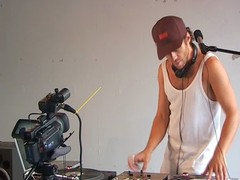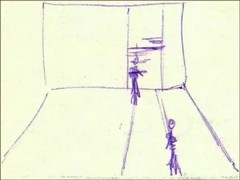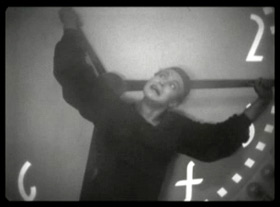
iua met I (2005, 60MB, 6:43 min.)
“inside us all” winners of the 2005 diesel music VJ competition.
iua met I (2005, 60MB, 6:43 min.)
“inside us all” winners of the 2005 diesel music VJ competition.

Bob’s Big Date (2008, 7 MB, 50 sec.)
“These are the adventures of a psychopath named Bob. Bob is not
a nice man; not even a little bit. This show is the video equivalent
of a Sunday comic strip.
Here Bob goes out on a date with Betty, perhaps the first woman
other than his mother to truly understand and appreciate him.”
From The AV Club.
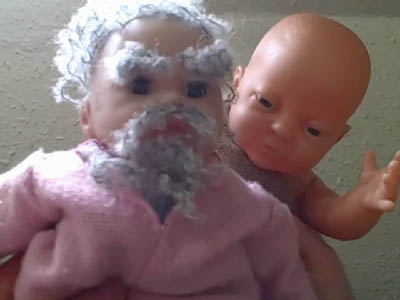
Mentoring (2012, 255MB, 16:01 min)
Final one in the present series of Edward Picot’s Dr Hairy videos.
Great stuff, which we’ve enjoyed a great deal.
We eagerly anticipate series #2, perhaps we could suggest The Return of Dr Hairy,
Dr Hairy’s Repeat Prescription or The Beard is Back.
Glad to see he’ll be putting in an artworld appearance at
the new Furtherfield Gallery in Finsbury Park, London.
Not to be missed if you’re in the area during the run of the show (not only
because Dr H is great but also because Furtherfield haven’t put together
a remotely dull show yet).

Media Burn by Ant Farm (1975, 202MB, 25:46)
Infamous July 4, 1975 “pseudo-event” featuring a
speech by “JFK Jr.” and a 1959 Cadillac turned wacky
crash test car through a wall of burning television sets,
produced by video artists and activist collective Ant Farm.
The first four and a half minutes of this particular video
feature actual news coverage about the event.
The rest is the full speech and crash. Inspiration.
Video via the Media Burn archive.
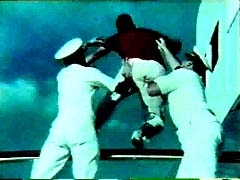
Serial Metaphysics #1 (1984-86, clip, 6.4MB, 1:08 min)

Serial Metaphysics #2 (1984-86, clip, 5.9MB, 1:08 min)
Wheeler Winston Dixon is now a professor of film studies
at the University of Nebraska, Lincoln. Before he did that he made
a lot of (on the evidence of these clips & others) really great short movies.
In particular these two clips from Serial Metaphysics, apparently almost
entirely constructed from TV ads, whet the appetite for a viewing
of the whole twenty minutes.
Dixon conjures fever dream magic from commercial banality.
Check in particular the end sequence of clip one:
David Lynch eat your heart out.
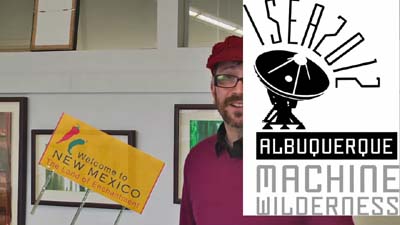
Tweets in Space (2012, 52MB, 2:27 min)
Scott Kildall and Nathaniel Stern of Wikipedia Art return with another
project both odd, lyrical and utopian.
“Tweets in Space” will beam Twitter discussions from participants worldwide
towards GJ667Cc: a planet 22 light years away that apparently might support
earth-like life.
Anyone can take part, simply by adding #tweetsinspace to their tweets during
two performance times in September, when Stern and Kildall will be doing live
projections at the International Symposium on Electronic Art in New Mexico,
and boldly tweeting where none have tweeted before.
They say:
“This differs from every past alien transmission in that it is not only
a public performance, but also performs a public: it is a real-time
conversation between hopeful peers sending their thoughts to everywhere
and nowhere.
Our soon-to-be alien friends will receive unmediated thoughts and responses
about politics, philosophy, pop culture, dinner, dancing cats and everything
in between.
By engaging the millions of voices in the Twitterverse and dispatching them
into the larger Universe, “Tweets in Space” activates a potent discussion
about communication and life that traverses beyond our borders or understanding.
It promises more than could ever be delivered.”
This is their fundraising video – please consider making a donation to make the
project happen and also publicise and share it on lists, facebook, twitter, etc.
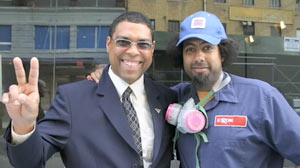
Tribute to Reggie (excerpt) (2007, 52MB, 2:51 min.)
Vintage Yes Men from 2007, posing as representatives of Exxon-Mobil
and the National Petroleum Council in Calgary, Alberta, to deliver a keynote
speech presenting a new product – Vivoleum, a new fuel made from the
deceased bodies of human climate-change casualties.
‘Tribute to Reggie” was a promo video for the event.
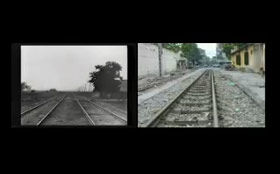
Man With a Movie Camera (Trailer) (1929-2007, 6MB, 2:17 min.)
“Man With a Movie Camera is a participatory video shot by people around the world
who are invited to record video according to the original script of Vertov’s Man With
A Movie Camera and submit it to a website which will archive, sequence and deliver
it. When the work streams your contribution becomes part of a worldwide montage,
in Vertov’s terms the ‘decoding of life as it is’.
Project by Perry Bard.
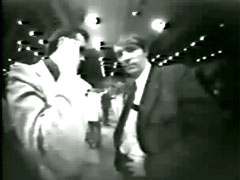
The World’s Largest TV Studio (1972, 17.2MB, 7:10 min.)
A historic piece of political video from
the 1972 Miami Democratic Convention, this excerpt featuring an interview
with Michael Shamberg, author of Guerilla Television & founder member of Top Value
Television. (Also founder of Raindance & subsequently big shot Hollywood Producer).
Found in the broadcasting section of the Southwest Museum of Engineering Communications
and Computation, which is actually stuffed with goodies.
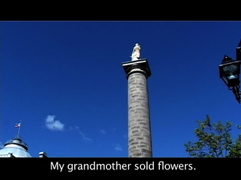
Sixth Map (2006, 17.3MB, 3.44 min.)
When filmmaker/videoblogger Daniel Liss challenged himself to make 7 videos in 7 days,
he also challenged his online audience to collaborate with him in the process.
His daily assignments came from viewers of his videoblog who determined
where, about what and how he should make each video.
Each day, they posted an assignment and each day Daniel posted a video in response.
Then came praise and criticism in the comments of each day’s videoblog post.
The process took him miles from home, he told personal stories, invented new narratives,
and played more than a few tricks on his guiding/goading audience.
For this video he was given the assignment,
“Today, you are a local. Trick us into believing that you are a local.
Tell us a story about your history.”
The entire Seven Maps series can be seen here : http://pouringdown.tv/sevenmaps
By Mica

Child Safety (2011, 189MB, 16:19 min)
Latest adventures of Edward Picot’s splendid Dr Hairy.
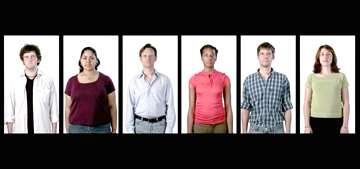
Want (clip) (2008, 74 MB, 2 min.)
‘Want was a new multiple channel algorithmic video installation as part of the exhibition
‘Live’ at the Beall Center for Art & Technology.
The life-sized six-screen video display uses custom software to monitor real time
Internet searches. When the software finds a programmed keyword, it triggers a
video clip of one of several actors/avatars who translates the virtual request to reality.
A soccer mom says,’I want French.’
A rocker dude says, ‘I want Star Trek Enterprise.’
A nondescript middle-aged guy says, ‘I want Little Girl.’
A girl says, ‘I want Forever.’
The six video screens are triggered almost concurrently, causing the voiced requests
to overlap. The result is an audio-visual cacophony of desire; an online echo chamber
of warped reality.‘

Richard Jochum, Selfportrait as a Group #5 (2006, 14.5MB, 3:33)
Captured by Richard Jochum, proof that a photograph is much
more than we ever see: a collection, a collective process,
the self interconnected.
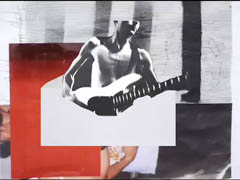
Mean Reds (2007, 11.6MB, 1:48 min)
Artist & filmmaker Paul Rodriguez made this rather good
(I particularly like the collage plus the loopy/scratchy business
towards the very end where he collages/edits the sound too)
music video in 2007.
He said:
‘I was planning on shooting my friends for a
documentary. Magically the Mean Reds were also
playing, so I decided to shoot them as well.
Months went by with me sitting on this footage.
Then I found my self printing out frames,
and doing collage on individual frames.’

Quilts Never Sleep (short version) (2007, 20.9MB, 3:07 min)
Two very different but attractive & telling pieces from Dan Canyon.
The first was part of a show of – you guessed it – quilts in London in 2006,
about which read more here.
The second could’ve been made for dvblog, well, at least for me, as I’m a fool
for all things turntablist, & features the splendidly monickered Mickey Morphingaz.

I recently attended a fairly high profile art video festival,
which shall be nameless, and I came away feeling depressed.
There was some good work (indeed, some magnificent, not much, but some) but
on the whole it was just a dispiriting display of meretricious effects, sloppy thinking
and a striving for the quick impression; all pretty souless & forgettable stuff.
(Oh, and plus a lot of cliched tosh about the – yawn – “post-human”. Wasn’t post human,
most of it, so much as post-being-any-good)
Then, on the other hand, you come across something like this:
no in-your-faceness, modest, austere and subtle, makes you do a little bit of work,
but so, so worth spending time with.
is the Brazilian video maker who made this small and perfect gem
– an account of the celebration of the Day of the Dead by expat Mexicans
living in London.
You can see the whole thing here (and I urge you to do so).
Betty Martins cheered me up considerably and I look forward to much more
work of this quality from her.
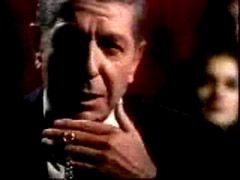
Dance Me To The End Of Love (clip, 1994, 0.5MB, 31 sec.)
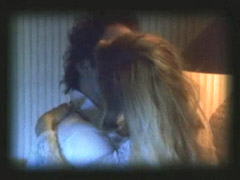
Dance Me To The End Of Love (1995, 34.1MB, 6:07 min.)
Leonard Cohen’s work has always walked a fine line
between kitsch & poetry.
Don’t get me wrong – the kitsch is like a dash of chilli,
gives the whole thing added piquancy & depth.
Check out these two videos for ‘Dance Me To The End Of Love’.
The first, the short clip, is the official video.
Now look at the second.
OK- first things first -just who is that playing the bridegroom?
Then, consider if this whole unofficial one ( by Aaron Goffman)
prolix & kitschy in some respects as it undoubtedly is,
doesn’t somehow do more justice to Cohen’s world !’
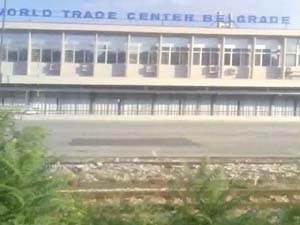
overland (2010, 131MB, 2:58 min)
And sadly, the last in our little season of movies by Ruth Catlow. This is another
train movie, no conceptual underpinnings to speak of this time, just a beautiful,
bleached out pastels, lo-fi ( mobile?) account of the Serbian section of a journey by train to Istanbul
last year when she was refusing ‘to fly for art’, something more people should do more often if
the results here are anything to go by.
More from Ruth, of course, as she produces it…
heima trailer (2007, 46.7 MB, 3:53 min.)
An exquisite trailer for the promising first film from Iceland’s Sigur Ròs.
Watch, and then tell me you did not add Iceland to your top 5 places
to see before you die.

The Lesbian Rangers (2005, 18 MB, 1:41 min.)
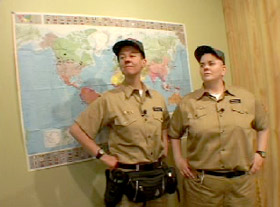
Welcome to Reorientation 2005 (2005, 34.8 MB, 2:17 min.)
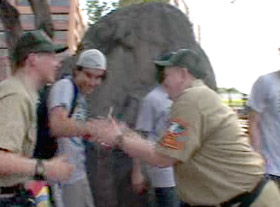
Victory at The Rock (2005, 72.4 MB, 4:45 min.)
Shawna Dempsey and Lorri Millan are Winnipeg-based collaborators whose
internationally acclaimed work addresses feminist, lesbian, and social concerns
with tremendous wit. “The Lesbian Rangers” were founded in 1997, to help people
learn about fascinating and fragile lesbian ecosystem. Rangers Dempsey and Millan
led the first expedition to Banff National Park, and continue to offer lesbian leadership today.
(thanks jillian)
Anyone who has been lucky enough to see dancer & artist Annie Pui Ling Lok
do the former will know what a fruitful combination of fierce, almost austere,
intellect & yet sensitivity to the particular, the fragile & the human, to expect.
There’s such a sure hand at work here – the confidence in collaging
disparate material brings Marker to mind & although we’ve tagged it
‘experimental’, in one sense the piece is anything but -it’s so not
a technical exercise, but a rounded, resonant work of art.
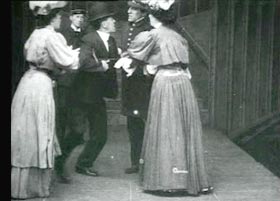
2 a.m. in the subway (1905, 8 MB, 56 sec.)
A subway platform, a policeman and a conductor, a well-dressed man
with a cigar and two women dressed in long skirts and jackets.
One of the women causes a sensation by raising her skirt and
revealing her stocking. Artificial legs are displayed out the subway car window.
Hilarious. From – The Open Video Project.

New Media in the Marketplace (2011, 37 MB, 52 min)
“Over the years, we’ve found that a number of the artists we support in our Emerging Fields category have questions about how they can better market and exhibit their work. They have questions about pricing and editioning; changing formats; what it is that they are actually selling when they offer a work for sale; what their obligations to representatives and collectors are after a sale; and whether or not they should even participate in an art market that is, in their eyes, more sympathetic and better able to represent works in more conventional or established media.
On November 2, Creative Capital hosted a webinar for grantees to explore some of these issues and answer specific questions from artists working in new media. The panelists were Jason Salavon (2000 Visual Arts), Karolina Sobecka (2009 Emerging Fields), Stephen Vitiello (2006 Emerging Fields) and Marina Zurkow (2001 Visual Arts). Sean Elwood, Creative Capital’s Director of Programs & Initiatives, served as the facilitator.”
LISTEN TO THE PODCAST FROM THIS DISCUSSION
Podcast from The Lab.
Neste vídeo há uma grande delicadeza, uma fragilidade,
que não deve levar a pensar que essa peça de Regina Pinto
é de alguma forma ocasional ou menos artística.
Em vez disso, esse é o trabalho de um artista maduro,
sem nada a provar, e com a enorme liberdade que isso traz.
Um estudo de todo o corpo de seu trabalho evidencia
amplamente tudo isso e mostra quão profundamente
consistente e coerente ele se apresenta.
Poder-se-ia ainda acrescentar o quanto ele nos emociona,
o quanto é estranho e muito bonito.
There’s a delicacy, a fragility, about this piece
that shouldn’t lead one to think that Regina Célia Pinto’s
work is in any way casual or artless.
Rather, this is the work of a mature artist with
nothing to prove and the enormous freedom that brings.
A study of the whole body of her work
amply bears this out.
It shows just how consistent and deeply considered
it is and, one should add, how affecting, how strange
and how very beautiful.
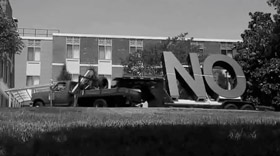
NO, Global Tour trailer (2010, 21 MB, 3:11 min)
Team Gallery, Lisson Gallery , Galería Helga de Alvear & Prometeogallery di Ida Pisani,
in association with Artprojx Cinema, present the UK premiere of NO, Global Tour,
2010 by Santiago Sierra.
The 120 minute film consists of the manufacture and transportation of two monumental sculptures
in the form of the word “NO”, travelling through different territories on a flatbed truck.
The NO, GLOBAL TOUR has resulted in a feature film that documents the passage of this
large NO through various world cities.
A monumental sculpture – unchanged both in its form and immediate meaning – that gradually
assumes a complex semantic load during a journey full of eventualities, accidents, and unexpected events.

Abbie Making Gefilte Fish (1973, 156.4MB, 21:04)
Footage of Abbie Hoffman making gefilte fish with Laura Cavestani
(who made the video) in his kitchen, 1973.
Like Abbie, I think art is in the everyday, and it sure is a fun
(and rather informative) twenty minutes if you’ve got it to spare.
Art for Abbie was education, constant revolution, evolution, and living for free.
Art and freedom were one in the same, inextricable from each other.
We miss you man.

Gov. Scott Walker gets checked, Mic Checked! (2011, 81MB, 3:45 min)
If you don’t feel inspired & cheered up by this tremendous video please do the checking
your pulse thing…
Stand Up Chicago
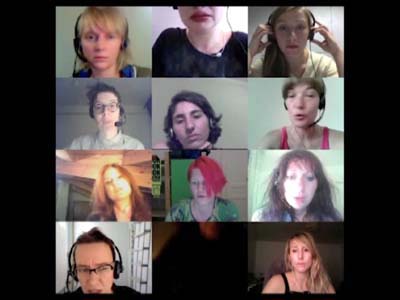
Angry Women (Left Panel/Clip) (2011, 188MB, 6:23 min)
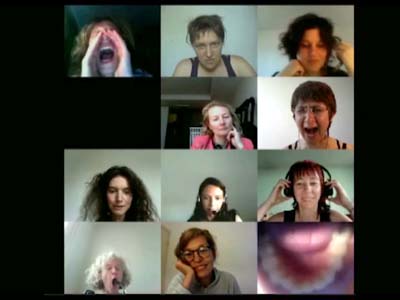
Angry Women (Right Panel/Clip) (2011, 142MB, 6:33 min)
Here are a couple of extracts by Annie Abrahams, whose work we love here at DVblog, from her show Training For a Better World which is currently running at the Centre Régional d’Art Contemporain, Languedoc-Roussillon in Sète until the first of January 2012.
I’d seriously suggest that anyone physically able to do so should visit it – I travelled down from London in a day, stayed a night and then trekked back, all by train. Very pleasant it was too.
Abraham’s exhibition runs in tandem with another, of the works of French artist Catherine Gfeller; Gfeller on the ground floor and Abrahams on the first, and the formal similarities (though I think these are largely superficial, for reasons I’ll enlarge upon soon) – the use of both moving and still images, text, an intervention at some level in the mechanics , the whys and wherefores, of how one presents these as art in a gallery setting – make it a stimulating pairing.
Abraham’s selection includes four pieces which are essentially (with some qualifications) video. They are constructed out of the telematics performance territory that she has so signally staked out in the last few years but, she insists, are not documentations of those performances. I think she’s right to emphasise this distinction – although in one sense the pieces clearly do document things that happened in performance they are ultimately video pieces made performatively .
The show doesn’t consist of moving image work only. There are some prints, drawings and a minimalist installation consisting of a single photograph of a pair of married fire-fighters and a sound track of them reading (in an extraordinarily graceful and musical edit [and this is where in this piece any surface similarities to, say, Nauman find their limit. Grace. Grace and elegance throughout.]) a collaborative text on fear.
The moving image and the other pieces occupy different ends of what is mostly a long thin exhibition space and are connected –“tied” together by a “ribbon”- a very long, three or four inch high, strip, of black highlighted, collaboratively generated white text –on the theme of madness – running at floor level for some considerable distance.
It’s important to both acknowledge this distinctly bi-partite character and then to immediately forget about it, so intimate is the connection between the two halves.
Despite the disparate and apparently laissez-faire methodologies used in the generation of all the work and the huge level of trust in the participants evinced by Abrahams, one’s main impression is of a body of work which forms a tight unity both stylistically and in its preoccupations. (And I’d argue that the principal pre-occupation is the question of what it means, physically, socially, psychically, to be a human being. And, further, that this high seriousness –allied to a playfulness which veers from the childishly innocent to the Rabelaisian – is what ultimately gives this work its huge authority and significance and distinguishes it in kind from the technically well executed and often engaging work on the floor below.)
The jewel in the crown of the show is the video installation ‘Angry Women’, created by Abrahams and 22 other women of many nationalities (3 more , in fact, in total, 2 “backstage” assistants, and a performer who opted for silence throughout) speaking about, acting out, demonstrating, reflecting upon, their anger and its causes and triggers, on webcams at their different individual locations and in their native tongues, with the images being sent to a 3X4 grid, in a format that Abrahams has made her own. Because of the limits of even current streaming technology it was necessary to conduct two distinct performances, separated, in fact, by an interval of two months. The length of each was determined by a protocol where a minute’s silence by all participants signalled the end. This resulted in pieces of differing lengths the lack of synchronisation of which adds another layer of fragile grace to the final projections, projected large on adjacent walls around their common corner, with sound from the left image grid fed to the right speaker and vice versa.
The piece occupies most of a large rectangular space at the CRAC (with the video ‘Double Blind (love)’, a collaboration with Curt Cloninger we’ve savoured here before, in its performance incarnation, in the opposite corner and in its full and majestic 264 minute duration).
The impact is visceral – we face what feels like a wave of humanity, not so much in numbers, although 23 women is impressive, at least to this man, but in the infinite malleability of face and hand, of gesture and expression and of how these things might occupy a frame. Sometimes that frame will resemble a Giacometti portrait, with the subject appearing to recede into what seems to be endlessly deep space. At others red lips or an open mouth, sensual and terrifying by turns, occupy the whole of the space – and furthermore each cell is constantly in flux (because these are living, breathing, unpredictable, human beings). There’s something both of portraiture and of the dance at work here, and a kind of found poetry too (which the moving image work has in common with the collaborative texts at the other end of the exhibition). The combination of iron control, planning, foresight (the grid, the protocols) with the letting go and trust evident elsewhere – the phased lengths, the blank space for the person who didn’t turn up, the open performative structure – makes for something of great richness.
Additionally it’s clear that those performers who had previous experience of the format were consciously playing with and against their fellows – gestures are mirrored, sounds echoed, the fiction of looking elsewhere – to the side, or above – of making contact in and across the grid itself, is impressively sustained.
The angry women turn out to be at one and the same time very particular – unique – women and women in general too; the women in general turn out to be human beings in general (and general en masse because each so particular) and the human beings in general turn out to live here, or there, now, in this, one, our only, very particular, world – that mysterious, frightening and wonderful place.
Book your train/plane ticket now!
***
Voici quelques extraits par Annie Abrahams, dont nous aimons le travail ici à DVblog, de son exposition Training For a Better World qui se déroule actuellement au Centre Régional d’Art Contemporain, Languedoc-Roussillon à Sète jusqu’au premier janvier 2012.
Je suggère sérieusement de la visiter à quiconque qui est effectivement en mesure d’y aller – j’ai voyagé depuis Londres en une seule journée, je suis resté une nuit et j’ai fait le retour le lendemain, le tout par train. C’était très agréable.
L’exposition d’Abrahams fonctionne en tandem avec une autre, des œuvres de l’artiste française Catherine Gfeller; Gfeller au rez de chaussée et Abrahams au premier étage, et les similitudes formelles (bien que je pense qu’elles soient essentiellement superficiels, pour des raisons sur lesquelles je vais m’étendre bientôt) – l’utilisation à la fois de l’image fixe et de l’image en mouvement, du texte, l’intervention à un certain niveau dans la mécanique, les tenants et aboutissants, de la façon dont on présente celles ci en tant que de l’art dans le contexte d’une galerie – en font un jumelage stimulant.
La sélection d’Abrahams comprend quatre pièces qui sont essentiellement (avec certaines réserves) vidéo. Elles sont construites à partir du territoire de la performance télématique qu’elle a jalonné si singulièrement les dernières années, mais, elle insiste, ce ne sont pas des documentations de ces performances. Je pense qu’elle a raison de souligner cette distinction – bien que dans un sens les pièces documentent bel et bien ce qui est arrivé dans la performance, elles sont finalement des pièces vidéo réalisées performativement.
L’exposition ne consiste pas seulement d’images en mouvement. Il y a quelques imprimées, des dessins et une installation minimaliste composé d’une seule photo d’un couple de pompiers mariés et une piste sonore d’eux lisant (dans un montage extrêmement gracieuse et musicale [et c’est là que dans cette pièce toute similitude de surface à, disons, Nauman trouve son limite. Grace. Grâce et de l’élégance tout au long.]) un texte collaborative sur la peur.
L’image en mouvement et les autres pièces occupent des extrémités différents de ce qui est surtout un espace d’exposition longue et mince et sont reliés – “liées” par un “ruban” – une très longue, trois ou quatre pouces de haut, bande, de texte blanc, généré en collaboration, souligné en noir – sur le thème de la folie – se déroulant au niveau du sol sur une distance considérable.
Il est important de reconnaître ce caractère nettement bi-partite et ensuite de l’oublier immédiatement, tellement intime est la connexion entre les deux moitiés.
Malgré les méthodologies disparates et apparemment laissez-faire utilisées dans la production de tout le travail et l’énorme niveau de confiance aux participants manifesté par Abrahams, la principale impression est celle d’un corps de travail qui forme une unité serrée à la fois stylistique et dans ses préoccupations. (Et je dirais que la principale préoccupation est la question de ce qu’il signifie, physiquement, socialement, psychologiquement, d’être un être humain. Et, puis, que cette haute degré de sérieux, allié à un enjouement qui vire de l’innocence enfantine au rabelaisien – est, ce qui donne finalement ce travail son énorme autorité et importance et le distingue de sa nature du travail techniquement bien exécuté et souvent engageant de l’étage en dessous).
Le joyau de la couronne de l’exposition est l’installation vidéo «Angry Women», créé par Abrahams et 22 autres femmes de plusieurs nationalités, (en fait, 3 de plus au total, 2 assistantes de “secours”, et une performeuse qui a choisi de rester silencieuse jusqu’à la fin), parlant, actant, démontrant, réfléchissant à, leur colère et ses causes et déclencheurs, devant des webcams dans leurs locations individuellement différentes et dans leur langue maternelle, avec les images envoyées à une grille de 3X4, dans un format que Abrahams a fait le sien. En raison des limites des technologies de streaming, mêmes actuelles, il était nécessaire d’effectuer deux performances distinctes, en fait séparées par une période de deux mois. La longueur de chaque performance a été déterminé par un protocole où une minute de silence par toutes les participantes marquait la fin. Il en résulte des pièces de longueurs différentes dont le manque de synchronisation ajoute une autre couche de grâce fragile aux projections finales, projetées en grand sur des murs adjacents autour de leur coin commun, avec le son de l’ image grillée de gauche envoyé au haut-parleur droit et vice versa.
La pièce occupe la majeure partie d’un grand espace rectangulaire au CRAC (avec la vidéo «Double Blind (love)», une collaboration avec Curt Cloninger que nous avons savouré ici avant dans son incarnation performative, dans le coin opposé, dans sa durée totale et majestueuse de 264 minutes).
L’effet est viscérale – nous faisons face à ce qui ressemble à une vague de humanité, non pas tant en nombre, bien que 23 femmes est impressionnant, au moins à cet homme, mais dans l’incessante malléabilité du visage et des mains, du geste et de l’expression et de la façon dont ces choses peuvent occuper un cadre. Parfois, ce cadre ressemble à un portrait de Giacometti, avec le sujet apparaissant reculer dans ce qui semble être un espace profond infini. À d’autres moments, des lèvres rouges ou une bouche ouverte, sensuel et terrifiant à tour de rôle, occupent la totalité de l’espace – et en plus chaque cellule est constamment en mouvement (parce que ce sont des êtres humains vivantes, respirantes, imprévisibles). Il y a quelque chose à la fois du portrait et de la danse à l’œuvre ici, et aussi une sorte de poésie trouvée (ce que le travail d’image en mouvement a en commun avec les textes collaboratives à l’autre bout de l’exposition). La combinaison du contrôle de fer, de la planification, de la prévision (la grille, les protocoles) avec le laisser-aller et la confiance manifeste ailleurs – les longueurs phasées, l’espace noir pour la personne qui ne se présente pas, la structure performative ouverte – produit quelque chose d’une grande richesse.
En outre, il est clair que ces artistes qui ont eu une expérience antérieure du format ont joué sciemment avec et contre leurs partenaires – les gestes sont mises en miroir, des sons font écho, la fiction de regarder ailleurs – sur le côté ou au-dessus – la prise de contact dans et à travers la grille lui-même, est impressionnant et soutenue.
Les femmes en colère se révèlent être tout à la fois des femmes très particulier – unique – et des femmes en général aussi ; les femmes en général se révèlent être des êtres humains en général (et en général en masse parce que chacune si particulière) et les êtres humains en général s’avèrent vivre ici, ou là, maintenant, dans ce, un, notre seul, très particulier monde – cet endroit mystérieux, effrayant et merveilleux.
Réservez votre train / avion billet dès maintenant!
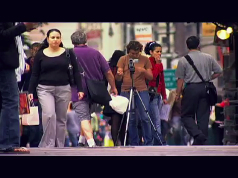
A Broad Way, Trailer (2007, 60.89 MB, 5:17 min)
Saul Goode worked with 400 filmmakers to
document every corner of New York’s most
famous street, Broadway.
By Mica
Change of Colour (2007, 6.16MB, 1:00 min)
Does what it says on the packaging & sublimely.
This is so beautiful.
A Lumière from Sam Renseiw.